Purges of military leaders may have dented China's war-fighting readiness, but are likely to have strengthened President Xi Jinping's grip on an institution that is a key source of power for the ruling Communist Party, diplomats and analysts say.
Regional military attaches and security analysts are watching the crackdown closely as China steps up efforts to modernise its military and boosts deployments around Taiwan, as well as hotly disputed parts of the South and East China Seas.
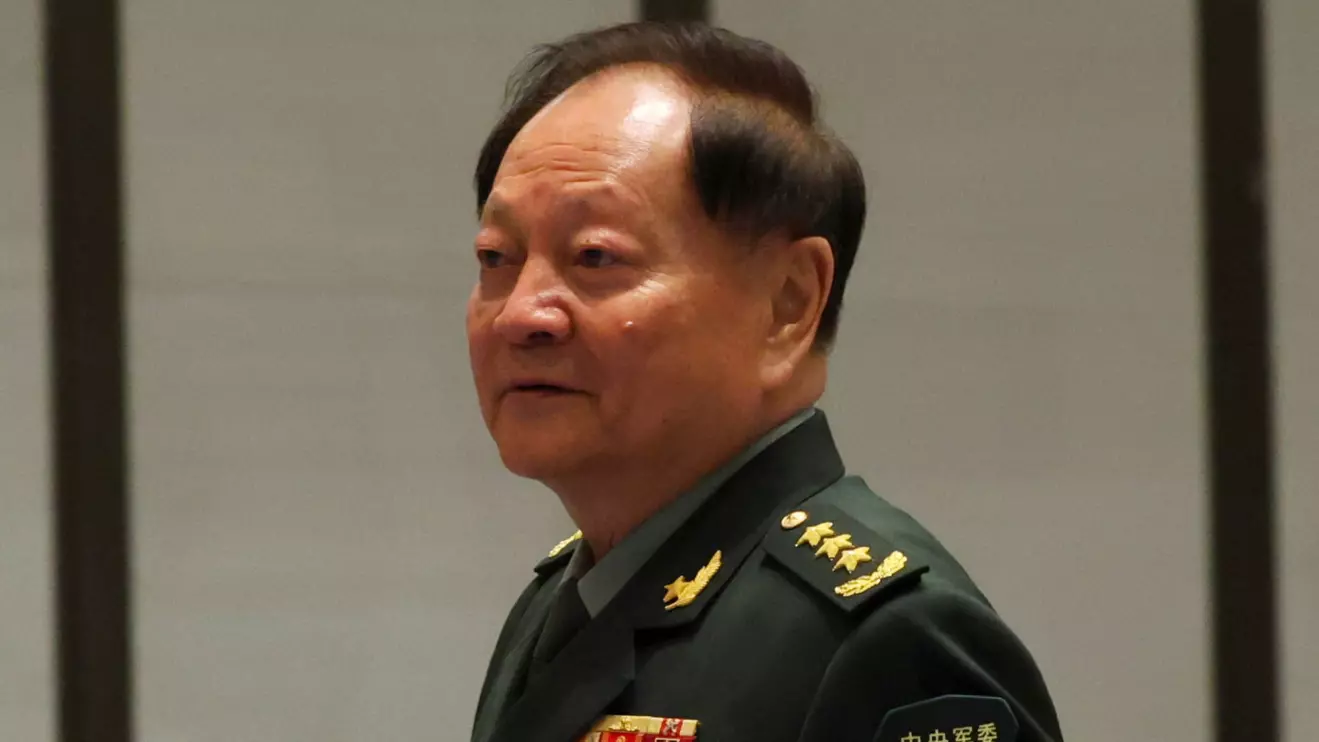
News this week of the ruling Politburo's expulsion of two top military leaders, Zhang Youxia and Liu Zhenli, from the Communist Party and the military, signalled the latest move in the long-running crackdown.
Zhang, the son of a close friend of Xi's father, had long been seen as his closest military ally, serving as his deputy on China's top defence command body, the Central Military Commission.
Analysts say dozens of second-line officers have filled key posts in the CMC, as well as theatre commands and individual services, but five places are still vacant on its ruling seven-person committee.
China's defence ministry did not immediately respond to a request for comment.
'DEFENESTRATION' SEEN STRENGTHENING XI'S HAND
Xi's hand has been further strengthened by the "defenestration" of proteges of Zhang and Miao Hua, formerly the military's top uniformed political officer, said Singapore-based Chinese security scholar James Char.
"We can expect Xi to continue exercising decisive control and influence over China's military affairs - and by extension, his dominance over the party-state, since whoever controls the People's Liberation Army controls the party," Char said.
Since coming to power in 2012, Xi has led one of the most extensive campaigns to root out corruption and indiscipline in China's modern history.
It has, in part, prompted descriptions of him as the most powerful leader since founding figure Mao Zedong.
Millions within the vast bureaucracy have been investigated to varying extent, with scores of senior party, government and military officials also investigated and purged.
"Eradicating corrupt elements strengthens, rather than weakens, the political foundation, cohesion, and overall combat effectiveness of the armed forces," said Tian Shichen, president of the Chinese think tank, Global Governance Institution.
Investigations of Zhang and Liu were first unveiled in January, though any formal punishments have yet to be revealed.
EXTENSIVE REPLACEMENTS PROMPT QUESTIONS
The extensive replacements of military brass mean that China maintains its current defence posture, continuing weapons tests and increasingly complex exercises.
But question-marks linger over the impact of the purges on China's ability to wage war, particularly over Taiwan, the democratically-governed island it regards as its own territory, sovereignty claims Taipei strongly objects to.
Zhang was the most senior officer with actual combat experience, gained in a brief but bloody border war with Vietnam in 1979, the last time China engaged in real fighting.
It "is hard to imagine upheaval on this scale wouldn't create issues for more complex operations - including a full-scale Taiwan contingency," said China analyst Ruby Osman, though the PLA had insulated routine operations from the turmoil.
"But Xi clearly sees short-term disruption as a price worth paying for long-term discipline and combat readiness," added Osman, a senior policy adviser on China at London's Tony Blair Institute.
Initially the crackdown targeted corruption, such as aspects of procurement by the PLA's elite Rocket Force, the main body controlling China's conventional and nuclear-armed missiles.
REMINDER OF THE PLA'S ROLE IN SERVING THE PARTY
But increasingly it has taken on a political edge, which some analysts see as a reminder that the PLA exists primarily to serve the Party, not the nation.
The PLA's fundamental principle "has always been the absolute leadership of the party over the military," said Tian, a former defence ministry official, dismissing foreign views that Xi's "personal power" had been concentrated.
Zhang and Liu had "seriously contributed to political and corruption problems that undermine the Party's absolute leadership over the military and endanger the Party's foundation of governance," the official PLA Daily said.
They had "caused enormous damage to the military's political development, political ecosystem, and combat effectiveness," it added in an editorial on Wednesday.
Char, of Singapore's S. Rajaratnam School of International Studies, said he did not expect the commission's top panel to be filled until the Communist Party's full congress in late 2027.
Xi is widely expected to cement his fourth five-year term at the event, a prospects analysts see as driving an intensified need for internal security.
That delay could continue to hamper engagement between China and foreign militaries, a factor diplomats consider critical as regional tension festers.
China's Defence Minister Dong Jun remains in place, but he is neither on the ruling Politburo nor the CMC, and is considered less powerful than many international peers.
Zhang's meeting in 2024 with then U.S. national security adviser Jake Sullivan in Beijing was viewed at the time as a breakthrough in U.S.-China military ties. But it is not clear who will replace him.
In the interim, Xi may be making some decisions on his own, said Bonnie Glaser of Washington based think tank, the German Marshall Fund of the United States.
"The PLA can still execute orders, of course, through the joint staff, theatre commands, services and party apparatus," added Glaser, who heads the Fund's Indo-Pacific Programme.