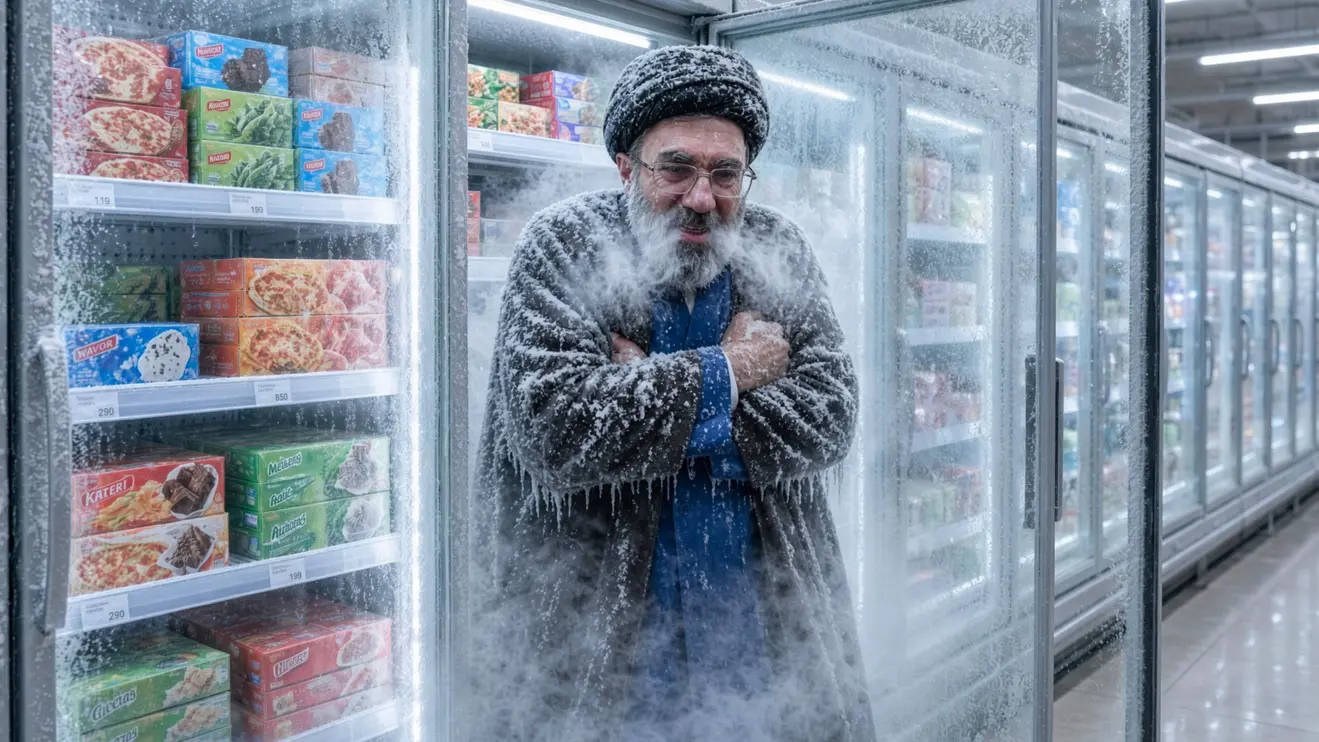
In October, hackers linked to Iran’s Islamic Revolutionary Guard Corps remotely seized control of refrigeration systems across roughly 700 French supermarkets and shops.
They forced freezers and chillers from sub-zero temperatures up past 50 °C, spoiling vast stocks of food, triggering fires in at least a dozen places, and inflicting tens of millions of euros in losses.
A second wave soon hit stores in Belgium, Sweden, Ireland, the Netherlands, Estonia, Finland and elsewhere. French authorities have formally attributed the operation to the IRGC’s Shahid Kaveh cyber unit.
Paris summoned the Iranian ambassador and is pushing for European sanctions. This was not a sophisticated technical feat; many controllers sat exposed on the internet with weak credentials. It was pure sabotage of civilian food infrastructure.
This is the true face of the regime. It does not content itself with proxy wars, nuclear brinkmanship, or the suppression of its own people. When it can, it reaches into European supermarket aisles and cooks the meat, melts the ice cream, and risks setting stores alight.
The same actors have been linked to earlier attacks on Western infrastructure. The message is unmistakable: ordinary Europeans are legitimate targets. Food security, the daily reliability of the cold chain that feeds millions, is just another front in their war.
The Islamic Republic does not operate alone. It benefits from direct military, technological, and intelligence support from Russia and China - direct accomplices.
Moscow has supplied satellite intelligence that aided Iranian precision strikes against U.S. and allied targets, shared technology for advanced missiles, and exchanged drone expertise refined on the Ukrainian battlefield. Beijing has provided dual-use components, rocket propellant precursors, high-resolution satellite imagery, and economic lifelines that keep the regime’s war machine running despite sanctions.
These are not passive bystanders or mere commercial partners. They are active enablers who strengthen the IRGC’s capacity to project sabotage and violence into Europe and beyond. When freezers overheat in French and Swedish supermarkets, the fingerprints of this axis are visible in the broader system that sustains Tehran’s aggression.
The only remaining option that matches the threat is the sustained application of military force sufficient to dismantle the regime’s capacity to wage this kind of war
The ideological engine is Islamist power exercised through the mullahs and the IRGC. This is not a conventional state pursuing limited interests.
It is a revolutionary theocracy that has spent decades exporting violence, funding terror networks, and treating negotiation as a temporary pause. Diplomacy has been tried for years—JCPOA-style bargains, sanctions relief in exchange for unverifiable promises, endless talks while enrichment continued and proxies expanded.
The result is a regime that still holds hostages, still builds missiles, and now casually attacks European freezers - all while drawing on Russian and Chinese support. Soft power and sanctions alone have not altered its nature. They have bought time and demonstrated Western hesitation.
The only remaining option that matches the threat is the sustained application of military force sufficient to dismantle the regime’s capacity to wage this kind of war.
That means targeting the IRGC’s command structures, its missile and drone infrastructure, its cyber apparatus, and the instruments that allow it to project power beyond its borders. Regime change is not a slogan; it is the logical endpoint of a strategy that has failed to contain an expansionist Islamist project.
Half-measures invite further provocations against civilian targets. The West must also confront the reality that Moscow and Beijing are not neutral observers but co-authors of the threat; treating them as partners while they arm and inform the mullahs is strategic self-deception.
The United States and the broader West cannot outsource this responsibility.
Europe’s food supply was attacked on European soil. The attribution is official and public.
Continued reliance on statements, summonses, and incremental sanctions signals that sabotage of civilian infrastructure carries limited cost.
The mullahs have calculated correctly so far. Only a clear demonstration that further attacks will be met with decisive force - strikes that degrade their military and security apparatus - will change the equation.
The alternative is more empty freezers, more disrupted infrastructure, and a regime that continues to treat Western restraint as an invitation, secure in the knowledge that Russia and China will keep the supply lines open.
The cold chain was the target this time. Next time it could be energy systems, water, transport, or hospitals.
The regime has shown what it is. Its great-power patrons have shown what they are. The West should stop pretending that engagement will transform any of them and act accordingly.