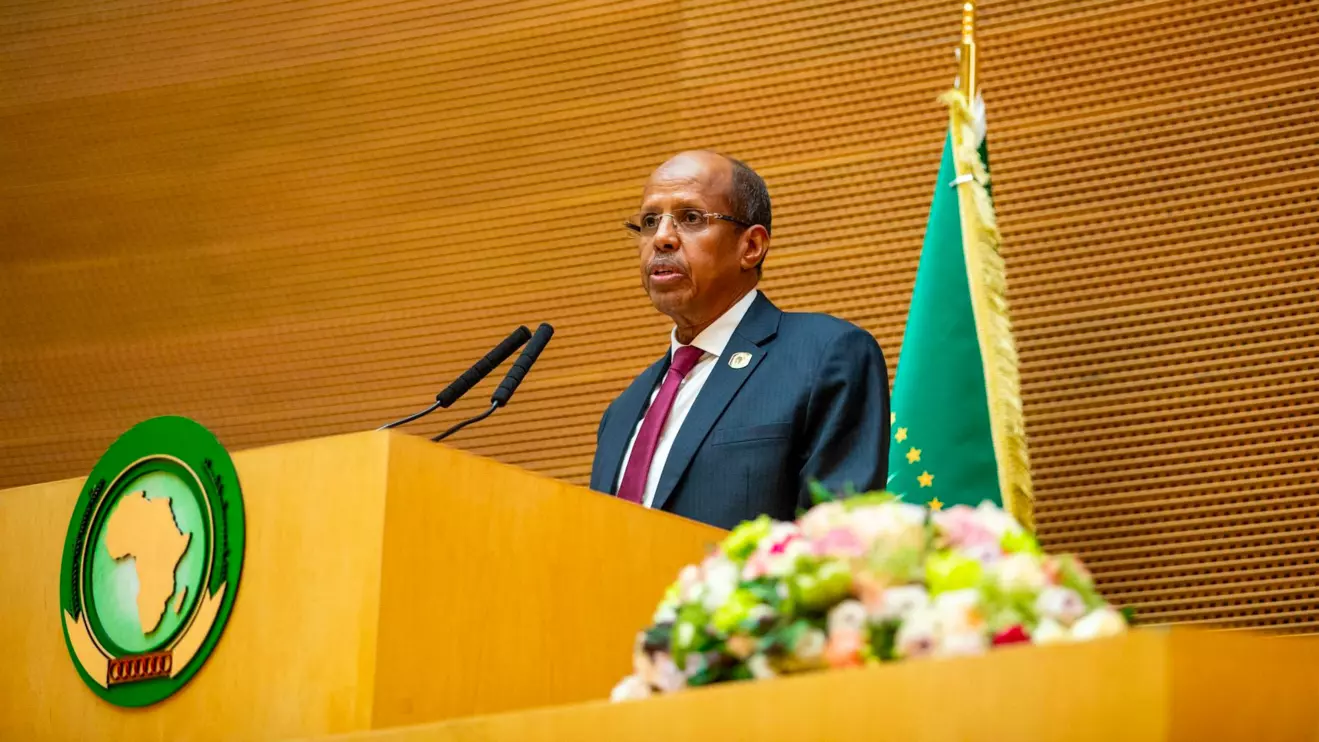
The opening of the 39th African Union summit in Addis Ababa was marked by a controversial statement from AU Commission Chair Mahamoud Ali Youssouf, who declared that the “extermination” of the Palestinian people “must stop.”
Such language, emotionally charged and politically loaded, immediately drew attention, not only for its gravity, but for its implications.
The term “extermination” carries a specific and powerful historical meaning. Its use in the context of the Gaza war suggests an accusation of deliberate mass destruction.
That framing is fiercely contested and remains at the center of ongoing legal and diplomatic debates worldwide. By adopting this terminology, the AU Commission risks appearing to take a definitive position in a highly complex conflict rather than maintaining the neutrality expected of a continental body representing 55 diverse member states.
There is no consensus across Africa on how to characterize the war in Gaza. While some governments, including Algeria, Tunisia, Libya and South Africa, have taken sharply critical positions toward Israel, many other African states maintain diplomatic, economic and security ties with Israel and simultaneously condemn the actions of Hamas and other armed groups.
Countries such as Morocco, Côte d’Ivoire, Togo, Benin, Uganda and Rwanda have generally favored a more balanced diplomatic approach.
The African Union represents a wide spectrum of political realities, strategic interests and diplomatic partnerships
For a multilateral institution like the African Union, language matters. Words used at the highest level can either preserve space for mediation or narrow it. They can unite member states — or deepen internal divisions.
The AU has traditionally positioned itself as a defender of international law, sovereignty and peaceful resolution of conflicts. In a context where terrorism, regional instability and geopolitical rivalries are deeply intertwined, the responsibility of its leadership is particularly delicate.
Many observers argue that the continent’s voice would carry greater weight if it focused on humanitarian protection, ceasefire advocacy and diplomatic engagement rather than adopting language that aligns too closely with one side’s narrative.
The African Union represents a wide spectrum of political realities, strategic interests and diplomatic partnerships.
Its credibility depends not only on moral conviction but also on measured language and institutional balance.
In a world increasingly polarized, the question is not whether African leaders should speak — but how they speak, and in whose name.