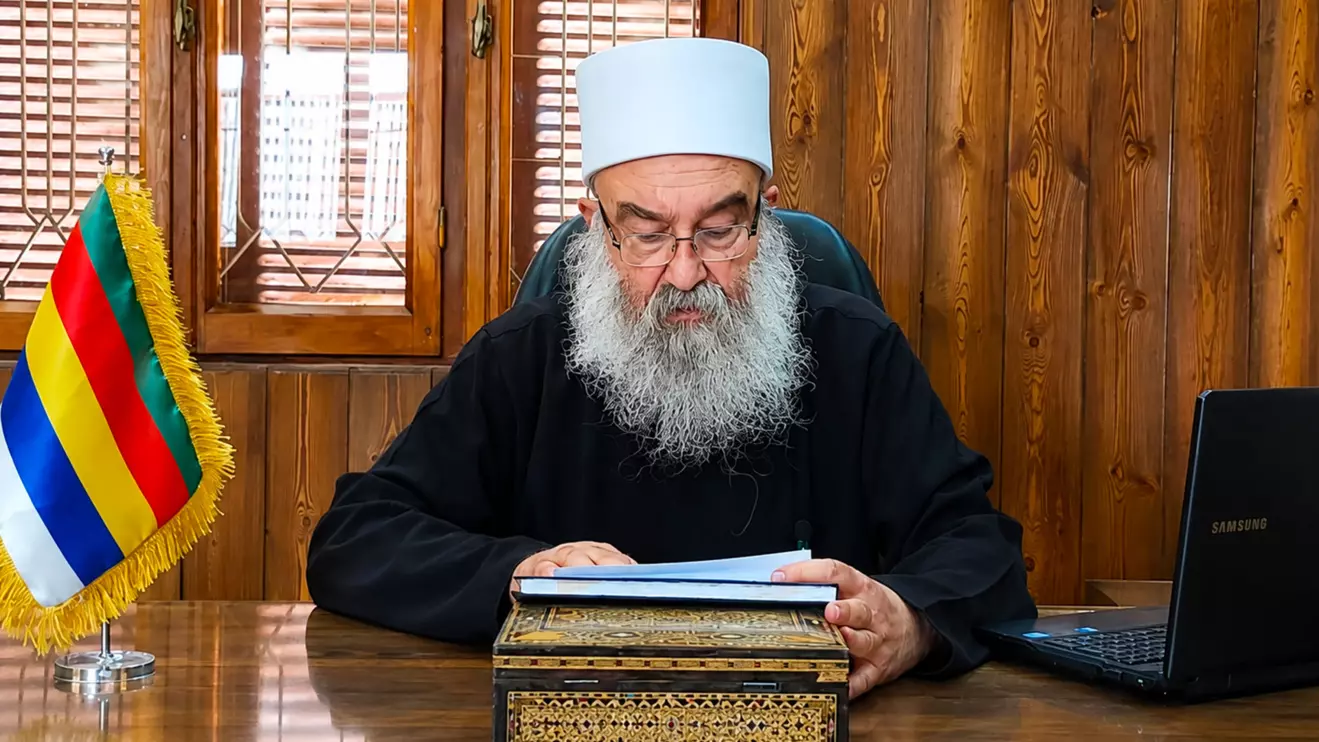
Sheikh Hikmat al-Hijri, spiritual leader of Syria's Druze community, said Monday that Suwayda's future could take several forms, full independence, autonomy under another state's protection, or union with another country, as he marked the first anniversary of the deadly July 2025 events in the southern Syrian province.
Speaking during commemorations for the clashes that killed hundreds of Druze last year, al-Hijri said the province's ultimate status should be left to the international community to decide, while making clear that independence remains his community's stated objective. He also expressed gratitude to those who had supported the Druze cause, including Israel.
Al-Hijri is one of three religious authorities recognized within Syria's Druze community, alongside Hammoud Yahya al-Hinnawi and Yusuf Jarbou'.
Since the fall of Bashar al-Assad's government in December 2024, he has emerged as the most prominent - and most defiant - voice among Suwayda's Druze leadership, positioning himself in open opposition to Syria's new authorities under President Ahmed al-Sharaa.
His profile rose sharply following the July 2025 violence in Suwayda, when clashes between Bedouin tribes, Druze factions and government-linked forces left more than 1,000 people dead, according to UN investigators, with credible reports of executions, sexual violence and the burning of entire neighborhoods.
Israel intervened militarily during the unrest, striking Syrian government positions in what it described as protection of the Druze, an intervention al-Hijri has since praised repeatedly, going as far as describing his followers as an "inseparable part" of Israel.
In the months since, al-Hijri has dissolved local governance structures loyal to Damascus, formed an armed "National Guard," and repeatedly called for Suwayda, which he refers to by the historical name Jabal Bashan, to become an autonomous or fully independent entity, with Israel as its preferred external guarantor.
His positions have drawn criticism even from within the Druze community: local sources have said many residents reject secession and continue to identify with Syria despite the country's hardships, while Israel has publicly stated it does not support Sweida's formal secession.
The Syrian government has consistently rejected al-Hijri's demands, insisting the Druze are a core component of the Syrian state, and has accused his aligned militias of repeatedly violating the ceasefire in place since the 2025 clashes.