In Harasta, a suburb east of Damascus, restoration crews are working to bring a centuries-old public bathhouse back into use after years in which war and displacement disrupted daily life across Eastern Ghouta.
The area was among the conflict’s hardest-hit zones—subject to siege conditions and later retaken in 2018—leaving physical destruction and deep social rupture.
For residents, the bathhouse’s return is framed less as a heritage showcase than as cultural repair. Eastern Ghouta remains closely associated with some of the war’s most traumatic episodes, including the 2013 chemical attack in the Ghouta area and the alleged 2018 chemical attack in Douma, events that left lasting scars on local memory.
As restoration work continues on Harasta’s historic bathhouse, residents say the landmark is more than a building returning to life, it is a revival of collective memory, traditional social rituals and architectural heritage deeply rooted in the city’s identity.
Omar Shaker, a longtime resident of Harasta in the Damascus countryside, recalls childhood visits to the city’s historic bathhouse, which for generations served as a social and cultural gathering place for families across Eastern Ghouta.
“Since my childhood, the bathhouse was a destination for the people of Eastern Ghouta,” Shaker said. “It was a meeting place where people exchanged news and celebrated traditional occasions, especially the groom’s procession.”
Dating back more than 400 years, the bathhouse is considered one of Harasta’s oldest landmarks and a living symbol of the area’s architectural and social heritage, reflecting the traditional design of historic baths that combine functionality with aesthetic detail.
Restoration work is currently under way through community efforts in coordination with the Directorate of Antiquities and Museums.
Anwar al-Abdallah, head of the restoration workshop, said teams are using materials close to the originals, including limestone and white cement, to preserve the site’s authenticity and fine architectural details. He said the remaining work is expected to be completed within about two months, after final cleaning and finishing, paving the way for the bathhouse to reopen.
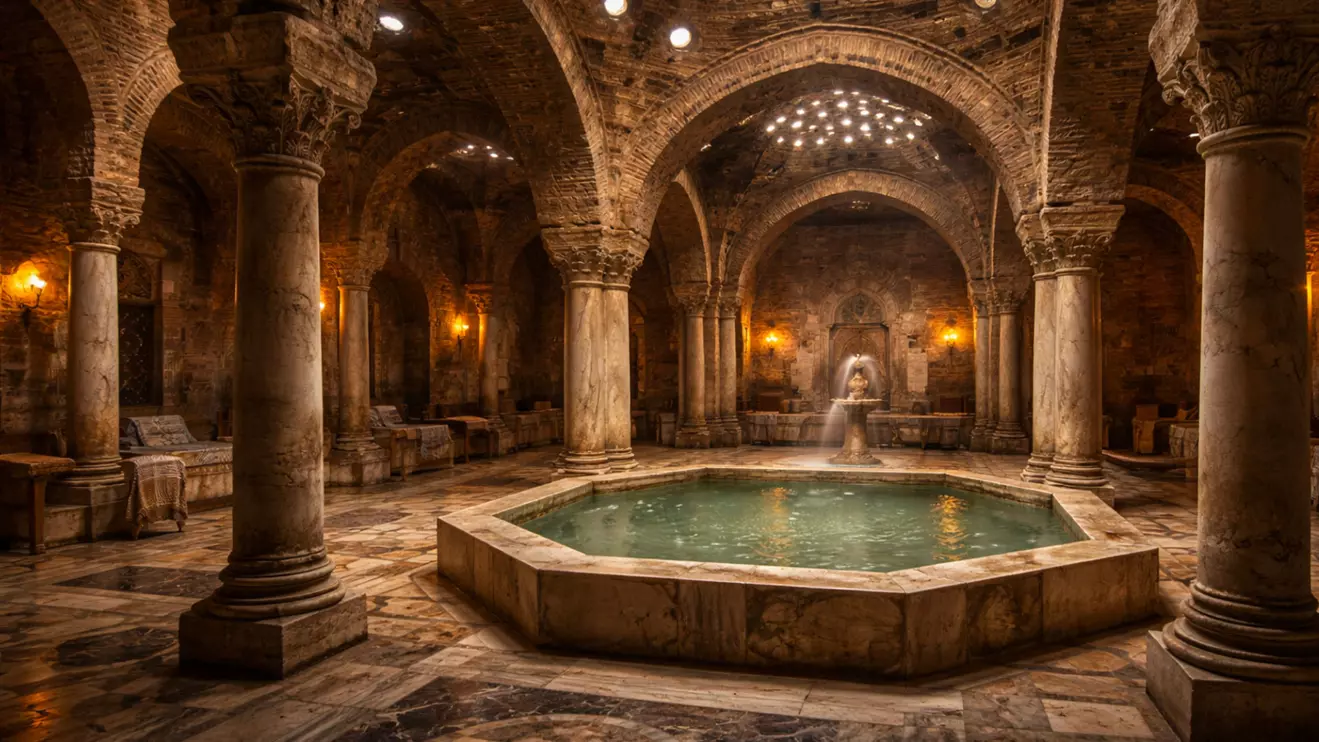
Located in the Thaghra neighborhood of Harasta, the bathhouse consists of four main sections. The barani, or outer hall, features a square chamber with a central octagonal limestone basin.
The space is covered by a smooth semi-spherical dome supported by four pointed limestone corners, transitioning from a square base to a circular dome through stone spherical triangles. Narrow elongated windows provide natural light and ventilation.
The wastani, or middle hall, includes warm rooms designed for rest and preparation, with stone platforms used for bathing.
The jawani, or inner hall, contains hot pools, steam rooms, massage areas and spaces for traditional soap-and-oil cleansing rituals.
The qammim, or service section, is dedicated to storage, heating facilities and operational supplies.
Residents say restoring the bathhouse not only preserves a rare architectural landmark but also revives a symbol of traditional life and collective memory in Eastern Ghouta.