Lebanon is finally saying out loud what its political class has been too afraid to admit: the country wants its sovereignty back.
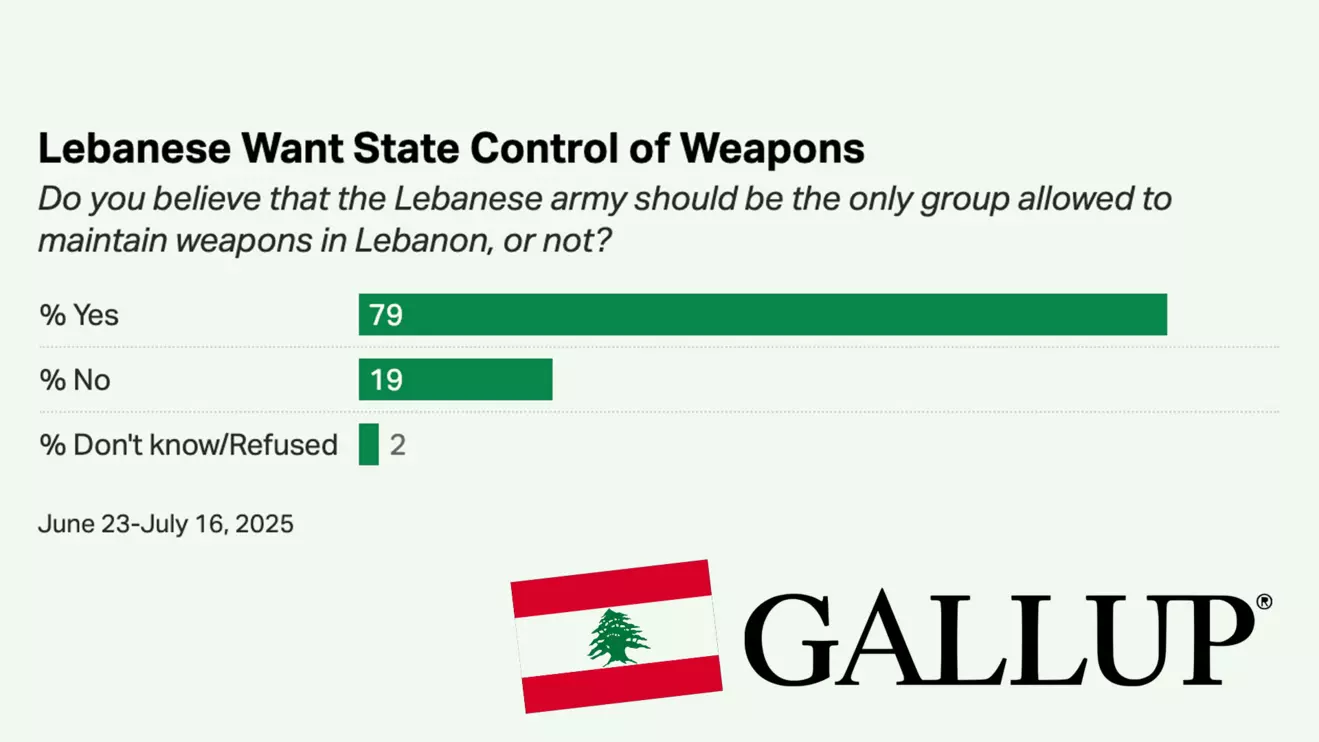
A sweeping new Gallup poll shows that 79% of Lebanese want only the Lebanese Armed Forces to have weapons. For a state suffocated for decades by militias, foreign agendas, and inherited wars, the message is unmistakable.
And the biggest obstacle to realizing that desire is just as clear: Hezbollah’s armed dominance — and the regional project it serves — is at odds with what most Lebanese citizens want for their future.
A Country Ready for Normalcy — Held Back by One Faction
The numbers cut across nearly every community:
• Christians: 92% support weapons only for the army
• Druze: 89% support the same
• Sunnis: 87% agree as well
Only among Shia — Hezbollah’s base — does the old narrative still hold, and even there the ground is shifting:
• Just 27% of Shia support army-only weapons
• 69% oppose it
• Meaning one in four Shia now reject Hezbollah’s exclusive claim to armed power
For a movement that once claimed to speak for the entire community, this is a serious warning sign.
Meanwhile, national trust in the Lebanese Armed Forces is overwhelming:
• 94% of Lebanese trust the army
• Including 98% of Shia
The message is simple: Lebanon wants one army, one authority, one state — not a militia-state within a state.
Lebanon Rejects Hezbollah’s “Resistance” Logic
Hezbollah’s long-standing justification for its weapons — support for Palestinians and a permanent “resistance axis” — finds no backing in Lebanese public opinion.
The Gallup poll shows:
Lebanon does NOT want war with Israel:
• Only 10% think Lebanon should support Palestinians by entering direct conflict with Israel
• 86% reject the idea outright
Lebanon opposes arming Palestinian groups:
• Only 14% support giving weapons or equipment to Palestinians
• 81% oppose
Lebanon is deeply divided on non-military assistance:
• 50% support economic aid to Palestinians in the Palestinian territories
• 50% support political backing
• But only 31% support economic aid to Palestinians living in Lebanon
• 65% oppose
The numbers leave no ambiguity:
The Lebanese public rejects the very military doctrine Hezbollah uses to justify its existence.
Israel’s Military Operations Changed the Strategic Reality, and Many Lebanese Know It
There is another truth running quietly beneath Lebanon’s political discourse:
Israel’s recent military campaign in Lebanon significantly weakened Hezbollah’s operational capacity , and, in doing so, created space for a national conversation Lebanese were previously too intimidated to have.
Israeli strikes dismantled:
• command nodes
• weapons depots
• cross-border launch infrastructure
• Iranian logistical networks in Lebanon
For the first time in decades, Hezbollah is no longer able to dictate Lebanon’s security agenda with the same impunity.
Lebanese may never say this publicly, but many privately recognize the irony:
By degrading Hezbollah’s war-making ability, Israel unintentionally opened a path toward the very future most Lebanese wan, a normal state with a single military authority.
Hezbollah Is Becoming the Last Barrier to Lebanon’s Sovereignty
Hezbollah was once celebrated for “defending Lebanon.” Today, it is increasingly viewed as the main reason Lebanon cannot defend itself as a sovereign state.
Its arsenal:
• prevents Lebanon from negotiating peace
• drags the country into conflicts it did not choose
• fuels economic isolation and political paralysis
• makes foreign investment impossible
• keeps Lebanon tied to Iran’s regional ambitions
And after the recent war, Hezbollah has lost the ability to provide the financial support it once used to cement loyalty. Its credibility inside its own base is fraying.
Lebanon Is Exhausted — And Ready to Move Beyond Militias
Lebanon has endured:
• 15 years of civil war
• decades of Syrian control
• repeated wars with Israel
• political paralysis
• economic collapse
• the port explosion
• constant militia interference
Hezbollah no longer appears as a “protector.” It appears as a permanent veto over Lebanon’s right to choose peace, prosperity, and statehood.
The poll results show a public that wants:
• One army
• No parallel militias
• An end to proxy wars
• A sovereign state free from Iran’s grip
• A future where Lebanon decides its own destiny
Bottom Line
Lebanon is speaking — loudly, clearly, and through data, not slogans:
• 79% want only the national army armed
• 94% trust the army
• Over 80% reject military action for Palestinians
• 81% oppose arming Palestinian groups
• 65% oppose financial aid to Palestinians in Lebanon
This is not marginal. It is a national consensus — the clearest that Lebanon has produced in generations.
And here is the unavoidable conclusion:
Hezbollah is the last major actor standing between Lebanon and the peaceful, sovereign, normal future its people overwhelmingly want.
Israel’s military campaign weakened Hezbollah’s ability to impose its agenda — and in doing so, has indirectly laid the groundwork for what could become a far more stable regional landscape:
• A Lebanon with a single army
• A border without militias
• A population demanding peace instead of proxy war
• A region where Iran’s influence is finally constrained
For the first time in years, the possibility of a different Lebanon — sovereign, peaceful, economically viable — is no longer a fantasy.
The people have shown the way.
Now the question is whether Lebanon’s leaders will follow them — or continue bowing to the one faction holding the entire country back.