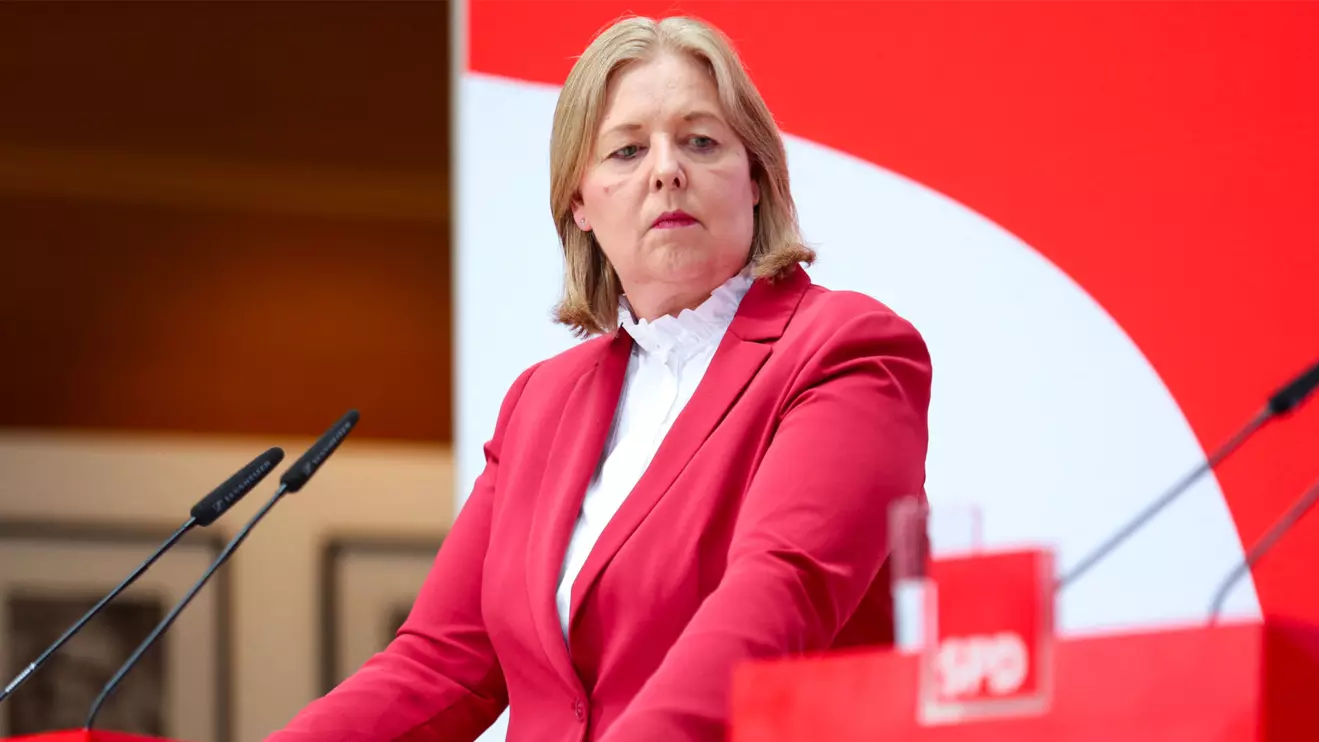
Germany's labour minister and co-head of the centre-left Social Democrats (SPD) quit unexpectedly on Monday, adding to uncertainty around Chancellor Friedrich Merz's struggling coalition after bruising state election defeats last month.
Baerbel Bas said she was resigning from both positions to deal with grief over her stepdaughter's recent death.
She added that "public attacks against me, unfortunately also from within the ranks of our coalition partner," had made her situation unbearable.
Bas will be replaced as minister by Alexander Schweitzer, former state premier of the western state of Rhineland-Palatinate, and the whole of the SPD leadership will face re-election in a special party conference at the end of the year.
While the departure of one minister was not expected to disrupt the overall government, it highlighted the turmoil facing Europe's largest economy.
Merz's coalition has been under growing pressure following state election victories for the far-right Alternative for Germany (AfD) in eastern Germany last month, which it views as the first step towards victory in federal elections due in 2029.
Merz's government is languishing in opinion polls amid economic uncertainty and frustration over living costs.
Bas, whose former ministry oversees large parts of Germany's welfare system, was the target of repeated criticism from some members of Merz's conservative Christian Democrats (CDU) who accused her of standing in the way of economic reforms.
Finance Minister Lars Klingbeil, who shared the leadership of the SPD with Bas, cancelled a planned trip to India and it was unclear whether he would attend a meeting of the Group of 20 finance ministers in Thailand this week.
STRAINED RELATIONS
Klingbeil said Bas had been subject to "unacceptable" attacks from the CDU while mourning her stepdaughter.
But at a press conference, Merz said he had urged his party to show her "every personal consideration, including Christian compassion," in recent weeks.
"I cannot see that we have failed to do so in any way," he said, adding that he was confident new minister Schweitzer would swiftly advance pending legislation and cooperate well within government.
Merz was speaking after senior CDU members had held a two-day meeting to seek a way forward after months of coalition wrangling over planned tax, pension and labour laws aimed at reviving Germany's sluggish economy.
"We want to demonstrate our readiness for change – something that is essential given the election results," he added.
As part of the leaders' five-page policy paper aimed at addressing voter discontent, he pledged to push ahead with a cut in electricity tax, reviving a measure that was shelved last year because of budget constraints.
While both sides in the coalition agree on the need for reforms to shore up the pension system as the population ages and to help industry confront a surge in energy prices and increasingly intense competition from China, significant differences remain.
Merz, a pro-business fiscal conservative, has struggled to win popular support for changes that could push back the retirement age for some, increase the cost of health insurance and weaken worker protections.
Support for the government will be further tested in five more regional elections next year that will impact his ability to get major legislation through the Bundesrat, the upper house of parliament filled by Germany's 16 states.
By Andreas Rinke and Holger Hansen