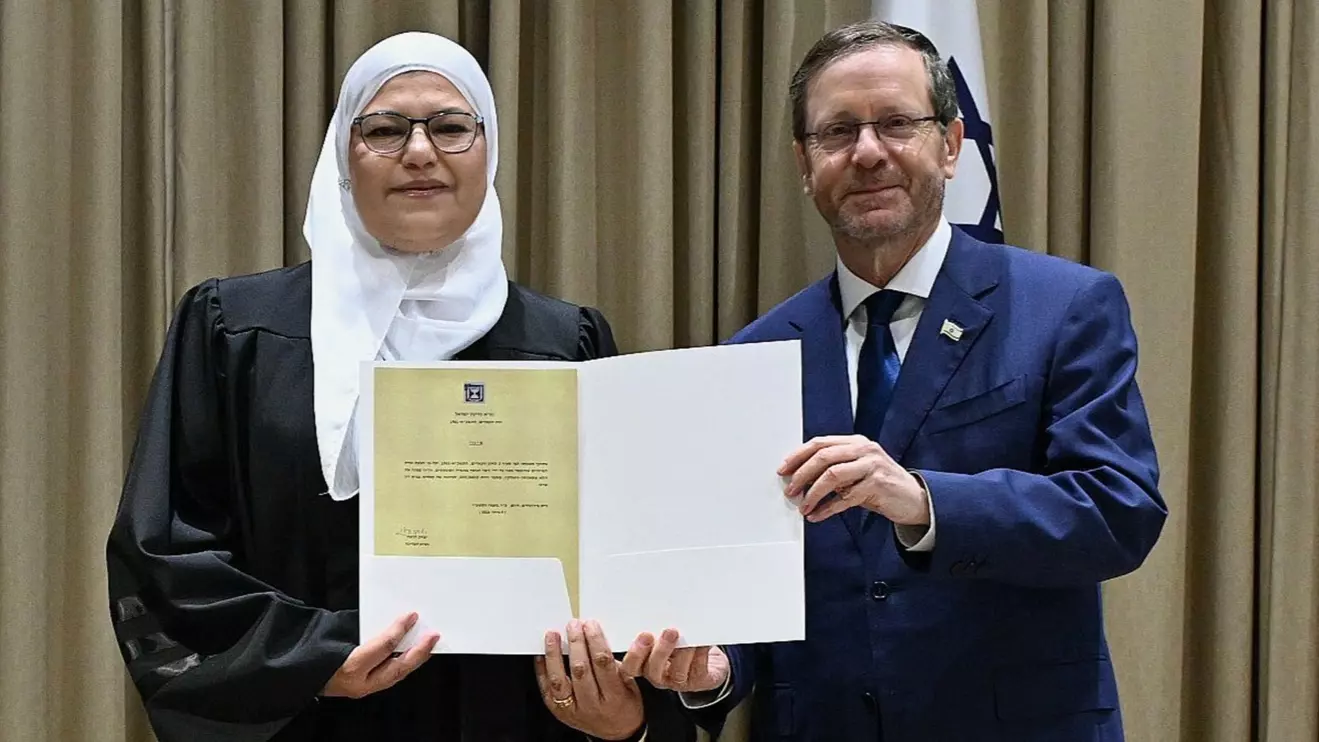
Five new Qadis - judges of Islamic law - were sworn in to serve in Israel's Sharia courts during a ceremony held today at the President's Residence in Jerusalem.
Among the new appointees was Rula Masalha-Zahalka, who becomes only the second woman ever to hold the position of Qadi in Israel's history. President Isaac Herzog marked the occasion on X, writing that he was especially moved by her swearing-in and offering his congratulations: "Mabrouk!"
Masalha-Zahalka follows in the footsteps of Hana Khatib, who became the first woman in Israel to be appointed a religious judge, or qadi, in the courts ruling on personal law for Muslims, in a ceremony at the President's Residence in May 2017.
Her landmark appointment was hailed by some Arab lawmakers as historic, and made her the first woman to preside over any religious court in the Jewish state.
What are Sharia courts in Israel?
Sharia courts in Israel deal with personal status issues for the Muslim community, including marriage, divorce, conversion, inheritance and the prevention of domestic violence.
They have existed since Ottoman times and were formally recognized by the State of Israel in 1948, before being integrated into the country's judicial system by the Knesset in 1961. There are nine regional Sharia courts across Israel, along with a Sharia Court of Appeals.
Unlike Israel's secular courts, the Sharia courts have significant control over family affairs and are supervised by their own official religious establishments, with judges elected by the Knesset, a system formalized under the Qadis Law of 1961, which sets out eligibility requirements for appointment, including that a candidate must be Muslim, have suitable training in Sharia law, and be at least thirty years old.
In Islamic tradition more broadly, a Qadi is a judge who rules according to Sharia, the body of religious law derived primarily from the Quran and the Hadith (the recorded sayings and practices of the Prophet Muhammad), as well as juristic reasoning developed over centuries by Islamic legal scholars across different schools of jurisprudence.
Historically, Qadis have presided over matters ranging from criminal and commercial disputes to family law, though in most modern states - including Israel - their jurisdiction is now largely confined to personal status matters such as marriage, divorce and inheritance among Muslim citizens.
The question of whether women can serve as Qadis has long been debated among Islamic scholars. Israel's Sharia courts based their 2017 decision to appoint a female Qadi on a fatwa issued by scholars of the Hanafi and Zahiri schools, as well as the historical jurist Ibn Jarir al-Tabari, all of whom permitted the appointment of women to the position.
The move was controversial in some conservative religious circles, both Muslim and Jewish, but was ultimately embraced by the leadership of Israel's Sharia court system.
Today's ceremony, bringing five new Qadis into Israel's Islamic judiciary, continues that gradual shift toward broader representation within the courts serving the country's Muslim community.