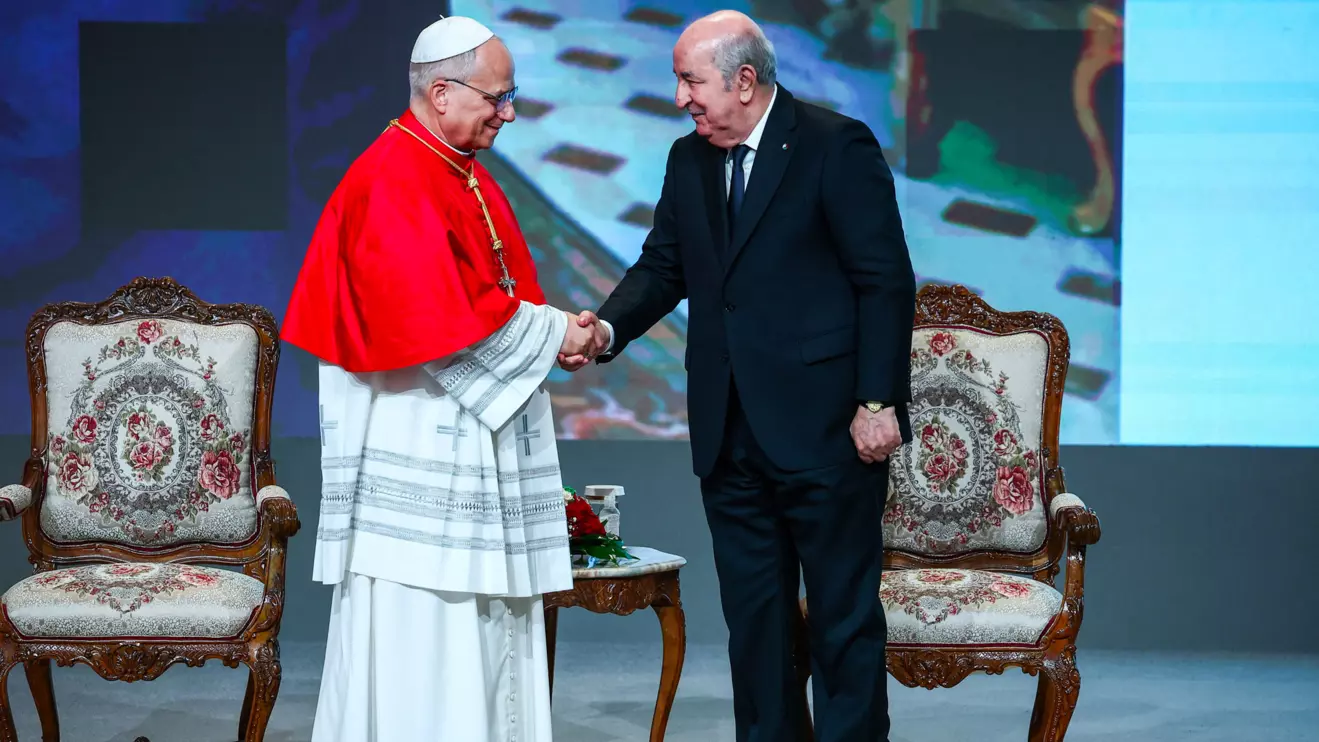
On the first day of his visit to Algeria, Pope Leo XIV delivered a message of democratic hope to a regime that has spent decades ensuring such hope goes nowhere.
Standing before a gathering of Algerian officials that included President Abdelmadjid Tebboune, the Pope called on authorities to "not fear" popular participation in political and economic life, to "serve the people rather than dominate them" and to promote "a living, dynamic and free civil society."
He singled out young Algerians, urging leaders to recognise their capacity to "broaden the horizon of hope for all."
It was a powerful speech. It will change absolutely nothing.
Algeria has been run by its military since independence. What presents itself as a civilian government is, in practice, a carefully dressed-up authoritarian system, corrupt, opaque and utterly resistant to reform.
The generals who hold real power in Algiers did not invite the Pope to receive a lecture on democracy. They invited him for the diplomatic legitimacy his presence confers.
The Hirak pro-democracy movement of 2019 showed what genuine popular participation looks like in Algeria, and showed, equally, how the regime responds to it.
When Leo XIV speaks of recognising young people's capacity to "broaden the horizon of hope," he is describing a reality that Algeria's rulers have spent years actively preventing
Millions of Algerians took to the streets calling for transparency and deep political reform. The authorities waited, co-opted what they could, crushed what they could not, and methodically reclaimed every inch of public space. Today, independent civil society is strangled, journalists are jailed, and dissent is systematically criminalised.
Three international NGOs, including Human Rights Watch, had urged the Pope ahead of his visit to raise human rights and religious freedom directly with Algerian authorities. Whether he will do so with sufficient force - and whether it will matter if he does - remains to be seen.
The Pope's words about youth resonated with painful irony. Algeria is a young country, the majority of its population is under 30, facing a suffocating lack of prospects.
Unemployment is high, emigration is the dream of millions, and the political system offers no legitimate channel for ambition or dissent. The regime has responded to this generational frustration not with reform but with repression and petrodollar subsidies designed to buy silence.
When Leo XIV speaks of recognising young people's capacity to "broaden the horizon of hope," he is describing a reality that Algeria's rulers have spent years actively preventing.
His words on democracy, civil society and popular participation are correct, courageous and completely futile in the Algerian context.
The men who run this country, from behind presidential facades and military compounds, have no intention of loosening their grip. They have survived oil shocks, civil war, mass protests and international pressure. A papal homily, however sincere, will not move them.
The regime will applaud politely, pose for photographs, and return to business as usual the moment the papal plane leaves Algerian airspace.
The Pope can preach. Algeria's rulers will not listen. They never do.