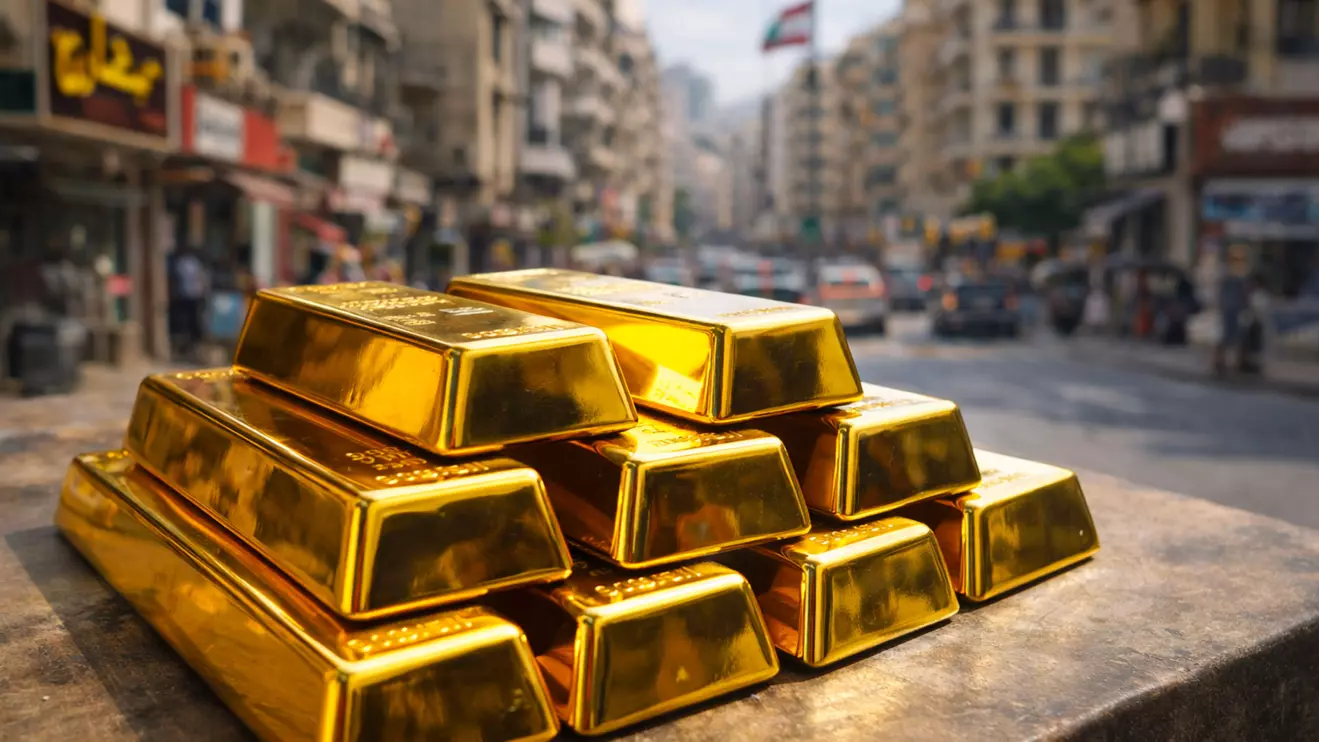
Lebanon holds one of the largest gold reserves in the Middle East. Now, as the country sinks deeper into economic collapse, officials are quietly debating whether that stockpile could help stabilize a shattered financial system, a move that remains politically toxic and legally constrained.
The central bank has accumulated about 286 tons of gold, roughly nine million ounces, since the 1960s. Only Saudi Arabia holds a larger reserve in the region. At its peak valuation, Lebanon’s gold was worth an estimated $50 billion, more than twice the country’s annual economic output.
The discussion comes as Lebanon enters another year of crisis, marked by persistent inflation, failing public services and stalled reforms.
The banking system collapsed in late 2019, wiping out savings for millions of depositors and pushing roughly half of the country’s 6.5 million people into poverty. Financial-sector losses are estimated at around $70 billion, with additional damage from the 2024 war between Israel and Hezbollah.
Against this backdrop, a small but growing number of officials and bankers are floating a highly sensitive idea: using part of the gold reserve to help repay depositors or shore up failing banks.
Senior banking figures say some institutions are proposing that the state tap the reserve to cover part of the losses created by the currency and banking crisis. The officials spoke anonymously because of the political and legal restrictions surrounding the issue.
The proposal faces steep obstacles. Lebanon passed a law in the mid-1980s banning the sale of the country’s gold during the civil war, in order to safeguard public assets during a period of extreme instability.
Since then, the reserves have remained untouched, through the end of the civil war, repeated confrontations with Israel, and years of political upheaval.
Any use of the gold would require parliamentary approval.
But the idea remains deeply unpopular, especially with national elections approaching. When the issue was briefly raised during a recent parliamentary session, Speaker Nabih Berri cut the discussion short, calling it unworkable.
Public mistrust runs deep. Many Lebanese blame political leaders and financial institutions for decades of corruption, waste and mismanagement. A draft law designed to address the massive financial gap, and define how losses should be shared between the state, banks and depositors, has been stalled in parliament for months.
Some economists argue that, if paired with sweeping reforms, a limited use of the gold could help revive essential public services, such as electricity, education or health care. But even among reform advocates, there is widespread concern that tapping the reserve without strong safeguards would only postpone deeper structural changes.
Economists note that the turn to gold is deeply rooted in Lebanon’s social and cultural history
For many citizens, the gold reserve represents the last untouchable national asset, one that should be preserved for future generations rather than consumed to patch a broken system.
While political leaders debate, ordinary Lebanese are making their own move toward precious metals.
As confidence in banks has collapsed, gold and silver have become a personal refuge for savers who no longer trust the financial system. At metal dealers on the outskirts of Beirut, long lines of customers now wait to buy coins, bars and medallions, often paying months in advance because of high demand.
Business owners say many customers are not investing for profit, but for survival, seeking something tangible in a cash-based economy battered by inflation and uncertainty.
For people who lost most of their savings, precious metals have become the only remaining store of value. Demand has surged alongside global price increases driven by geopolitical tensions, central bank purchases and investor interest.
Economists note that the turn to gold is deeply rooted in Lebanon’s social and cultural history. For generations, families have passed down gold jewelry, often given to brides, as a form of personal security. That tradition has gained renewed meaning during the financial collapse.
For many Lebanese, gold is not just an investment. It is a last line of defense in a country where trust in institutions has all but disappeared.
As one economist put it, the reluctance to sell - whether by citizens or the state - reflects how central gold has become to the national psyche. For most people, it is no longer viewed as a resource to be used, but as a shield against a future that feels increasingly uncertain.