Lebanon's Foreign Minister Joe Raggi has failed. Despite considerable diplomatic effort, he has been unable to enforce the expulsion order issued against Iranian Ambassador Mohammad Reza Shibani, a man declared persona non grata by the Lebanese state and given a deadline to leave the country that has long since passed.
Shibani remains in Beirut, unbothered and unrepentant.
For a sovereign state, it is nothing short of a humiliation. For Lebanon, it is, depressingly, business as usual.
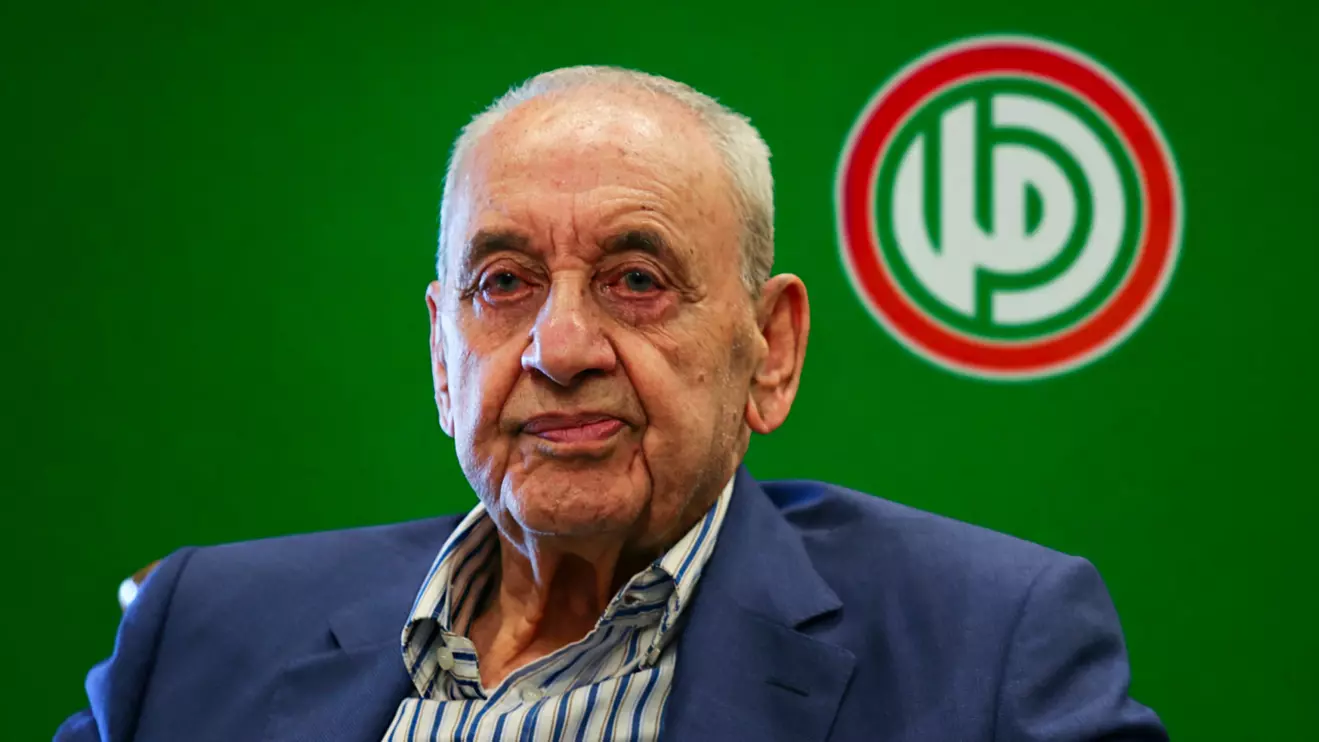
The man standing in the way is not a foreign power acting from afar. He is a Lebanese politician sitting in Beirut's parliament building. His name is Nabih Berri, and his story explains almost everything about why Lebanon has been unable to govern itself for four decades.
Nabih Berri, 86, has been Speaker of the Lebanese Parliament without interruption since 1992, a tenure of over three decades that makes him one of the most entrenched political figures in the Arab world. He is the founder and undisputed leader of the Amal Movement, Lebanon's principal Shia political party and Hezbollah's closest political ally.
Born in Sierra Leone to Lebanese parents and educated partly in the United States, Berri entered Lebanese politics in the turbulent years of the civil war, positioning Amal as the political vehicle of the Shia community at a time when Hezbollah was still consolidating its military infrastructure.
Over decades, he has performed a careful balancing act: presenting himself as a pragmatic, dealmaking politician acceptable to Western governments, while simultaneously shielding Hezbollah's military activities from accountability and maintaining Amal's deep structural ties to Tehran.
The Billionaire Who Built His Fortune on Iranian Patronage
Berri is, by any measure, extraordinarily wealthy for a man who has spent his entire career in Lebanese public service.
His fortune, estimated to run into the billions, has been accumulated through decades of political patronage, control of state resources and lucrative business networks that flourish under his protection.
The relationship between Berri's wealth, his political machine and Iranian backing is not incidental. It is structural. For forty years, Iran has funded, supported and protected the Shia political establishment in Lebanon, and Berri has been its most visible and durable beneficiary. His political survival, his financial empire and his institutional power are all, to varying degrees, products of that relationship.
This is the man who told Iran's ambassador not to leave. This is the man whose political network makes it effectively impossible for the Lebanese state to enforce its own sovereign decisions against Iranian interests.
The Architecture of Lebanese Paralysis
What the Shibani affair reveals is not merely a diplomatic embarrassment. It exposes the fundamental architecture of Lebanese political paralysis, a system in which a foreign power (Iran) maintains effective veto authority over Lebanese state decisions through its domestic proxies (Hezbollah and Amal), and in which those proxies are led by figures (Berri) whose personal and political interests are inseparable from the continuation of Iranian influence.
Lebanon's Prime Minister Nawaf Salam and Foreign Minister Raggi are not weak men. They are operating within a system specifically designed to prevent the Lebanese state from exercising genuine sovereignty, a system built over forty years with Iranian money, Iranian weapons and Iranian strategic patience.
Berri is not protecting Iran's ambassador because he believes in diplomatic norms. He is protecting him because Iran's presence in Lebanon is the foundation on which his own power rests. An Iran expelled from Lebanese politics is an Amal stripped of its most powerful patron. That is a scenario Berri will resist by every means available to him.
The Humiliation Is the Point
In a functioning sovereign state, a foreign ambassador declared persona non grata would be on a plane within 48 hours. In Lebanon, he drinks his morning coffee in his residence while the parliament speaker explains to the government why its own decisions cannot be implemented.
This is not a diplomatic incident. It is a demonstration of who actually holds power in Lebanon, and a reminder, if any were needed, that the Lebanese state's sovereignty remains, in critical respects, a polite fiction maintained for the benefit of international observers.
Joe Raggi issued a legal, legitimate, sovereign order. Nabih Berri overruled it. Iran's ambassador stayed.
Lebanon deserves better than this. It has deserved better for forty years. And as long as figures like Berri remain at the centre of its political life, enriched by Tehran, protected by Hezbollah, and immune to accountability, it will continue to receive exactly what it has always received: humiliation dressed up as politics.