Pedro Sanchez has once again chosen to place himself firmly on the wrong side of history, doubling down Wednesday on his refusal to support the U.S.-Israeli campaign against Iran, threatening the cohesion of NATO and exposing himself as the Western leader most willing to provide diplomatic cover for a theocratic regime that has spent decades sponsoring terrorism across the globe.
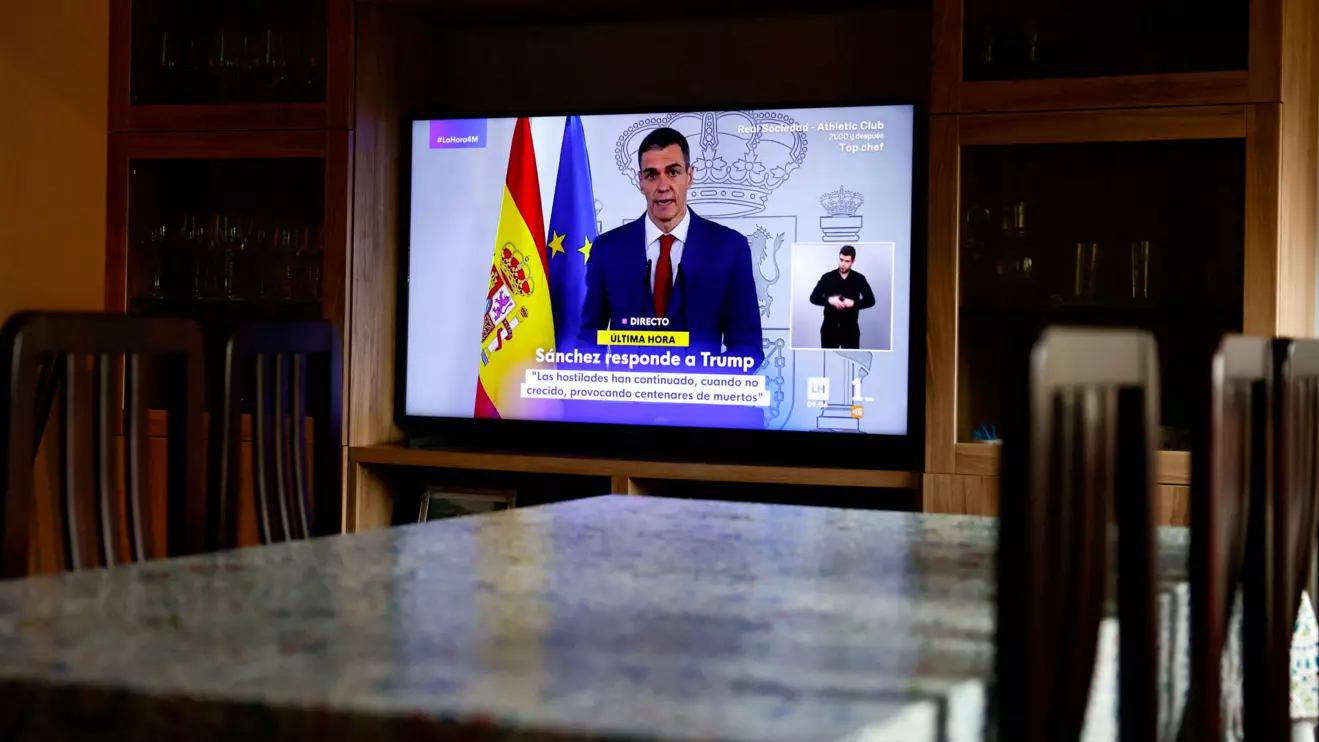
In a televised address dripping with self-righteous indignation, Sanchez declared that Spain would not be "complicit in something bad for the world."
The irony, apparently lost on him entirely, is that his posture of studied neutrality is itself an act of complicity, with Iran, with its proxies, and with every enemy of the Western democratic order.
A Disgrace to the Alliance
While Britain's Keir Starmer authorised the use of UK bases for defensive strikes against Tehran, while France and Greece dispatched armaments to Cyprus after it was struck by an Iranian drone, and while virtually every other European nation held its tongue rather than undermine the alliance at a moment of acute crisis, Sanchez chose to grandstand.
He refused U.S. aircraft access to jointly operated bases on Spanish soil. He denounced Washington and Jerusalem. He lectured the world about Russian roulette while Tehran was firing ballistic missiles across the Gulf.
Donald Trump's response was swift and proportionate: trade consequences for a country that takes American military protection while stabbing America in the back. Sanchez called it "reprisals." Most reasonable observers would call it accountability.
The Anti-American, Anti-Israel Obsession
Let us be clear about what drives Sanchez's foreign policy. This is not principled pacifism. This is not neutral diplomacy. This is a deep, ideological hostility toward the United States and Israel that predates the current conflict by years, shared and amplified by the hard-left coalition partners on whom Sanchez depends for his political survival.
Since the Hamas massacres of October 7, 2023, in which terrorists slaughtered, raped and kidnapped Israeli civilians in scenes of medieval barbarity, Sanchez has directed his fury not at the perpetrators but at the victims.
His declarations have at times veered so close to antisemitic tropes that Israel felt compelled to accuse him publicly of "standing with tyrants." That accusation, from a democracy that has buried its dead and fought for its survival, deserves to be taken seriously.
A Man Clinging to Power
What makes Sanchez's posturing all the more contemptible is the context in which it occurs. He is one of the most unpopular leaders in Spain's democratic history, clinging to power through a patchwork coalition of regional separatists and radical leftists, his government mired in corruption scandals that would have finished most politicians long ago. His electoral prospects, should Spain go to the polls, are somewhere between bleak and catastrophic.
International grandstanding is the last refuge of a leader who has run out of domestic credibility. Condemning America and Israel costs Sanchez nothing with his radical base, and provides a welcome distraction from the scandals, the economic anxieties and the questions of integrity that dog his every step at home.
Spain under Sanchez has become a liability for the European project and a embarrassment to the Western alliance. At a moment when unity, resolve and clarity of purpose are demanded of every NATO member, Madrid has offered equivocation, obstruction and moral preening.
"No to the war," says Sanchez. Fine words from a man who enjoys American military protection, benefits from the security architecture built by the alliance he undermines, and has never once been asked to pay the price that genuine courage demands.
Europe deserves better. The Western alliance deserves better. And frankly, so do the Spanish people, who have already rendered their verdict on this man, and are simply waiting for the chance to make it official at the ballot box.
Pedro Sanchez will not be remembered as a peacemaker. He will be remembered as the leader who chose the wrong side, and called it principle.