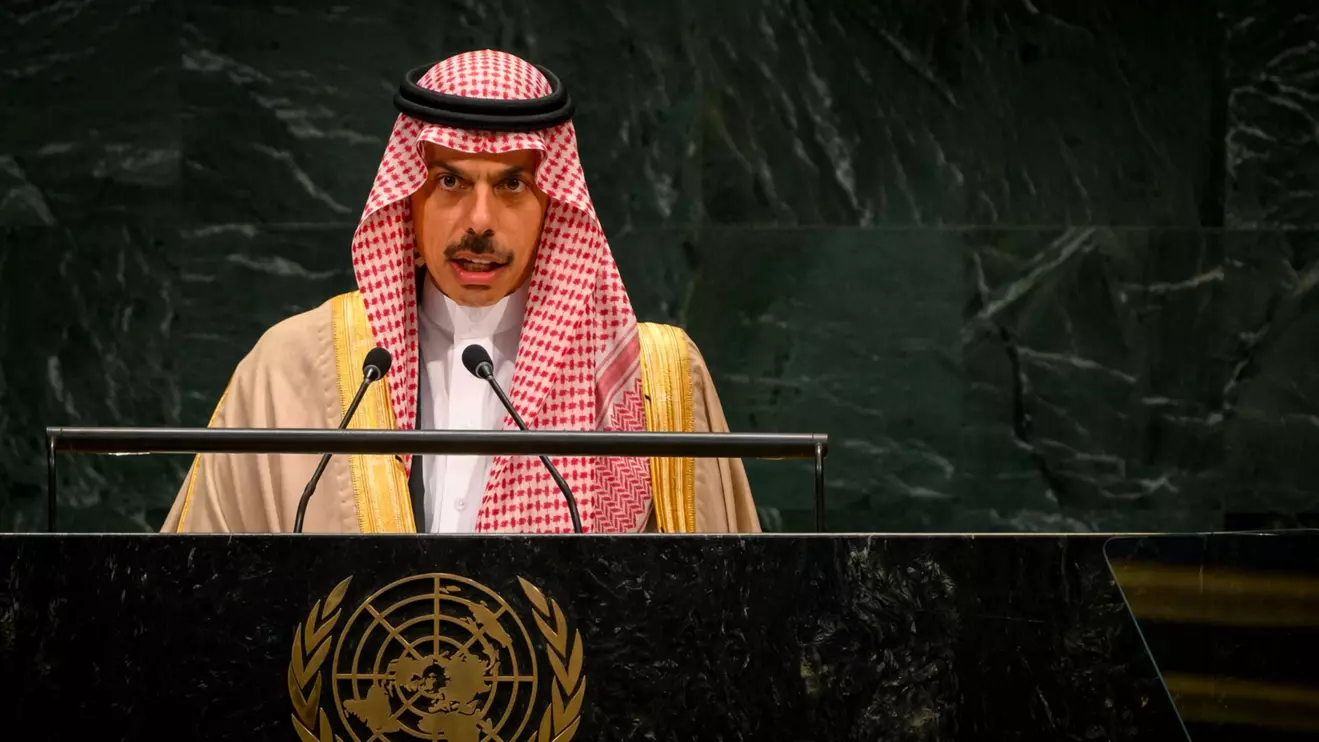
Saudi Arabia's foreign minister told the UN General Assembly on Saturday that Gulf security is inseparable from global stability, warning that the world has been too slow to respond to threats against the region's waterways.
"The security of the Gulf region is part and parcel of the security of the region and the world at large," Prince Faisal bin Farhan Al Saud said, stressing that the area's stability is directly tied to global energy security and international trade. He said Saudi Arabia and its neighbors have faced "flagrant Iranian attacks," reaffirming the kingdom's right to defend itself.
Since the US and Israel launched their war against Iran in late February, Tehran has disrupted shipping through the Strait of Hormuz, while its Houthi allies in Yemen have done the same in the Bab al-Mandab Strait, both vital corridors for global oil and gas exports.
"Safeguarding international navigation and the resilience of global supply chains is a shared responsibility," Prince Faisal said, calling for the situation in the Strait of Hormuz to be restored to its pre-February 28 status, free of any fees or restrictions.
He rejected the use of these waterways by any party "as an instrument of pressure, threat or harm to the interests of states," naming Hormuz, Bab al-Mandab, the Red Sea and the Gulf of Aden as passages requiring protection under international law.
"The international community has been absent"
In some of his sharpest language, the minister said "the international community has been absent from assuming its responsibilities in confronting all that threatens international peace and security." He argued that efforts to restore regional stability cannot be built on "domination, influence or exploitation of crises," and renewed the kingdom's call for a Middle East free of weapons of mass destruction.
Turning to regional conflicts, Prince Faisal called for a comprehensive political solution in Yemen and condemned Houthi missile and drone attacks on Saudi Arabia and commercial vessels, along with threats to Red Sea navigation. He also voiced support for Syria's security, stability and territorial integrity, and underscored Iraq's role in regional stability, insisting that Iraqi territory must