
Politics
Who is Paraguay's new president Pedro Alliana?
Paraguay's Vice President Pedro Alliana became president after the country's Senate impeached and removed Santiago Peña amid a banking crisis that triggered major political backlash.

South Africa's African National Congress (ANC) was dealt a stinging blow in last week's municipal elections, results showed on Sunday, weakening its hand in coalition talks that will follow to form city governments.
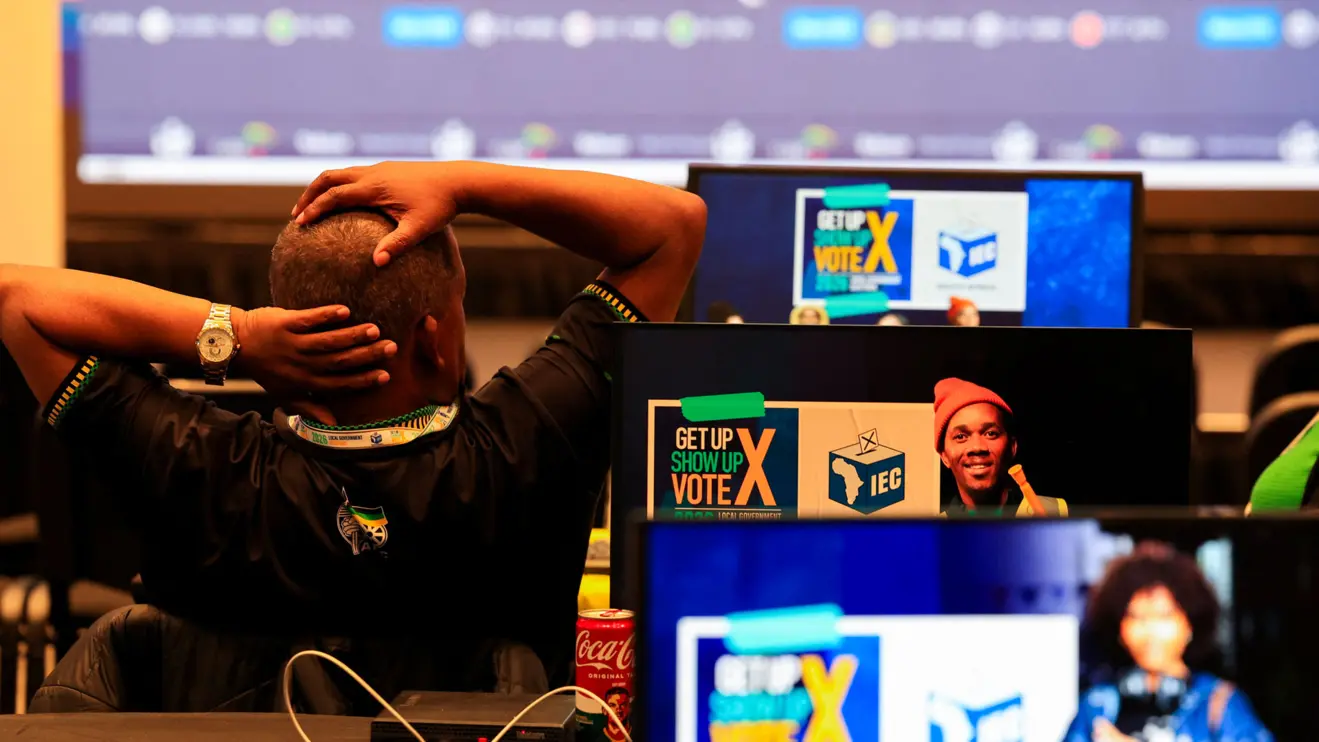
A member of the African National Congress reacts as he looks at a screen inside the Western Cape Provincial Results Operation Centre as they await municipal election results in Cape Town, South Africa, November 6, 2026. Reuters/Esa Alexander
South Africa's African National Congress (ANC) was dealt a stinging blow in last week's municipal elections, results showed on Sunday, weakening its hand in coalition talks that will follow to form city governments.
The ANC ended up with 30.76% of the vote against 24.64% for its main rival, the Democratic Alliance (DA).
Former President Jacob Zuma's party uMkhonto weSizwe had 9.76% of votes, putting it in third place, while the rest was split between hundreds of smaller parties.
The outcome marks a further painful setback for the ANC, which has seen its vote share fall steadily in local elections over the last 15 years due largely to failures in basic services such as water and electricity. The former liberation movement got 45.59% of votes in the last municipal elections in 2021.
Since no party won more than 50% of votes in many cities including South Africa's commercial hub Johannesburg, the ANC and DA will have to team up, or hash it out with smaller parties to form majority municipal governments.
The number of municipalities where coalitions will be needed more than doubled from 2021, reflecting a fragmentation of South Africa's electorate.
ANC OFFICIAL CALLS RESULTS 'CATASTROPHIC'
In brief remarks after the results announcement, President Cyril Ramaphosa said he was proud of the multi-party nature of South Africa's democracy.
"We celebrate the enduring strength of our democracy and the sovereign right of the people of South Africa to choose their representatives," he said.
ANC Secretary-General Fikile Mbalula called the result "catastrophic" for the once-dominant party of Nelson Mandela but said the party would not go begging for positions when coalition talks begin soon.
"When the people tell us we have fallen short... the honest answer is not to argue with them but to go home and put our house in order," Mbalula said on Saturday.
Parties will have 14 days to negotiate before city councils are formed.
Ramaphosa said political parties should approach the negotiations with humility.
"Our people's interest must not be drowned by the quest of political parties or representatives to settle political scores or petty squabbles," he said.
In Johannesburg the pro-business DA got about 35% of votes, compared to 20% for the ANC.
That could give DA veteran Helen Zille, who had campaigned on fixing potholes and leaking water pipes, a good chance of becoming mayor, depending on the coalition agreements reached.
Analysts have said the best option for stability in cities like Johannesburg would be for the ANC to partner with the DA, mirroring the arrangement they have had in national government for the past two years.
But the two are ideologically opposed on key issues such as racial redress.
ActionSA, which came third in Johannesburg with 16% of the vote, will not support the DA with Zille as its mayoral candidate, the party's leader Herman Mashaba told Reuters on Sunday.
By Nellie Peyton, Sfundo Parakozov and Nilutpal Timsina
Paraguay's Vice President Pedro Alliana became president after the country's Senate impeached and removed Santiago Peña amid a banking crisis that triggered major political backlash.
Jean-Luc Melenchon criticised NATO and "American wars" while pledging an economic stimulus-led revival on Saturday as he unveiled his 2027 presidential programme at a rally in the northern Paris suburb of Le Bourget.
North Korea rewards its top hackers, tasked with heists like the Binance crypto hack that netted a cool $6.3 billion, with perks such as a spacious apartment in the capital of Pyongyang and huge hard currency awards.

To make this website run properly and to improve your experience, we use cookies. For more detailed information, please check our Cookie Policy.
Necessary cookies enable core functionality. The website cannot function properly without these cookies, and can only be disabled by changing your browser preferences.