Iran
Trump downplays duration of renewed Iran strikes
President Donald Trump said on Wednesday that the renewed U.S. campaign against Iran would not continue for "too long" after the biggest exchange of fire between Tehran and Washington since July.

The Israeli military took an unusual step on Wednesday, addressing the Lebanese people directly through a message delivered by Avichay Adraee, spokesperson for the Israel Defense Forces to Arab media.
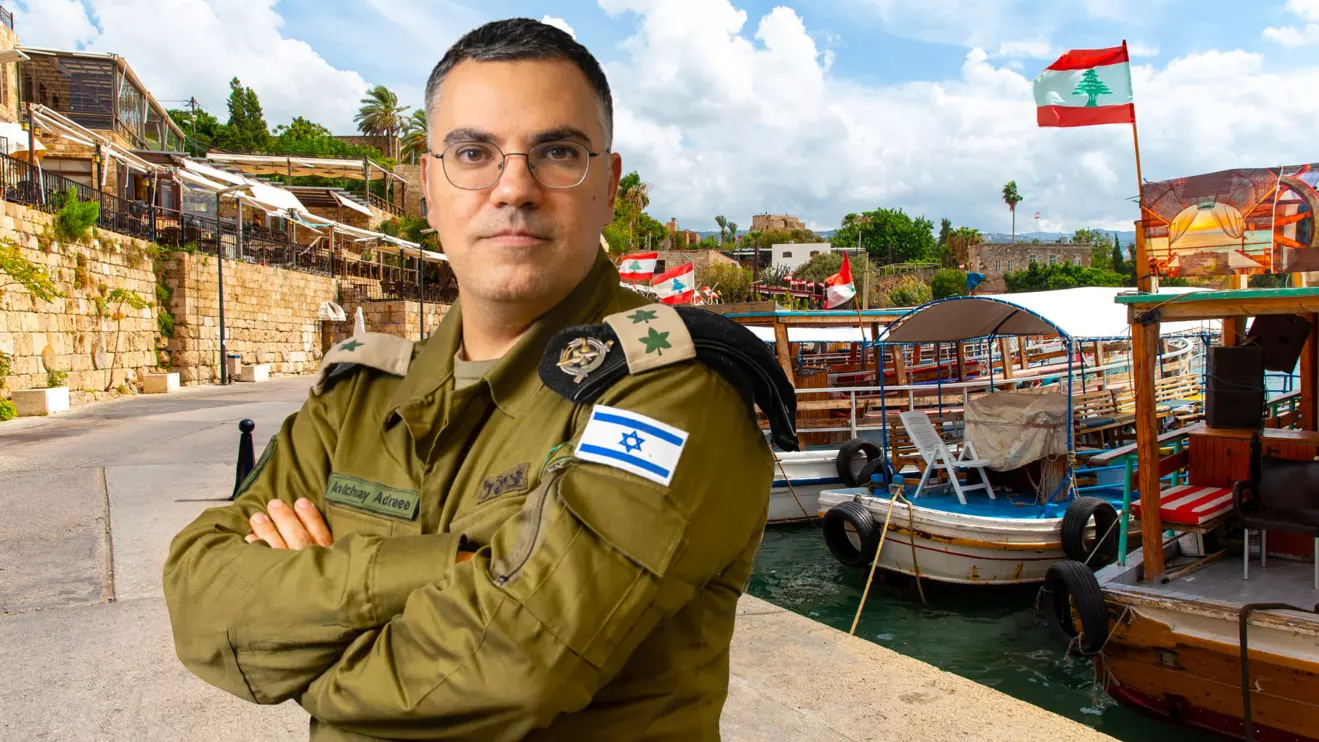
Avichay Adraee © Mena Today
The Israeli military took an unusual step on Wednesday, addressing the Lebanese people directly through a message delivered by Avichay Adraee, spokesperson for the Israel Defense Forces to Arab media, a communiqué that reads less like a military statement and more like a diplomatic appeal, drawing a sharp and deliberate distinction between Lebanon as a sovereign nation and Hezbollah as an occupying force within it.
The timing makes the tone all the more striking. At a moment when Israeli strikes are reshaping the landscape of southern Lebanon and the Bekaa Valley, Adraee's message contains no threats, no ultimatums, no body counts. Instead, it opens with an invocation of shared civilisation, two peoples bound, it argues, by a common reverence for science, creativity, family and the freedom to think.
"What unites the Lebanese and the Israeli is far greater than what terrorism seeks to portray," the text reads. It evokes the Lebanese diaspora, dazzling the world in medicine, the arts and the sciences — alongside Israeli innovation, arguing that both peoples share an instinct for excellence that decades of conflict and ideology have failed to permanently extinguish.
The implicit argument is both simple and powerful: two of the most intellectually vibrant peoples in the Middle East have not been locked in conflict by history, or by genuine mutual enmity, but by the deliberate design of a third party - Iran - whose strategic interests have never coincided with Lebanon's own.
It is a striking choice of messenger. Adraee, the IDF's Arabic-language voice and one of the most recognisable Israeli military figures in the Arab world, has spent years building a direct line of communication to Arab audiences. His involvement signals that this message was not incidental — it was crafted for maximum reach and resonance across the Lebanese street.
The distinction Israel is drawing
The most politically charged line in the message is also its most direct: "Our war today is not against you, nor against the Lebanon of the Cedars, which we respect. Our battle is against the hordes of the Iranian Revolutionary Guard and its mercenaries in Hezbollah."
This is a precisely calibrated statement. It separates the Lebanese state and people from the armed organisation that has operated for decades as a state within a state, financed by Tehran, commanded by the IRGC, and deployed in service of Iranian regional ambitions rather than Lebanese national interests.
Crucially, it is a distinction that many Lebanese have themselves been drawing for years, at considerable personal and political risk.
The implosion of the Lebanese economy, the destruction of the banking system, the slow erosion of state sovereignty, all of this has generated a deep and growing domestic frustration with Hezbollah's grip on the country. Adraee's message addresses that frustration directly, positioning Israel not as Lebanon's adversary but as the force confronting the organisation that has held the Lebanese state hostage for a generation.
The question that cannot be avoided
"What kind of Lebanon do you want?"
The message poses the question, and deliberately leaves it unanswered. It is not Israel's question to resolve. It belongs to the Lebanese people alone, and always has.
But its weight comes precisely from the absence of an easy answer. A Lebanon without Hezbollah's military infrastructure would need to be rebuilt from the ground up, politically, economically, institutionally. It would require a state strong enough to fill the vacuum, international partners with the will and resources to support it, and a population prepared to make a choice that carries real and immediate risks.
Whether the bombs falling today in the south bring that future closer or push it further away is a question that will outlast this conflict by many years.
What is already clear is that Israel, in speaking directly to the Lebanese people through one of the Arab world's most prominent military spokespeople, is advancing a political argument alongside its military campaign — that this war has a purpose beyond destruction, and that purpose is a Lebanon capable, at last, of governing itself.
The Lebanon of the Cedars - the Lebanon of Gibran, of Fairuz, of the universities that once made Beirut the intellectual capital of the Arab world, is the Lebanon Israel insists it is fighting for, not against.
Whether the Lebanese choose to believe that is another matter entirely.
But the fact that the question is being asked, across the noise of airstrikes and the smoke of burning villages, through the carefully chosen voice of the IDF's Arab-world spokesman, may itself be the most significant development of this extraordinary week.
President Donald Trump said on Wednesday that the renewed U.S. campaign against Iran would not continue for "too long" after the biggest exchange of fire between Tehran and Washington since July.
Top aides to President Donald Trump are pushing to keep the Iran war from escalating before November's midterm elections to staunch Republican electoral losses, four people familiar with the discussions said, a strategy already under strain as the U.S. and Iran exchanged back-and-forth attacks overnight.
Russia has secretly helped Iran develop advanced supersonic cruise missiles, in what the Financial Times describes as one of the most significant known transfers of strategic military technology from Moscow to Tehran, according to an investigation published Wednesday.
To make this website run properly and to improve your experience, we use cookies. For more detailed information, please check our Cookie Policy.
Necessary cookies enable core functionality. The website cannot function properly without these cookies, and can only be disabled by changing your browser preferences.