BRICS divisions exposed as Iran seeks unified condemnation

1 min Mena Today

Indian Foreign Minister Subrahmanyam Jaishankar said on Thursday that unimpeded maritime flows through international waters, including the Strait of Hormuz, are vital for global economic well-being.

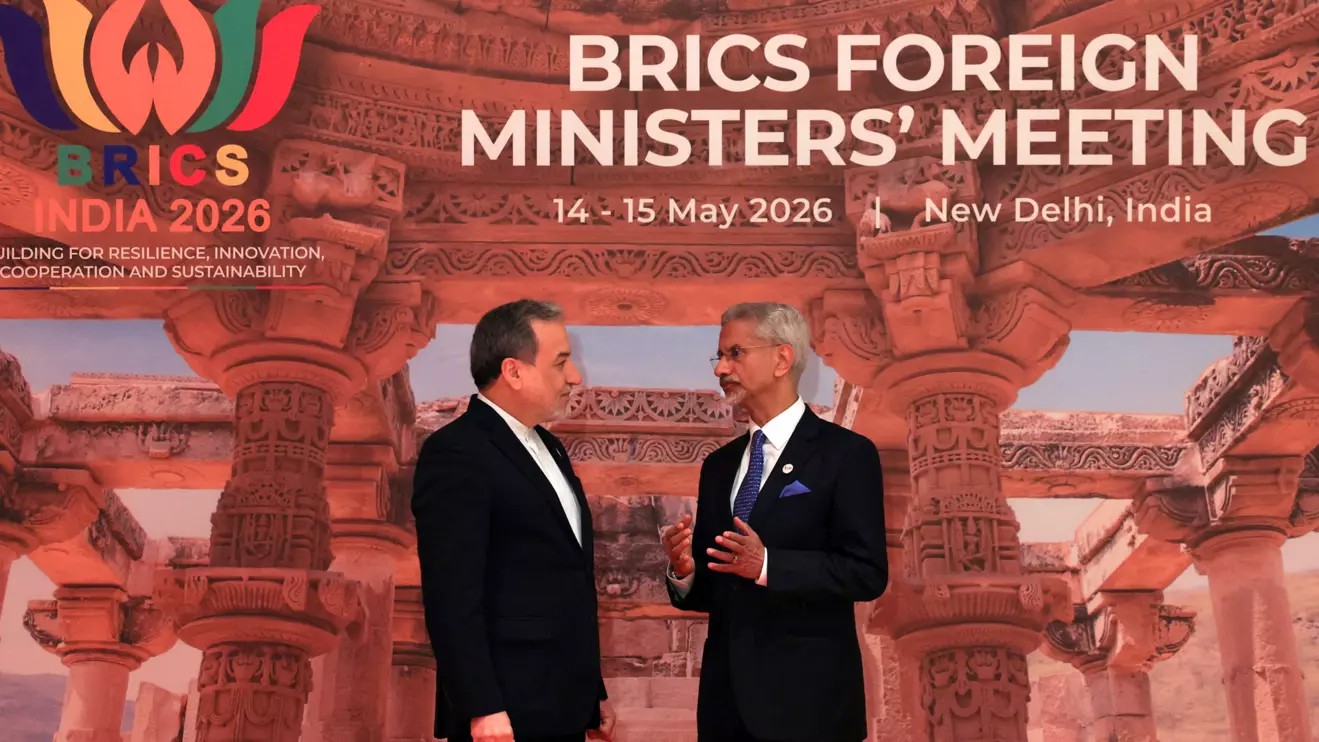
India's Foreign Minister Subrahmanyam Jaishankar welcomes Iran's Foreign Minister Abbas Araqchi during the BRICS foreign ministers' meeting at Bharat Mandapam in New Delhi, India May 14, 2026. Reuters/Adnan Abidi

India's Foreign Minister Subrahmanyam Jaishankar welcomes Iran's Foreign Minister Abbas Araqchi during the BRICS foreign ministers' meeting at Bharat Mandapam in New Delhi, India May 14, 2026. Reuters/Adnan Abidi

Indian Foreign Minister Subrahmanyam Jaishankar said on Thursday that unimpeded maritime flows through international waters, including the Strait of Hormuz, are vital for global economic well-being.

Jaishankar was speaking at the start of a two-day meeting of BRICS foreign ministers in New Delhi.

"The conflict in West Asia merits particular attention," Jaishankar said, referring to the U.S.-Israeli war in Iran.

"Safe and unimpeded maritime flows through international waterways, including the Strait of Hormuz and the Red Sea, remain vital for global economic well-being."

The impact of the war in Iran, including the effective closure of the Strait of Hormuz, has been described as one of the biggest disruptions to energy markets in history.

The disruption has choked tanker traffic and sent energy prices surging, stoking fears of spiralling inflation and a global economic downturn.

The BRICS grouping, founded by Brazil, Russia, India and China, expanded to include South Africa in 2011. Egypt, Ethiopia, Indonesia, Iran and the United Arab Emirates have joined more recently. India holds the BRICS chair for 2026.

Foreign ministers from most member states are attending the meeting in New Delhi, including Iran’s Foreign Minister Abbas Araqchi and the UAE’s Deputy Foreign Minister Khalifa Shaheen Al Marar.

The war has made it harder for the group to reach consensus on a joint statement, reflecting differences between Iran and the UAE, which are on opposing sides in the conflict launched on February 28.

Jaishankar also said BRICS must address the "increasing resort to unilateral coercive measures and sanctions inconsistent with international law and the U.N. Charter."

"Such measures disproportionately affect developing countries. These unjustifiable measures cannot substitute dialogue, nor can pressure replace diplomacy."

He said emerging economies expect BRICS to play a constructive and stabilising role.

Reporting by Aftab Ahmed and Saurabh Sharma

Related

Bahrain

U.S. seeks Bahraini support for Iran deal

U.S. Secretary of State Marco Rubio will meet with Bahrain officials on Thursday on the final leg of a trip to the Middle East where he has sought to sell the Trump administration's preliminary Iran accord to skeptical Gulf Arab allies. 

Syria

Disarm Hezbollah by force: Syria's Liberal Party offers Lebanon a way out

The Syrian Liberal Party has issued a bold call for a decisive international military alliance to disarm Hezbollah and restore full stability to Lebanon, proposing that Beirut formally request assistance from the existing US-sponsored international counterterrorism coalition.

Iran

Rubio defends Iran deal as Israel holds firm on Lebanon troops

The United States' top diplomat sought backing from sceptical Gulf allies on Wednesday for President Donald Trump's deal with Iran to end their war, while in another challenge to the accord, Israel insisted it would keep troops in southern Lebanon.

Subscribe to our newsletter

Mena banner 4

To make this website run properly and to improve your experience, we use cookies. For more detailed information, please check our Cookie Policy.

  • Necessary cookies enable core functionality. The website cannot function properly without these cookies, and can only be disabled by changing your browser preferences.