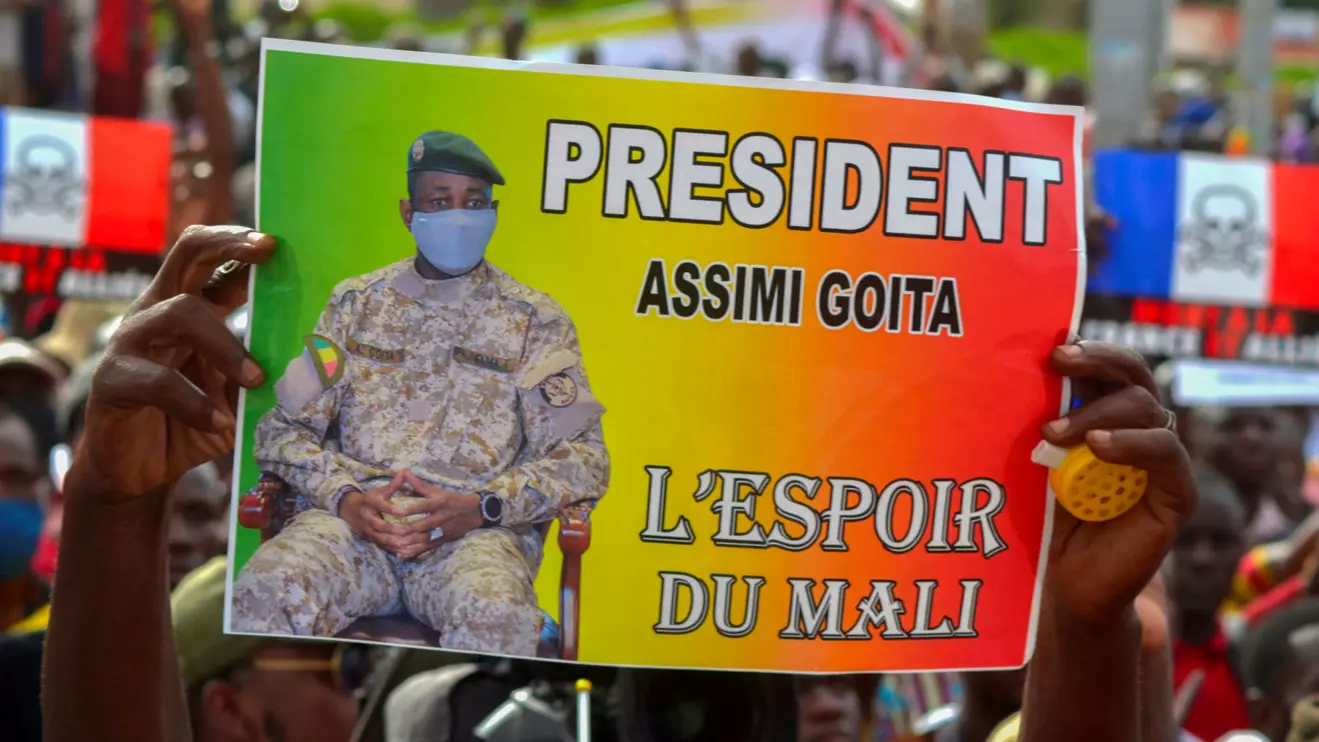
The U.S. is nearing a deal with Mali that will allow Washington to resume flying aircraft and drones over the West African country's airspace to gather intelligence on jihadist groups linked to al Qaeda, according to one current U.S. official and a former U.S. official.
Last month, Washington made the first move to implement the agreement by lifting sanctions targeting the defense minister and other senior officials who it said had ties with Russian mercenaries, a key request by Mali's government, the sources said. The U.S. hopes this will lead Mali to grant the U.S. permission to fly intelligence-gathering missions over the country's vast terrain where jihadists have been gaining ground, according to the current and former U.S. officials.
The Trump administration has sought to rebuild ties with Mali after they came under strain during the previous administration.
In Washington, the goal to resume intelligence gathering is partly driven by a desire to find an American pilot who was kidnapped by armed men while working for Christian missionaries in neighboring Niger. The pilot is currently believed to be held in Mali by the local al Qaeda affiliate, Jama'at Nusrat al-Islam wal-Muslimin (JNIM), the officials said.
The State Department declined to comment.
A Malian government spokesperson did not respond to a request for comment.
But after the sanctions were lifted on February 27, Mali's government praised the move, describing it as a step that would help "improve relations between our two countries, while reiterating respect for national sovereignty."
Mali, a gold-producing, landlocked nation in the Sahel region of Africa, is roughly twice the size of France. Like several of its neighbors in the Sahel, it is battling an increasingly violent insurgency led by JNIM.
JNIM has pursued widespread kidnapping campaigns targeting foreign nationals to finance its operations in West Africa, according to U.S. crisis-monitoring group Armed Conflict Location & Event Data.
US REBUILDING TIES WITH BAMAKO DESPITE SETBACKS
The top U.S. envoy to Africa, Nick Checker, visited Mali last month to meet with Malian Foreign Minister Abdoulaye Diop. The goal was to convey Washington's "desire to chart a new course in the bilateral relationship and move past policy missteps," according to the State Department, an apparent reference to Biden administration policies.
Diop praised American efforts to relaunch the relationship with a new approach based on mutual respect for its sovereignty and non-interference.
The Trump administration has largely dropped efforts to promote elections in the Sahel region, where military officials have overthrown elected but unpopular, Western-backed governments in recent years and turned to Russia for security support.
That has been a welcome move in Bamako and other Sahelian capitals. In the Sahel, perceived lecturing by Washington is often viewed as paternalistic and even racist, according to Catherine Nzuki of the Center for Strategic and International Studies, a U.S.-based think tank, which published a note about the U.S. loss of a base in Niger.
The Biden administration’s efforts to promote democracy after the coups helped trigger a break with Niger in 2024, with Niamey ordering all U.S. troops to leave a newly built, sprawling drone base in Agadez after a meeting with Biden officials went poorly. The multimillion-dollar base was intended to underpin intelligence-gathering operations across the region.
But the Trump administration's effort to improve relations has also encountered setbacks. Mali, Niger and Burkina Faso in December took steps to implement a reciprocal travel ban on Americans after the three nations were added to the White House's travel ban list.
MALI'S LEADERS UNDER GROWING STRAIN
In Mali, militants allied with al Qaeda and other groups have gained influence, spreading across the region despite a nearly decade-long intervention backed by France and the West, and later the efforts of Russian mercenaries. Over the past year, suspected jihadists have attacked gold mining assets and key highways, starving the capital of fuel for businesses and schools.
Reuters was unable to determine whether Mali was taking steps to give Washington permission to conduct missions in its airspace or when it was expected to take action.
The former U.S. official said cooperation was likely to come eventually because it was in Mali's interest to allow the U.S. to resume intelligence-gathering operations. “They will derive direct benefit from U.S. ISR activities where their national capabilities are insufficient,” the former official said, referring to intelligence, surveillance and reconnaissance.
"This overflight would build on likely ongoing cooperation with other USG entities,” the former official added, referring to U.S. government agencies.
The U.S. has shared intelligence with Mali that helped lead to a strike on senior JNIM leadership last year.
It wasn’t immediately clear where the U.S. might base aircraft if Mali proceeds with granting permission to resume overflight operations. Ivory Coast has previously been discussed as an option, as it shares its northern border with Mali. Ghana hosted U.S. contractors late last year when the Trump administration began surveillance flights over Nigeria, ahead of its Christmas Day bombing of what the U.S. said were Islamic State positions.