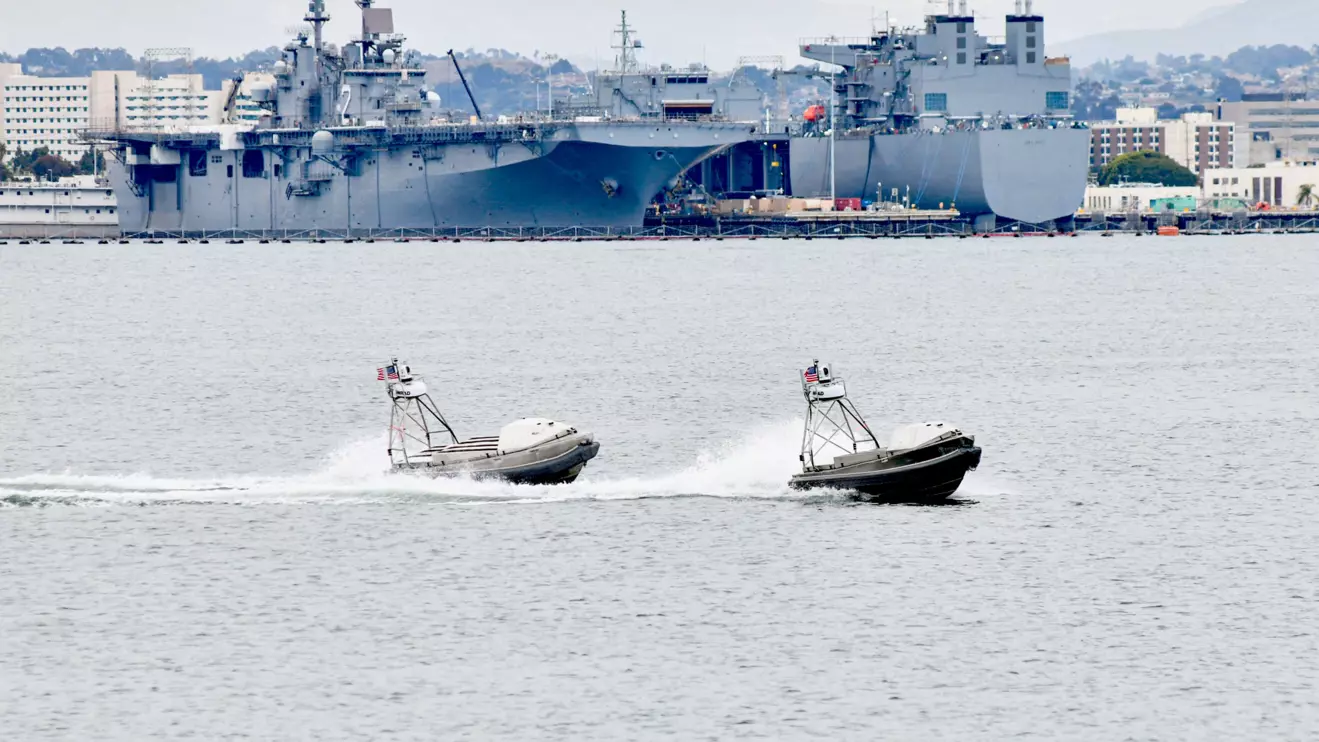
The rescue of two U.S. Army helicopter crew members by a Navy drone has spotlighted Task Force 59, the U.S. Navy's first dedicated unmanned systems unit, based in Bahrain and part of Naval Forces Central Command (NAVCENT), which oversees U.S. naval operations in the Middle East.
Since its establishment in 2021, the task force has been testing and deploying an expanding fleet of sea drones across the region, reflecting a broader Pentagon effort to develop autonomous vessels as cost-effective, rapid-response assets, though the concept has faced notable setbacks and technical challenges.Five key points about sea drones:
1. The U.S. operates both surface and underwater unmanned vessels, designed for specific roles and missions.
2. Surface vessels range widely in size. On the smaller end are the 5-metre long angular speedboats like the Global Autonomous Reconnaissance Craft (GARC) used for reconnaissance of ports, shorelines and vessels. Larger high-speed boats such as the L3Harris Arabian Fox MAST-13 can perform surveillance, assist with targeting and relay communications at sea.
3. The Navy operates unmanned underwater vehicles across several classes — large, medium, and small — each designed for different missions and depths. Large underwater drones can travel thousands of miles on their own, while smaller ones are used for shorter-range tasks such as mine detection. Much of what the U.S. military has developed and deployed in this category is classified, and systems that become public tend to disappear from view quickly.
4. Sea drones serve diverse roles. Many are built for surveillance and to track the enemy, or help clear mines, while others are designed for offensive or combat-related tasks. Central Command told Reuters the rescue was carried out by a drone but did not specify the model. One possible scenario is that a large drone arrived at the scene and the crew got on board.
5. Some sea drones have had great success. Ukraine's Magura V5 - not a U.S. asset - is the most combat-proven sea drone. It has sunk multiple Russian warships and, in December 2024, shot down a Russian helicopter—marking the first instance of a sea drone destroying an aircraft.