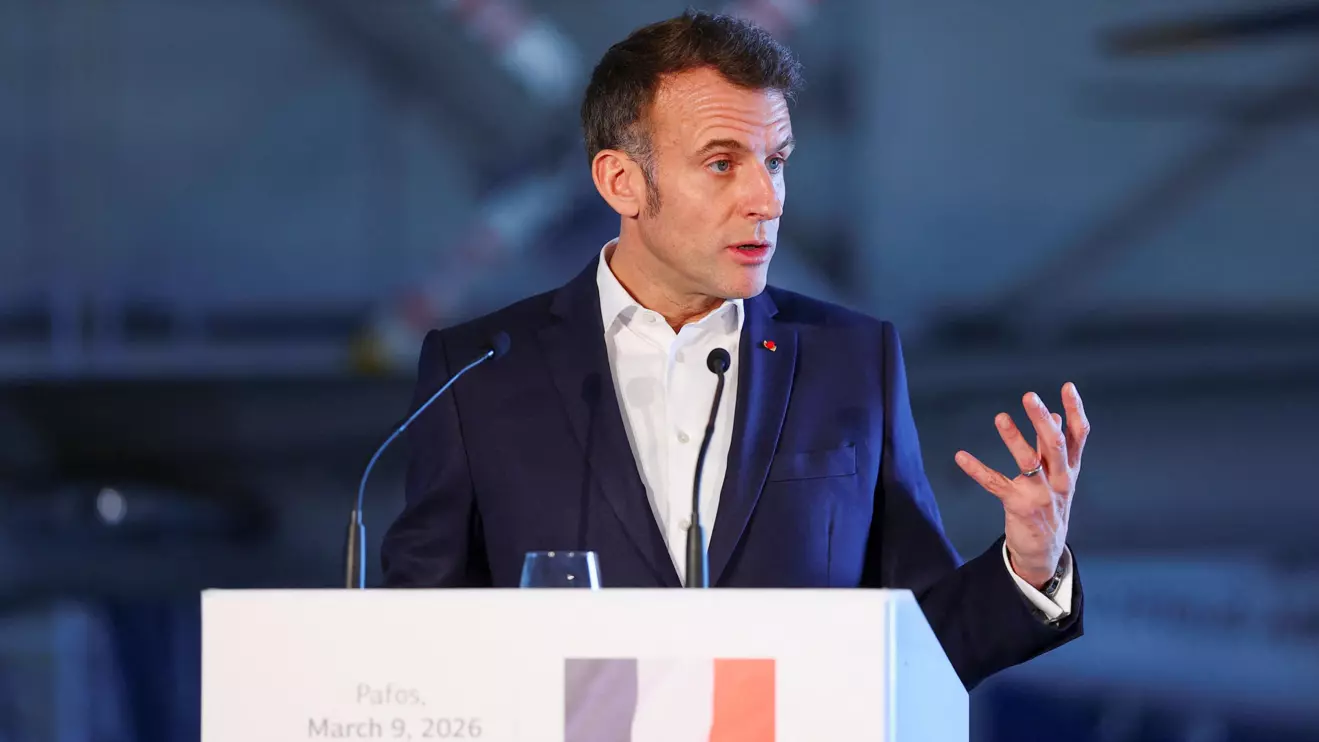
France is sending two frigates to the Red Sea as part of the EU's Aspides naval mission. Emmanuel Macron, meeting with the leaders of Cyprus and Greece, spoke of a "purely defensive, purely escort mission." A measured gesture. A careful statement. A perfectly calibrated non-event.
This is French diplomacy in 2026: present everywhere, decisive nowhere.
When the United States and Israel launched their strikes on Iran on February 28, France was not in the room. Not consulted. Not warned. Simply informed, after the fact, like everyone else.
That exclusion speaks louder than any communiqué from the Élysée. Paris, a permanent member of the UN Security Council, holder of nuclear weapons, self-proclaimed bridge between civilizations, was kept at arm's length from the most significant military operation in the Middle East in decades.
Then Donald Trump called Macron. A brief, diplomatic phone call, the kind of minimal courtesy extended to an ally who no longer sits at the top table. In Paris, it was immediately spun as confirmation of France's indispensable role. The gap between reality and narrative has rarely been so wide.
The Mediator Nobody Asked For
Macron has cast himself, once again, as the indispensable mediator, the leader who can speak to everyone. Tehran, Washington, the Gulf states, Israel. The great balancer in an unbalanced world.
The problem is that in a war, balance is weakness. And everyone can see it.
Arab allies watch a France that preaches dialogue with Tehran while selling weapons to the UAE and Saudi Arabia. Iranian leaders see Paris as a Washington vassal dressed up in mediator's clothing. Donald Trump considers Macron naive about Iran's regional ambitions and its Hezbollah proxies. And the Israelis have long since stopped expecting anything substantive from Paris.
To want to speak to everyone is, in practice, to be trusted by no one.
The deeper truth is uncomfortable but undeniable: France has become a medium power in a world reshaped by strategic empires. The United States decides. Russia disrupts. China maneuvers. The Gulf states finance. Everyone else comments.
France comments very well. It has the vocabulary, the tradition, the institutions. It has the Quai d'Orsay, centuries of diplomatic culture, a seat on the Security Council. What it no longer has is the hard power to back its words, or the strategic autonomy to act independently of Washington when it truly matters.
De Gaulle's ghost still haunts French foreign policy, the memory of a France that said no to Washington, that maintained open channels with Moscow, that refused alignment as a matter of principle. Macron invokes that tradition constantly. But the world has moved on.
Condemned to Commentary
In the Middle East today, the war does not wait for French nuance. The missiles do not pause for Macron's phone calls. The ceasefire negotiations, if they come, will be shaped in Washington, Riyadh and Jerusalem, not Paris.
France will be present, of course. It always is. It will issue statements, propose frameworks, offer its good offices. It will send its frigates and call it leadership.
But between prudence and resignation, between the nostalgia for Gaullist grandeur and the reality of strategic irrelevance, France appears increasingly condemned to one role above all others:
Explaining a world it no longer shapes.