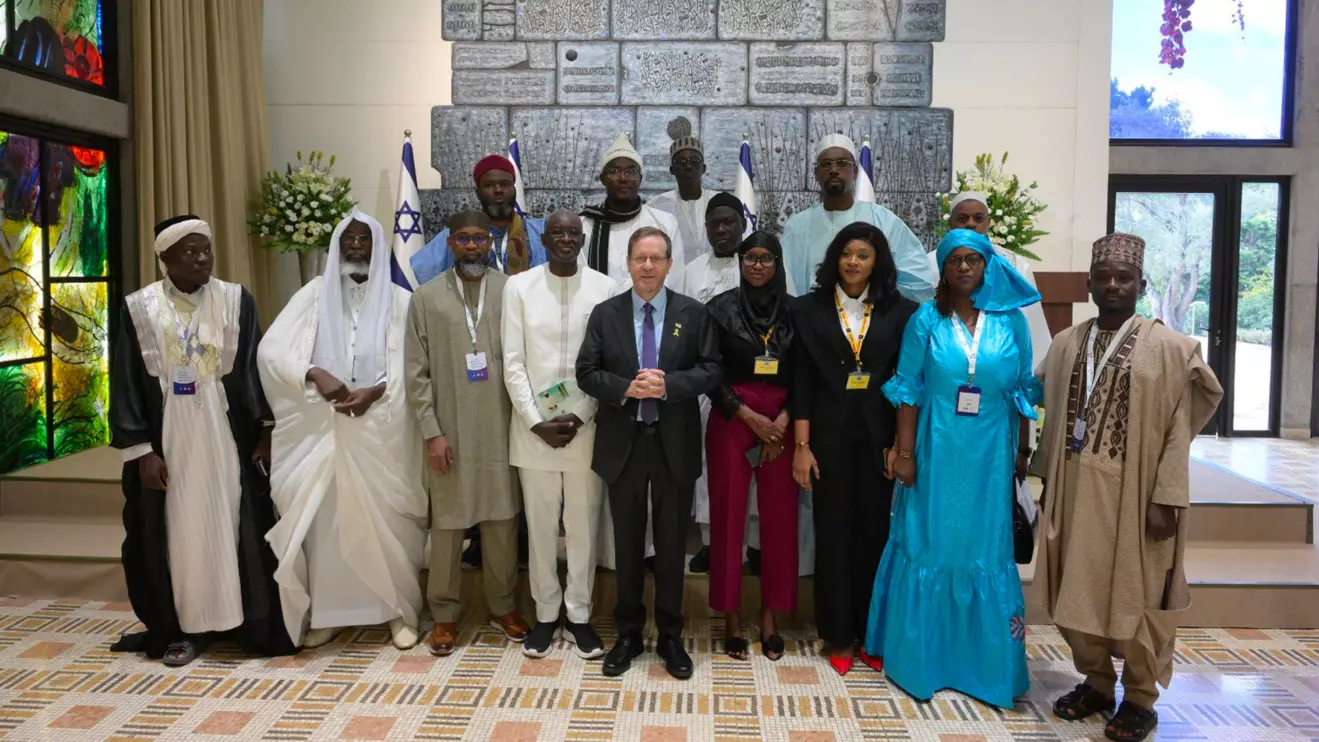
Israeli President Isaac Herzog hosted on Monday a delegation of Muslim religious leaders from Senegal, Cameroon, Côte d’Ivoire, Benin, and Togo in Jerusalem, marking a rare and symbolically powerful moment of interfaith, diplomatic, and strategic engagement.
The visit, organized with Israel’s Foreign Ministry, focused on strengthening ties between Israel and African nations while promoting coexistence between Jews and Muslims. The delegation said its goal was to bring a message of peace, partnership, and mutual understanding back to their home communities.
Herzog stressed that face-to-face engagement is essential in an era shaped by polarization and misinformation. He said the delegation’s firsthand exposure to life in Israel offers a critical counterweight to distorted global narratives and helps build trust at a human level, not just a political one.
Beyond symbolism, the visit highlights a growing reality: interfaith dialogue is becoming a strategic pillar of Africa–Israel relations. In many African countries, religious leaders carry enormous social, political, and cultural influence. When Muslim leaders openly engage with Israel, they help legitimize cooperation in the eyes of millions of people—far beyond the reach of formal diplomacy.
This influence directly affects public opinion, government policy, and long-term stability. It also creates space for pragmatic collaboration in areas where Israel and Africa already share strong interests: agriculture, water management, healthcare, technology, education, and infrastructure development.
By building trust through faith-based dialogue, Israel strengthens its ability to operate as a long-term partner across the continent—not only with governments, but with communities.
Economic Cooperation Beneath the Diplomacy
The diplomatic outreach is also tightly linked to economics. Africa is one of the fastest-growing regions in the world, and Israel has steadily expanded its footprint there through trade, innovation partnerships, and development projects. From desert agriculture to cybersecurity and medical technologies, Israeli expertise aligns directly with pressing African needs.
Religious diplomacy plays a quiet but powerful role in enabling that cooperation. When religious leadership supports engagement, economic partnerships encounter fewer political and cultural barriers. The result is faster project approval, deeper community acceptance, and more durable bilateral ties.
Herzog referenced Israel’s recent high-level diplomatic activity across Africa as part of this broader effort to anchor long-term economic partnerships through trust-based engagement.
Security Interests Run in Parallel
Security concerns are also never far from the picture. Parts of Africa face growing threats from extremist groups, regional instability, and transnational terrorism. Israel’s security experience, intelligence capabilities, and defensive technologies are increasingly viewed as valuable assets by African governments seeking to stabilize vulnerable regions.
Interfaith dialogue reinforces that security cooperation by countering radicalization at its source. When respected Muslim leaders publicly advocate coexistence and partnership with Israel, they weaken extremist narratives that thrive on demonization and isolation.
In that sense, this visit was not only about peace rhetoric—it was also about soft-power defense against the ideological forces that fuel violent conflict.
Faith as a Diplomatic Multiplier
The visiting leaders spoke about their emotional experience at Muslim holy sites in Jerusalem and said they would share what they witnessed with their communities at home. Their testimony carries weight not because it is official, but because it is personal.
Herzog tied the visit to broader regional reconciliation efforts, citing recent peace frameworks as proof that entrenched divisions can be reduced through sustained dialogue. He also pointed to the potential for Africa to play a constructive role in supporting future regional stability.
“We live in an age of constant hatred and distortion,” Herzog said. “You are seeing the truth directly. Africa has the power to become a bridge of peace in our region—and your role in that is vital.”
In practical terms, this visit showed how faith, economics, and security increasingly overlap in modern diplomacy. Interfaith engagement is no longer just symbolic—it is emerging as a quiet but durable engine for Africa–Israel cooperation across political, commercial, and security domains.