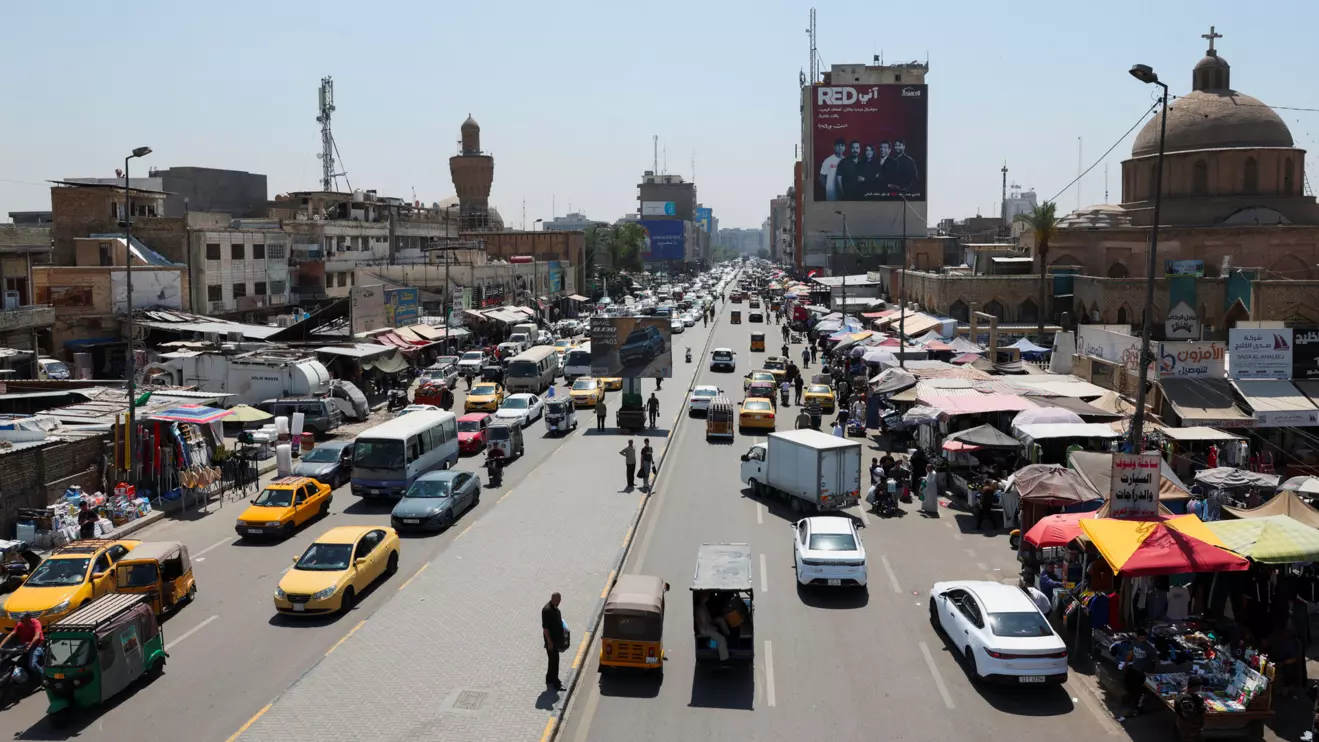
Iraq could serve as an example of how the United States could carry out its threat to force countries that continue trading with Iran out of the dollar-based financial system.
Washington has already sanctioned a host of Iraqi banks accused of doing business with Tehran, though it has avoided measures that would devastate the economy of the strategic ally of both countries.
U.S. President Donald Trump has warned that any country that provides Iran with an economic lifeline would face severe consequences. That could put Iran's main trading partners of recent years in the frame: China, the United Arab Emirates, Turkey, India, Pakistan and Oman.
U.S. Treasury Secretary Scott Bessent on Monday announced "an economic onslaught" against Iran with sanctions, saying its trading partners would be targeted, without naming them.
HOW THE U.S. INFLUENCES THE IRAQI ECONOMY
The United States, since its 2003 invasion of Iraq, has held effective control over the country's oil revenue dollars, primarily through the Federal Reserve Bank of New York, giving Washington extraordinary leverage over Baghdad's affairs.
A rare ally of both the United States and Iran, with more than $100 billion in reserves held in the U.S., Iraq relies heavily on Washington's goodwill to keep its oil revenues and finances flowing.
Reuters revealed in late 2024 a fuel oil smuggling network generating at least $1 billion a year for Iran and its proxies in Iraq. Other neighbours of Iran involved in similar schemes could face similar scrutiny from Washington.
While the U.S. has uniquely strong leverage over Iraq compared with other major trading partners of Iran, the U.S. dollar's status as the linchpin of global trade makes its reach formidable.
WHAT MEASURES HAS THE U.S. ALREADY TAKEN AGAINST IRAQ?
In April, Reuters reported the U.S. halted a $500 million cash shipment to Iraq and suspended parts of security cooperation to pressure Baghdad over Iran-backed militias. In January, Washington reportedly threatened senior Iraqi politicians with sanctions — including on oil revenues — should such groups join the next government.
Successive U.S. administrations have sought to choke that dollar stream with sanctions on Iraqi banks in recent years, though some of the largest banks were spared.
Iraq's current prime minister emerged as a candidate seen as acceptable to the Trump administration, which has steadily pressured Baghdad to curb Tehran's influence.
U.S. pressure has raised the costs and risks of financial dealings with Iran, forcing Iraqi institutions to improve compliance, said Neil Quilliam, associate fellow at UK-based think tank Chatham House.
But it hasn't broken Iraq's economic ties with Iran, which extend beyond the financial system — leaving Baghdad caught between its dependence on both Washington and Tehran.
"Countries such as China or Turkey have larger economies and more room to absorb pressure. Iraq has fewer alternatives and significantly less financial resilience," Quilliam said.
"Its vulnerability comes less from the scale of its trade with Iran and more from its dependence on continued access to the U.S.-led financial architecture."
WHAT ARE IRAQ'S TRADE TIES WITH IRAN?
Iraq's trade with Iran topped $10 billion in 2025, according to official figures, driven mainly by Iranian exports of food and consumer goods to the Iraqi market.
Trade has fallen in 2026 after the Iran war began, raising security risks, disrupting border crossings and increasing transport costs.
Iran has long viewed its neighbour and ally Iraq as an economic "lung" and wields considerable military, political and economic influence there through the powerful Shi'ite militias and political parties it backs. It has also sourced hard currency from Iraq through exports and has avoided U.S. sanctions via its neighbour's banking system.
Energy is central to the relationship: Iraq pays Iran $4 billion to $5 billion a year for natural gas used to generate electricity, Iraqi energy officials say, and officials warn new U.S. measures could jeopardise those payments.
WILL ANY NEW U.S. MEASURES AGAINST IRAQ BE EFFECTIVE?
Iraq has long been an effective sanctions-evasion route for Iran, said Tom Keatinge, director at the Centre for Finance and Security at the Royal United Services Institute.
"As Iran's connections with the international financial system are squeezed further, existing vulnerabilities will find themselves exploited to a greater extent. In that regard, Iraq, its banking system and its informal financial sector can expect to face mounting challenges," he added.
He said, however, that an approach based on incentives rather than punitive measures could be more effective. For example, the U.S. could provide technical assistance for the Iraqi central bank and the broader Iraqi government in "a strategy based on carrots rather than sticks," he added.
The U.S. is also wary of wider fallout for the financial system. Asked why he stopped short of penalising Iran directly or naming targeted countries, Bessent said: "Why would I want to blow up the global financial system?"