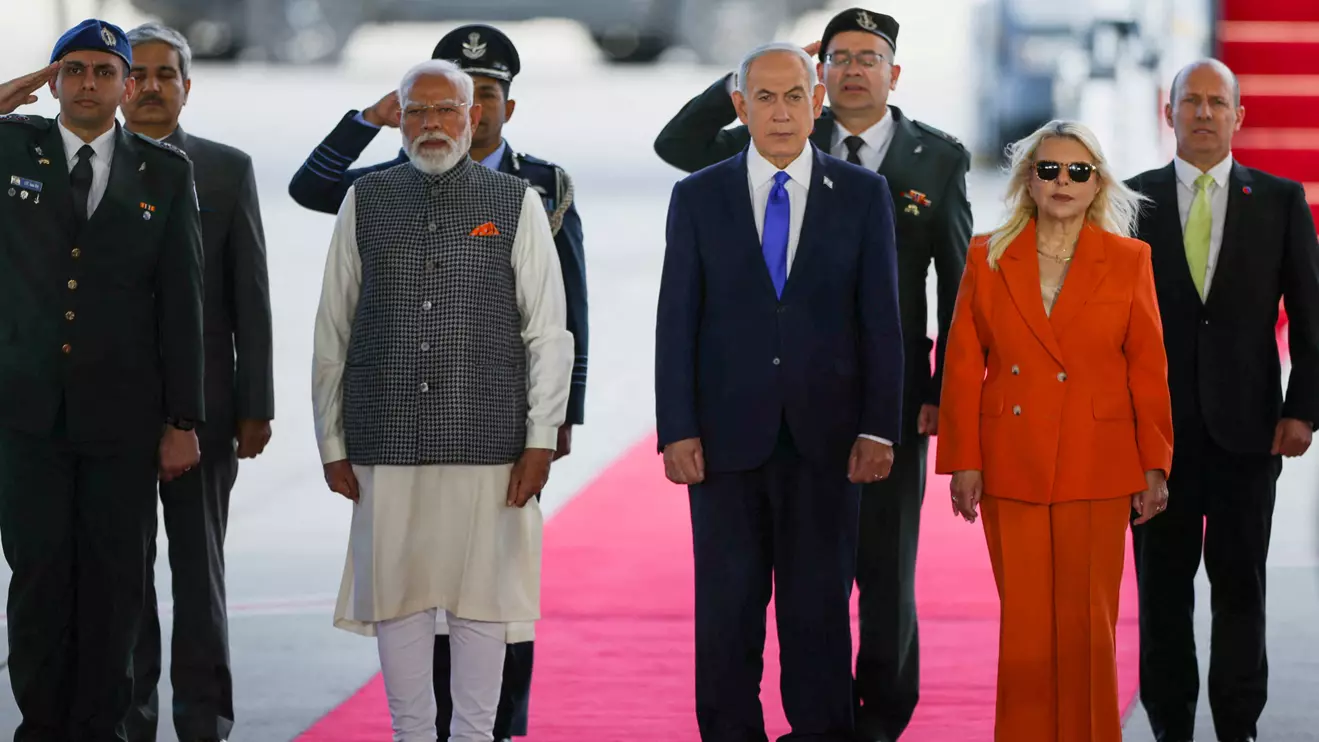
India's Prime Minister Narendra Modi arrived in Israel on Wednesday for a two-day visit that both countries have cast as a chance to deepen relations, as regional concerns mount over the risk of military conflict between the United States and Iran.
In an address to the Israeli parliament, Modi told lawmakers that India stood with Israel "with full conviction" as he shared his nation's condolences over the October 2023 Hamas attack.
"Like you, we have a consistent and uncompromising policy of zero tolerance for terrorism, with no double standards," he said.
Both Modi and Israeli Prime Minister Benjamin Netanyahu, who also addressed the parliament, spoke of terrorist attacks that their nations had faced, with Netanyahu saying India and Israel both faced the challenge of confronting "radical Islam".
Some opposition lawmakers briefly walked out of the special session, protesting at the speaker's decision not to invite the head of the Supreme Court, but returned for Modi's remarks.
Netanyahu's right-wing government, which the speaker belongs to, has had a confrontational relationship with the court.
Modi, a Hindu nationalist, became the first prime minister in India's history to visit Israel in 2017, during which he and Netanyahu took a barefoot stroll on a beach in the northern port city of Haifa.
Both still in power nearly nine years later, the two leaders, who describe one another as friends, are expected to hold talks on artificial intelligence as well as defence at a time when Israel is seeking to increase its military exports.
An Israeli government official said Modi's visit would "pave the way for new partnerships and collaborations across many fields." Bilateral ties were on the cusp of a significant upgrade, an Israeli foreign ministry official said.
US MILITARY BUILDUP NEAR IRAN
Modi is visiting as the United States deploys a vast naval force near Iran's coast ahead of possible strikes on the Islamic Republic, with the two countries at an impasse in talks over Tehran's nuclear programme. The Pentagon has also deployed an aircraft carrier to the Mediterranean, bound for Israel's coast.
A U.S. attack on Iran could draw Iranian retaliation against Israel as well as U.S. military facilities in Gulf Arab countries, where millions of Indians live and work and send home billions of dollars of remittances each year.
In his speech to lawmakers, Modi vaguely spoke about the challenges facing stability in the region, acknowledging that the landscape had become more challenging in recent years, but made no mention of the U.S. military build-up, or of Iran.
He backed the U.S. plan to end the war in Gaza, telling the parliament that it could lead to peace "for all people of the region, including by addressing the Palestinian issue."
"The road to peace is not always easy. But India joins you and the world for dialogue, peace and stability in this region," Modi said.