Hezbollah spokesman Youssef Zein declared Monday that his party was "disappointed" by Lebanese President Joseph Aoun's remarks about the militia's weapons during a televised interview marking his first year in office.
Translation: the terrorist organization is upset that Lebanon's president dares to demand it obey the law.
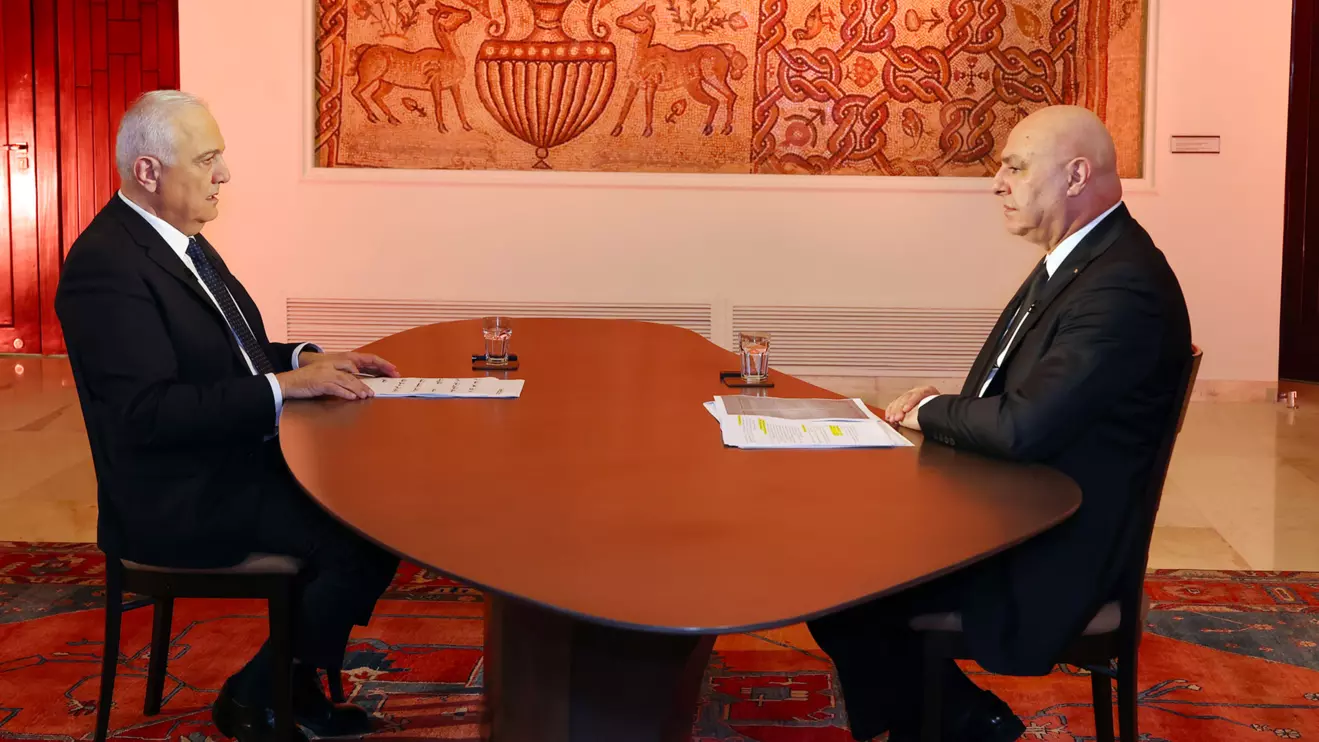
During his Sunday interview on Télé Liban, Aoun called on the Shiite militia to be "reasonable" regarding its disarmament, which Lebanese authorities launched in September 2025 in accordance with the state's founding texts and UN resolutions.
His tone was notably firmer than in previous months, when he had emphasized dialogue while refusing to forcibly seize the party's arsenal.
Aoun stated that "the situation that had allowed the existence of weapons outside state control in Lebanon no longer exists," adding that "the presence of these weapons has become a burden for [Hezbollah's base] and for Lebanon as a whole."
These are polite words for an uncomfortable truth: Hezbollah's weapons exist not to defend Lebanon, but to serve Iranian interests and maintain the militia's stranglehold on Lebanese politics.
His comments came three days after the Cabinet tasked the army with preparing the second phase of the disarmament plan, with details to be presented to the government in February.
During the first phase, the Shiite party did not oppose dismantling its arsenal south of the Litani River—because it had little choice after Israel's military campaign destroyed much of that infrastructure.
Hezbollah's Bad Faith Interpretation
The second phase targets areas between the north of the Litani River and the Awali River in southern Lebanon. Hezbollah has repeatedly claimed that the November 2024 ceasefire agreement only requires disarmament south of the Litani. This is a deliberate misreading—or outright lie.
UN Security Council Resolution 1701, which itself builds on the 1989 Taif Agreement and serves as the foundation for the truce, explicitly demands the total disarmament of militias and non-state groups. Not partial disarmament. Not south-of-the-river disarmament. Total disarmament.
Hezbollah knows this. Lebanese authorities know this. The international community knows this. But Iran's Lebanese proxy is doing everything possible to avoid surrendering its military arsenal because those weapons are the source of its power—and the key to Tehran's continued influence over Lebanon.
It is obvious that this terrorist formation, financed by Iran, is doing everything to keep its military arsenal. Every delay tactic, every legal quibble, every expression of "disappointment" serves one purpose: buying time to preserve the weapons that allow Hezbollah to function as a state within a state.
The militia's "disappointment" is rich with irony. For decades, Hezbollah has disappointed the Lebanese people by dragging them into wars they didn't choose, by assassinating politicians who challenged its dominance, by crippling the economy through its parallel structures, and by subordinating Lebanese sovereignty to Iranian strategic interests.
Now, faced with a president who actually expects compliance with Lebanese law and UN resolutions, Hezbollah expresses disappointment. The audacity is breathtaking.
The Iranian Lifeline
Hezbollah's intransigence reflects its existential dependence on Iran. The militia receives an estimated $700-$800 million annually from Tehran, along with weapons, training, and strategic direction. Its arsenal exists not to defend Lebanese borders but to advance Iranian regional ambitions and threaten Israel on Tehran's behalf.
The fall of the Iranian regime would deliver a fatal blow to Hezbollah, already severely weakened by Israel's recent military operations.
Iranian money keeps Hezbollah afloat. Iranian weapons fill its arsenals. Iranian ideology justifies its existence. Remove Iran, and Hezbollah becomes just another Lebanese political party—one that would need to compete for influence through normal politics rather than armed intimidation.
This explains Hezbollah's desperate efforts to preserve its weapons. Without them, the party loses its ability to veto government decisions, to dominate Lebanese politics, and to maintain the parallel state structures that generate revenue and loyalty. Disarmed Hezbollah would be neutered Hezbollah.
President Aoun faces a defining challenge. He can continue the cautious approach of dialogue and gradualism, hoping Hezbollah will voluntarily surrender weapons it views as essential to its survival. Or he can recognize that a militia created, funded, and directed by a foreign power will never willingly disarm and must be compelled to do so.
The first phase succeeded largely because Israel had already destroyed much of Hezbollah's southern infrastructure.
The second phase will be harder because it targets areas where Hezbollah retains greater capabilities. The militia's "disappointment" signals its intention to resist—through political pressure, legal maneuvering, and if necessary, intimidation.
International Support Required
Lebanon cannot face down Hezbollah alone. The militia is too powerful, too deeply entrenched, and too willing to use violence to preserve its position. International support—diplomatic, financial, and potentially military, will be necessary to enforce Resolution 1701 and restore Lebanese sovereignty.
This means the United States, European Union, and Arab states must make clear that continued international assistance to Lebanon depends on disarmament progress.
It means ensuring the Lebanese army has the resources and backing to implement the plan. And it means holding Iran accountable for its continued arming and funding of a designated terrorist organization.
No More Excuses
Hezbollah has run out of excuses. The Israeli threat that supposedly justified its "resistance" weapons has been addressed by the ceasefire.
The liberation of Lebanese territory, the militia's original stated purpose, was accomplished years ago. UN Resolution 1701 requires disarmament. Lebanese law prohibits armed non-state actors. The Taif Agreement established state monopoly on weapons.
Every legal, political, and strategic justification for Hezbollah's arsenal has evaporated. What remains is naked self-interest: the determination of an Iranian proxy to retain the weapons that give it power over Lebanon regardless of what Lebanese law, international agreements, or Lebanese public interest demand.
The Test of Lebanese Sovereignty
Hezbollah's "disappointment" with President Aoun's remarks reveals the fundamental question facing Lebanon: Is it a sovereign state or an Iranian province? Does Lebanese law apply to everyone or just to those without Iranian backing? Can the Lebanese government govern Lebanon or must it defer to a foreign-funded militia?
Aoun's firmer tone suggests he understands what's at stake. Hezbollah's reaction confirms that it will not surrender its weapons voluntarily. The coming months will reveal whether Lebanon has the strength—with international support—to enforce its sovereignty, or whether Iran's militia will successfully defy yet another Lebanese president and continue its armed domination of the country.
The militia is disappointed? Too bad. The Lebanese people are disappointed by decades of Hezbollah's destructive dominance. It's time for the terrorist organization to learn that in a functioning state, militias don't get to keep private armies simply because surrendering them would be disappointing.
Disarm or face consequences. Those should be Lebanon's only two options for Hezbollah. Everything else is just more delay tactics from a militia doing everything possible to avoid the accountability it has evaded for far too long.