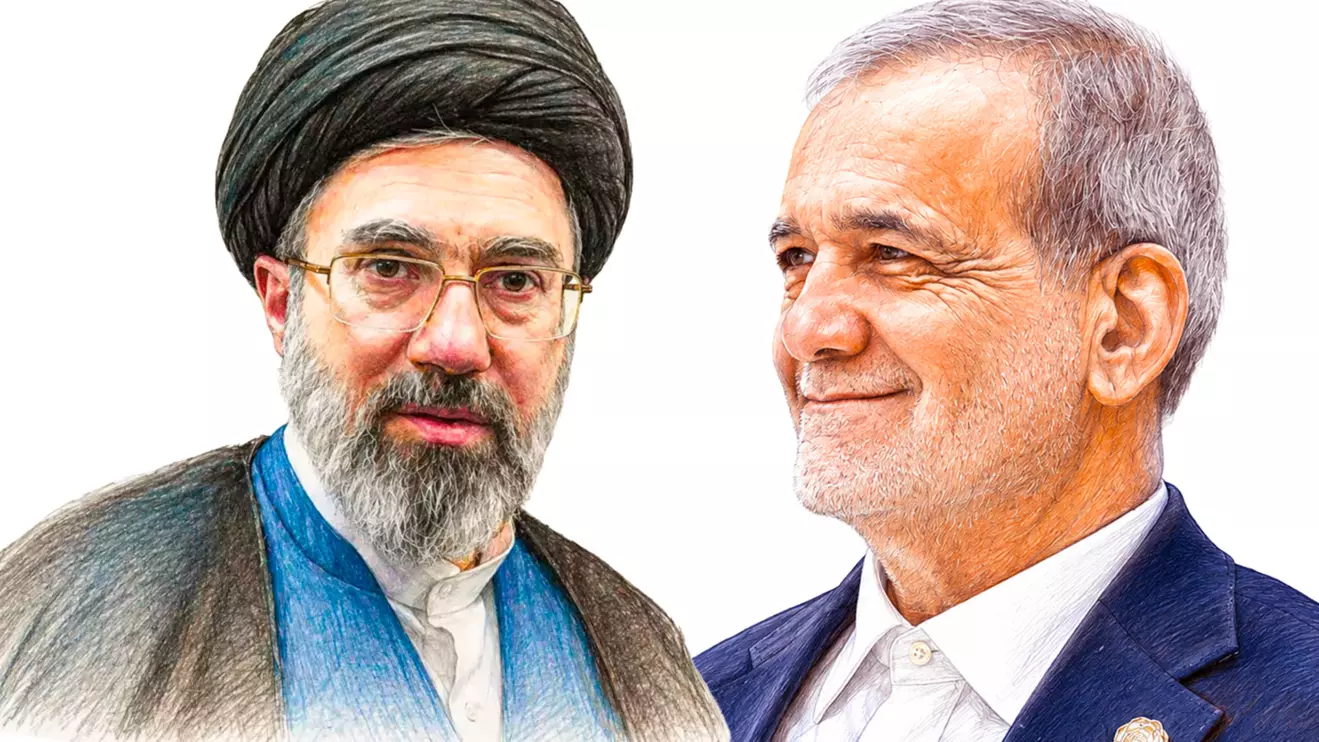
Iranian President Masoud Pezeshkian announced Thursday that he had met Supreme Leader Mojtaba Khamenei, at some point, on some unspecified date, in some undisclosed location.
"What struck me most during this meeting was the vision and the humble, sincere approach of the Supreme Leader," Pezeshkian said in a video broadcast by state television.
No date. No image. No footage. No independent witness. Just a presidential testimonial, delivered to a state broadcaster whose relationship with the truth has always been, at best, complicated.
Mojtaba Khamenei has not been seen in public since his nomination as Supreme Leader was announced on 9 March, itself a rushed, opaque process following the death of his father Ali Khamenei, killed alongside dozens of senior officials in the joint US-Israeli strikes of 28 February.
On that first day of war, Mojtaba was reportedly gravely wounded. Some sources go further, suggesting he may not have survived at all.
Since his designation, the new Supreme Leader has communicated exclusively through written statements.
His portrait is plastered across Iranian streets. His voice has never been heard. His face has not been shown. For a man who is supposedly running one of the most consequential states in the Middle East, he maintains a remarkably spectral presence.
A republic built on strategic lying
What makes Pezeshkian's claim particularly unconvincing is its context. The Islamic Republic has a long, well-documented tradition of manufacturing reality when reality becomes inconvenient.
The regime spent years denying it had shot down a Ukrainian passenger jet, before satellite evidence made denial impossible. It fabricated military victories throughout the Iran-Iraq war. It doctored photographs of missile tests.
It announced the death of dissidents as "suicides." It broadcast forced confessions. It told its people that protests were foreign-orchestrated conspiracies, while the world watched Iranians being shot in the streets.
Claiming that a gravely wounded - or deceased - Supreme Leader received the president for a meeting of visionary humility fits neatly into this tradition. It is the Islamic Republic doing what the Islamic Republic does: constructing a narrative, demanding belief, and punishing doubt.
The propaganda of the phantom leader
The strategy is transparent but not without purpose. An invisible Supreme Leader is a liability, it raises questions about succession, stability and legitimacy that the regime cannot afford to answer openly.
A Supreme Leader who "receives" the president, who issues statements, whose portrait fills the public space, that is a Supreme Leader who still governs, at least in the story the regime tells itself and its people.
Whether Mojtaba Khamenei is alive, incapacitated or dead, the Islamic Republic will say whatever serves the moment. It always has.