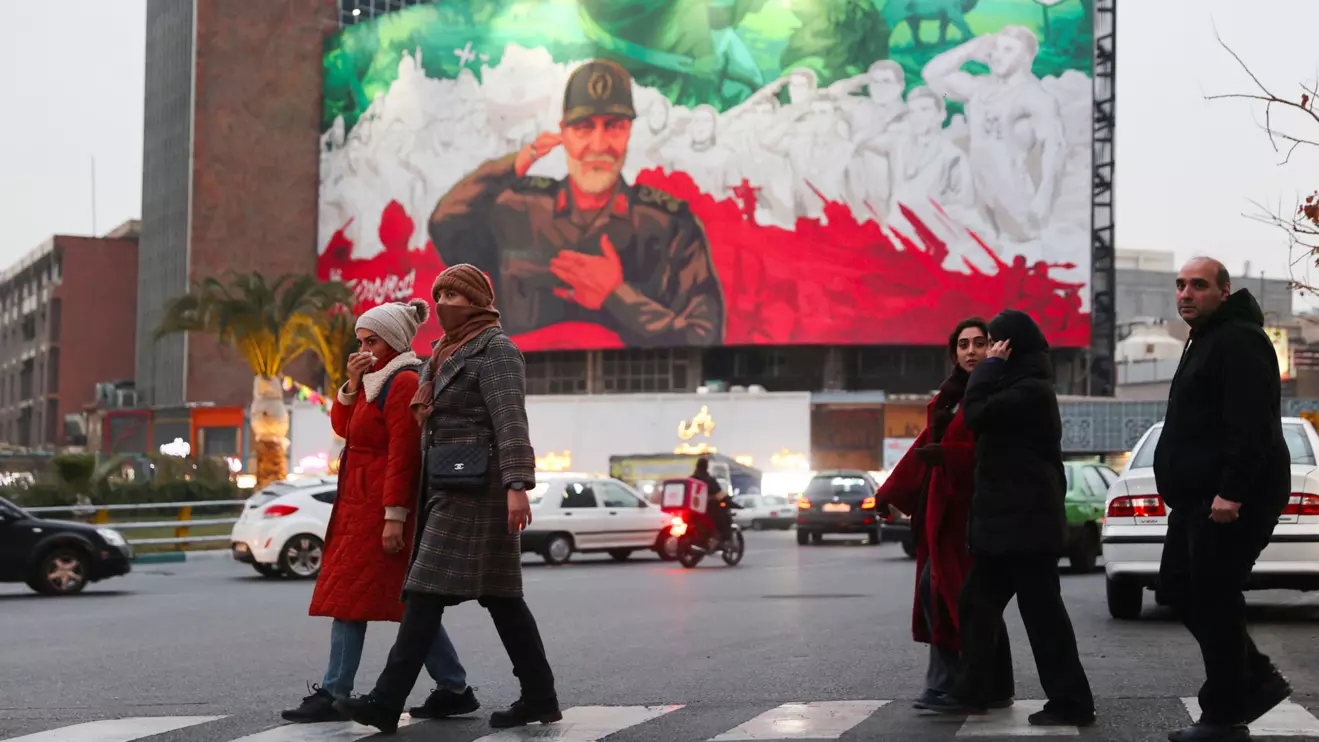
Iran's top judge warned protesters on Wednesday there would be "no leniency for those who help the enemy against the Islamic Republic", while accusing Israel and the U.S. of pursuing hybrid methods to disrupt the country.
Tehran is under international pressure with U.S. President Donald Trump threatening to come to the aid of protesters if security forces fired on them, seven months after Israeli and U.S. forces bombed Iranian nuclear sites in a 12-day war.
Iranian Supreme Leader Ayatollah Ali Khamenei has vowed not to "yield to the enemy".
The current protests, the biggest wave of dissent in three years, began last month in Tehran's Grand Bazaar by shopkeepers condemning the currency's free fall. Unrest has since spread nationwide amid deepening distress over economic hardships, including rocketing inflation driven by mismanagement and Western sanctions, and curbs on political and social freedoms.
"Following announcements by Israel and the U.S. president, there is no excuse for those coming to the streets for riots and unrest, Chief Justice Gholamhossein Mohseni Ejei, the head of Iran's judiciary, was quoted as saying by state media.
"From now on, there will be no leniency for whoever helps the enemy against the Islamic Republic and the calm of the people," Ejei said.
At least 27 people have been killed and more than 1,500 arrested in Iran in the first 10 days of protests, with the west of the country seeing the highest number of casualties according to Kurdish-Iranian rights group Hengaw.
HRANA, a network of human rights activists, has reported a higher death toll of at least 36 people as well as the arrest of at least 2,076 people.
Reuters has not been able to independently verify the numbers of casualties or details of disturbances reported by Iranian media and rights groups.
Iranian authorities have not given a death toll for protesters, but have said at least two members of the security services have died and more than a dozen have been injured.
Iran's western provinces - which are economically marginalised and are heavily policed due to past outbreaks of unrest and their strategic location for national defence - have witnessed the most violent protests and repression lately.
MOST KILLINGS IN SIX WESTERN PROVINCES
Demonstrators took to the streets again overnight in the western province of Ilam and disturbances erupted, Hengaw said.
It has counted at least 20 demonstrators killed since late December in the provinces of Ilam, Lorestan, Kermanshah, Fars, Chaharmahal and Bakhtiari, and Hamadan.
"During the funeral of two people in Malekshahi on Tuesday, a number of attendees began chanting harsh, anti-system slogans," said Fars, a news agency affiliated with Iran's Revolutionary Guards.
After the funeral, Fars said, "about 100 mourners went into the city and trashed three banks ... Some started shooting at the police trying to disperse them".
In Abdanan, a city in southwestern Ilam province, a large crowd gathered late on Tuesday and chanted slogans against Khamenei that could be heard in a video shared on a Telegram channel called Nistemanijoan with over 180,000 followers.
The semi-official news agency Tasnim said a crowd of 300 gathered peacefully in Abdanan to make economic demands and some started shouting "anti-establishment" slogans, after which many demonstrators fled while security forces tackled "rioters".
Another Iranian outlet, Mehr News, said protesters had stormed a food store and emptied bags of rice, which has been affected by galloping inflation that has made ordinary staples increasingly unaffordable for many Iranians.
Social media footage shared by Iranian media outlets showed young men flinging grains of rice into the air, with the crowd cheering them on. Reuters was not able to verify the videos.
Reporting by Dubai Newsroom