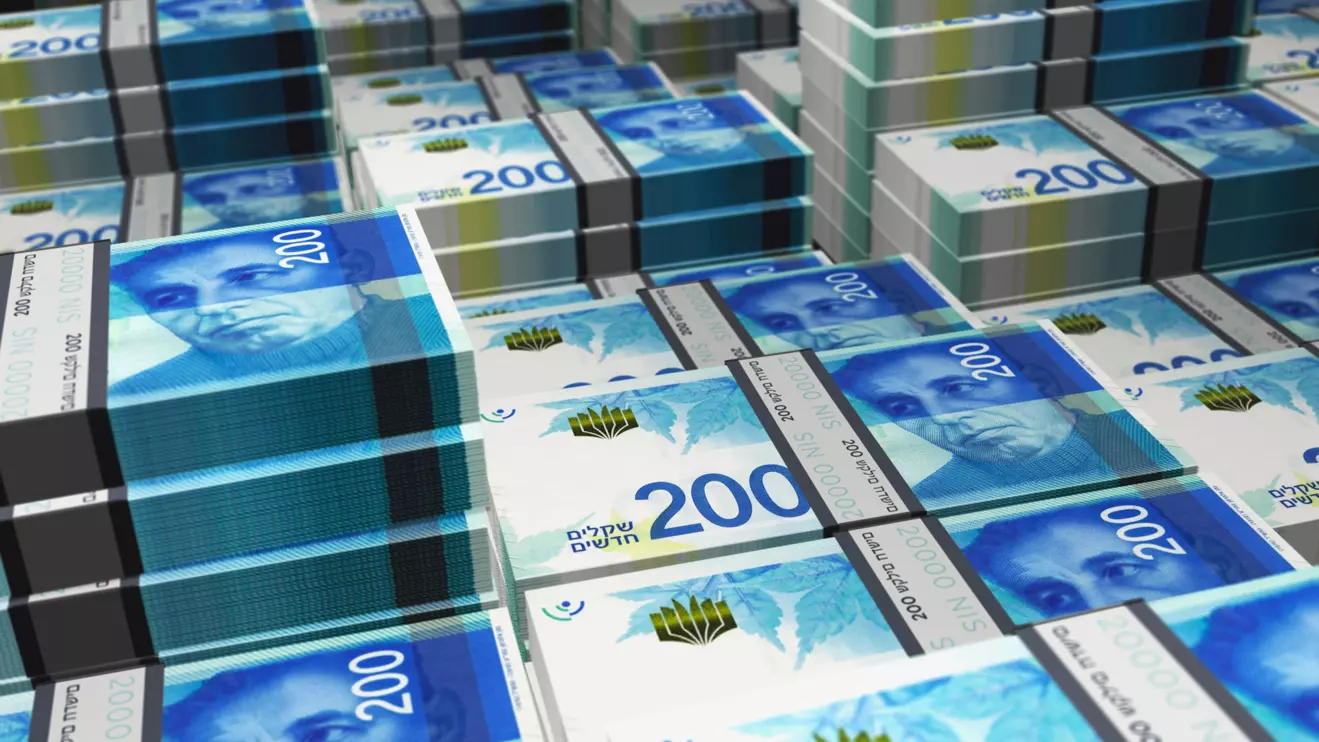
In the middle of a regional war, drone attacks, Hezbollah threats and grinding geopolitical uncertainty, Israel's shekel is doing something unexpected: it is surging. And that is becoming a serious problem.
Over the past week, the shekel has traded between 0.2937 and 0.2983 against the euro — hitting its highest point on May 22, when one shekel was worth 0.2983 euros. Against the euro, the current mid-market rate stands at approximately €1 = ₪3.36, having traded between 3.37 and 3.52 over the past 30 days. Against the dollar, the shekel has strengthened dramatically, up nearly 17% over the past twelve months, touching multi-year highs.
For a currency belonging to a country at war, these are extraordinary figures.
The Bank of Israel's impossible balancing act
At the heart of the shekel's strength lies a monetary policy dilemma that Governor Amir Yaron has been navigating with visible caution.
After holding rates at 4.5% through ten consecutive meetings during the Gaza war, the Bank of Israel finally cut rates twice in late 2025 — first to 4.25% in November, then to 4% in January 2026 — as inflation moderated and the ceasefire took hold.
But the Iran war changed everything. At its March 2026 meeting, the central bank left the benchmark rate unchanged at 4%, noting a marked increase in the inflation environment driven largely by surging global energy prices.
Governor Yaron was direct about the dilemma: "Wars, especially those that last for a prolonged period, are accompanied by high inflation, and by a considerable negative impact on GDP."
The lesson from the Gaza war was seared into the Bank's institutional memory: cutting rates too early, with conflict-driven price pressures still building, risks losing control of inflation entirely.
The central bank trimmed its 2026 growth forecast to 3.8% while raising its inflation projection to 2.3%, a combination that leaves little room for aggressive easing, even as exporters and manufacturers scream for relief.
While many other global central banks are considering hiking borrowing costs in the face of rising oil prices, Yaron noted that Israel's situation is different — its rate remains far higher than those in the US and Europe, yet still insufficient, in his view, to cut further without risking a wage-price spiral in an already tight labour market.
Beyond monetary policy, several structural forces are keeping the shekel elevated, and largely beyond the Bank's direct control.
Israel's deep linkage to US financial markets plays a central role. The technology sector, which generates the bulk of Israel's export revenues, is priced and paid in dollars. When US tech stocks recover, as they have done, Israeli tech companies repatriate dollar earnings into shekels, creating sustained demand for the currency regardless of the security situation.
Pension funds tell a similar story. Israeli institutional investors, who had aggressively hedged their foreign currency exposure during the peak of the war, converting foreign assets back into shekels as a defensive measure, are now gradually unwinding those hedges as conditions stabilise.
This process releases a steady flow of foreign currency being sold for shekels, adding upward pressure that has little to do with economic fundamentals and everything to do with portfolio mechanics.
High-tech fundraising has also remained resilient. Policymakers noted that economic activity continues to expand, supported by credit card spending, exports and high-tech fundraising, while the risk premium remains close to pre-war levels. Each funding round - paid in dollars or euros - feeds directly into shekel demand.
For exporters, hoteliers, airlines and agricultural producers, a high shekel is quietly devastating. Israeli technology exports become more expensive in foreign markets. Tourism, already severely depressed since October 7, 2023, faces the double burden of security concerns and an unfavourable exchange rate for incoming visitors.
Agricultural exports lose competitiveness. The real estate sector, already strained, faces additional pressure as foreign buyers find Israeli property more expensive in their own currencies.
Israel's business community is increasingly vocal. A shekel at these levels, they argue, is simply incompatible with an export-driven growth model, particularly when the country needs every competitive advantage it can find.
An uncomfortable paradox
Israel finds itself in a position few countries have faced: a currency that markets trust more than the geopolitical situation seems to warrant, propped up by structural flows that monetary policy cannot easily offset, while the central bank remains handcuffed by war-driven inflation risks that prevent the rate cuts that might provide relief.
The Bank of Israel's own forecast projects rates falling to 3.5% by end-2026, but only assuming a stable geopolitical environment and sound fiscal situation. Neither condition is currently guaranteed.
War is expensive enough. A strong currency, in the wrong circumstances, makes it more expensive still.