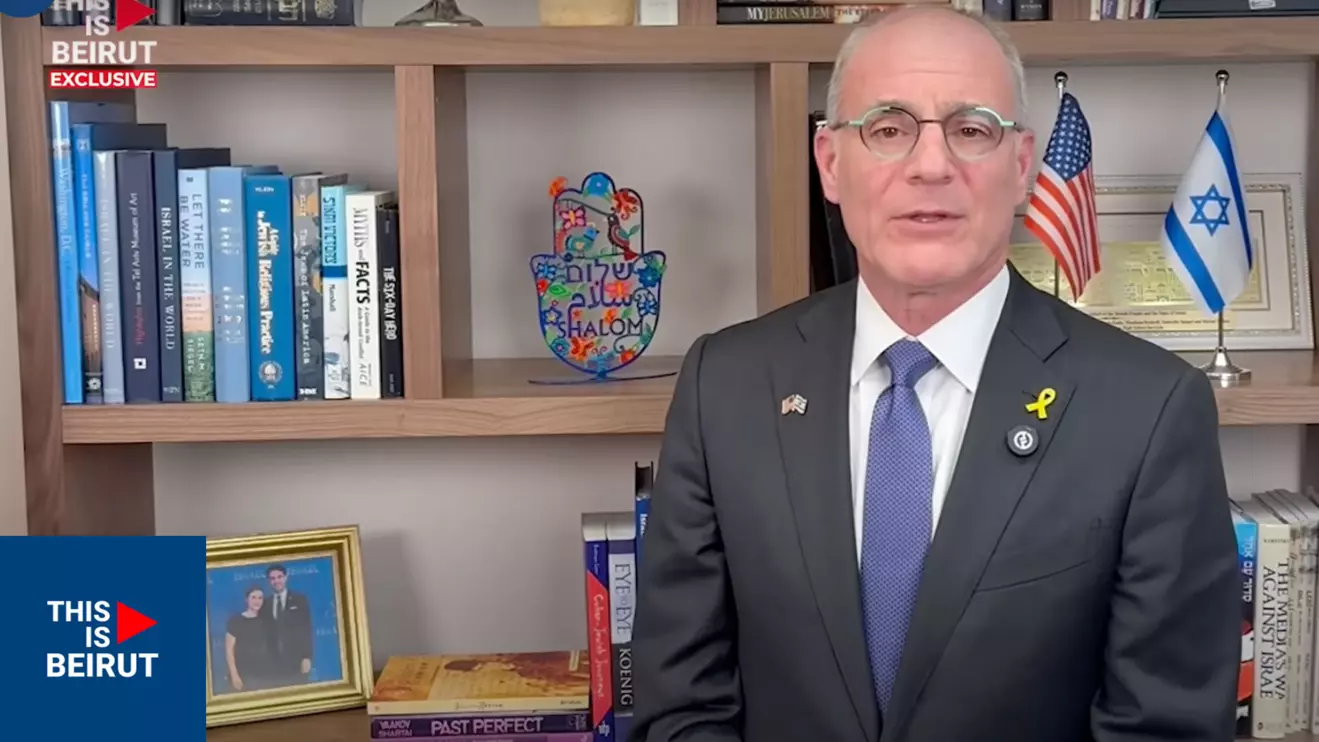
In an unusual move that cuts against the usual script of mutual accusations and threats, Israel’s ambassador to the United States, Yechiel Leiter, has delivered a direct appeal to the people of Lebanon: We want peace, not your territory.
In a rare interview with This Is Beirut, an English-language Lebanese outlet, Leiter laid out a vision that, on paper, sounds almost utopian given the current climate: a disarmed Hezbollah, a Lebanon no longer tethered to Iran’s agenda, and a pathway toward peace, economic growth, and even inclusion in a new round of Abraham Accords as early as 2026.
If that sounds wildly optimistic, that’s because it is. But it’s also strategically deliberate.
Talking Over Hezbollah’s Head
Leiter did something Israeli officials almost never do: he spoke not just about Lebanon, but to Lebanese citizens.
“We want very much to pursue peace with you,” he said, stressing that Israel has “no issues with your territory” and is focused only on its own security. The message repeated a simple line: we do not see Lebanon as an enemy country by definition; we see armed groups acting on behalf of Iran as the problem.
That framing is no accident. It reflects a broader Israeli effort to drive a wedge—politically and emotionally, between Lebanese society and Hezbollah. The more Israel can portray Hezbollah as an Iranian franchise draining Lebanon’s future, the more it hopes to normalize the idea that peace is possible with Lebanon even while confrontation continues with Hezbollah.
Leiter’s narrative leans heavily on that distinction. Most Lebanese, he argued, fall under what he called “moderate Islam”, people who want to live, trade, and integrate with the West, not wage an endless war on its behalf.
“They are tired of this,” he said simply. “So we must move forward.”
Security First, But Not Only
The ambassador’s message can be boiled down to one line: we don’t have a border problem, we have a security problem.
“We have no issues with your territory,” he insisted. “We have issues only with our security. And when we’re threatened, we have to respond, because the same way you want to live in security, so do we.”
This is classic Israeli doctrine, but wrapped here in softer language aimed at a civilian audience. The points along the border, he explains, are not about expansionism but about defending Israeli towns and cities. The subtext: if Hezbollah rockets stop, so do Israeli strikes.
Leiter also repeatedly stressed that Israel does not seek harm to Lebanese civilians, only to “those who fire rockets and threaten the existence of our state,” and to those aligned with what he called the “Iranian regime” and its wider project against Israel, the West, and Judeo-Christian civilization.
It’s a line that will be dismissed by many in Lebanon as self-serving — but it is also clearly crafted for a Lebanese audience that is exhausted by economic collapse, political paralysis, and the sense that their country is being used as a forward operating base in someone else’s regional war.
Abraham Accords 2.0: Hope or Fantasy?
Leiter didn’t stop at vague talk of coexistence. He went further and put a date on his hope: 2026.
“Let’s pray together that 2026 becomes the year of Abraham Accords 2.0,” he said, envisioning a scenario where Lebanon joins the normalization wave that began with the UAE, Bahrain, Morocco, and Sudan.
On its face, this sounds almost detached from reality. Lebanon’s political system is fractured, Hezbollah is entrenched as both a militia and a political actor, and the country is deeply divided over relations with the West, let alone with Israel.
But diplomatically, the statement serves a purpose. By floating the idea publicly, Israel is trying to shift the Overton window: normalize the notion that peace with Lebanon is not a fantasy but a long-term strategic goal. It also signals to Washington and Arab states that Israel still sees the Abraham Accords model as expandable, even if the next candidates are currently unthinkable.
A Message Timed to Quiet Talks
Leiter’s comments did not come in a vacuum.
They were delivered just days after a historic meeting in Naqoura, in southern Lebanon, between a senior Israeli representative and a Lebanese government envoy. It was the first direct civilian-level contact in decades, facilitated under a UN framework and backed by American mediation.
Those talks are focused on practical disputes: border security, de-escalation mechanisms, and ways to prevent a limited ceasefire from sliding back into full-scale war with Hezbollah.
Leiter’s interview adds a layer of political narrative on top of that: if these mechanisms hold, there is a “door” to something more ambitious.
Is that door actually open? For now, it’s more symbolic than real. Hezbollah is not disarming. Iran is not loosening its grip on the Lebanese arena. And Israeli strikes in Lebanon continue against targets it views as strategic threats.
But in diplomacy, symbolism matters. An Israeli ambassador giving a long-form interview to a Lebanese outlet and addressing Lebanese citizens directly is not routine. It signals that at least part of Israel’s leadership wants to frame the current moment not only as a war-management problem but as a potential pivot point.
Peace Rhetoric Meets Regional Reality
Leiter’s language is aspirational, almost pastoral: peace, harmony, shared opportunities. It sits uneasily alongside the hard reality: thousands of Israeli strikes in Lebanon since the ceasefire, Hezbollah’s refusal to step back from the border, and open talk on both sides about the possibility of a wider war.
That tension is exactly where this message lives. On one side, an Israeli ambassador promising that “we do not want to act against Lebanon” and calling for business ties, shared projects, and regional integration.
On the other, an entrenched militant movement that defines itself as Israel’s enemy and a regional power structure that rewards confrontation more than compromise.
What This Really Tells Us
Leiter’s interview should not be read as a prediction. It is not a realistic blueprint for Lebanon joining the Abraham Accords in a year’s time.
But it is something else: a window into how part of Israel’s strategic thinking is evolving. It suggests that Israeli officials see real value in talking over Hezbollah’s head to the Lebanese public, in framing Iran as the external spoiler, and in anchoring any future arrangements in a language of mutual security rather than territorial bargaining.
And it signals this: despite the strikes, the rhetoric, and the simmering risk of escalation, some in Israel’s leadership still want the world to know they have not given up on the idea of a future where the phrase “Israel–Lebanon relations” means more than missiles, militias, and UN buffer zones.
For now, the ambassador’s message is just that , a message.
Whether it becomes anything more depends not only on what happens in Jerusalem and Beirut, but also in Tehran, Washington, and the streets of southern Lebanon.