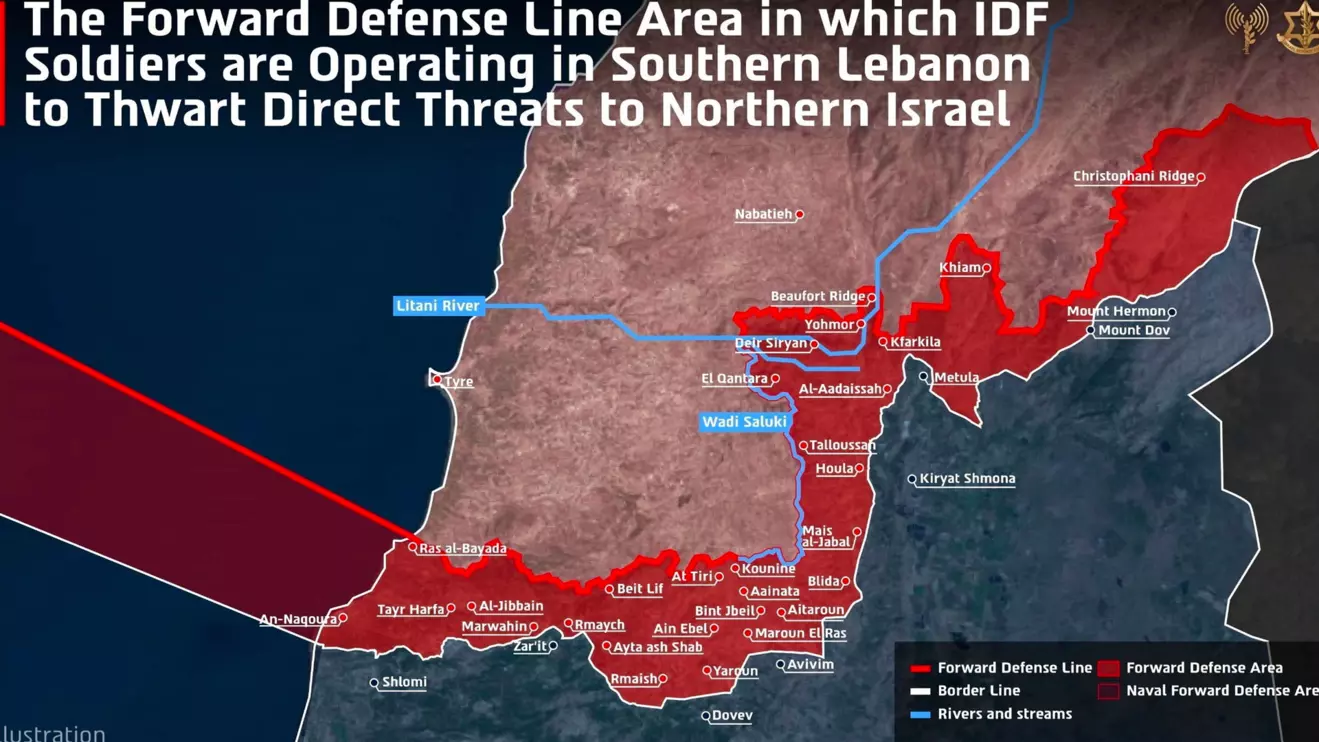
The Israeli military published for the first time a map of its new deployment line inside Lebanon on Sunday, bringing dozens of mostly abandoned Lebanese villages under its control, days after a ceasefire with Hezbollah took effect.
There was no immediate comment from Lebanese officials or from Iran-backed Hezbollah. Israel and Lebanon agreed on Thursday to a U.S.-backed ceasefire in fighting between Israel and Hezbollah.
The deal, which followed the first direct talks in decades between Israel and Lebanon on April 14, is meant to enable broader U.S.-Iran negotiations but with Israeli forces maintaining positions deep inside southern Lebanon.
Stretching east to west, the deployment line on the map runs 5-10 km deep from the border into Lebanese territory, where Israel has said that it plans to create a so-called buffer zone.
Israeli forces have destroyed Lebanese villages in the area, saying their aim is to protect northern Israeli towns from Hezbollah attacks. It has created buffer zones in Syria and in Gaza, where it controls more than half the enclave.
"Five divisions, alongside Israeli Navy forces, are operating simultaneously south of the forward defence line in southern Lebanon in order to dismantle Hezbollah terror infrastructure sites and to prevent direct threats to communities in northern Israel," the military said in a statement accompanying the map.
Asked whether people who fled the Israeli strikes would be allowed to return to their homes, the Israeli military declined to comment.
Lebanese civilians have been able to access some of the villages that fall on or beyond the Israeli-set line, but Israeli forces still prevent people from accessing most of those south of the line, a Lebanese security source said.
Israeli Defence Minister Israel Katz said on Sunday that homes on the border exploited by Hezbollah would be demolished and that "any structure threatening our soldiers and any road suspected of (being planted with) explosives must be immediately destroyed".
Lebanon was dragged into the war on March 2, when Hezbollah opened fire in support of Tehran, prompting an Israeli offensive that has killed more than 2,100 people, including 177 children, and forced more than 1.2 million to flee, Lebanese authorities say.
Hezbollah has not disclosed its casualty figures. At least 400 of its fighters had been killed by the end of March, according to sources close to the group.
Hezbollah has fired hundreds of rockets and drones at Israel. Its attacks killed two civilians in Israel while 15 Israeli soldiers have died in Lebanon since March 2, Israel says.