Nationalist Prime Minister Albin Kurti’s party won more than half of the votes in Sunday's election, opening the way to create a new government after a year-long political deadlock that has paralysed parliament and delayed key international funding.
The vote is the second this year in Kosovo after Kurti's Vetevendosje party fell short of a majority in February. Months of failed coalition talks prompted President Vjosa Osmani to dissolve parliament in November and call an early election.
Kurti's party was leading with 50.2% of Sunday's vote, with 87% of votes counted after polls closed at 7 p.m. (1800 GMT). Analysts say it is difficult to predict if Kurti will be able to form the government on its own without a coalition to secure the 61 seats in the 120-seat assembly.
"The results are not final and I don't see how Kurti will form the government alone but it will be very easy for him to govern with a small coalition," said Ismet Kryeziu from the Kosovo Democratic Institute think tank.
Kryeziu said Kurti needs few votes from Albanian or minority parties to form the new cabinet.
The two main opposition parties, the Democratic Party and the Democratic League, were at 20.7% and at 14%, respectively.
“The will of the citizens is now in the ballot boxes. Preserving this will is essential for the legitimacy and credibility of the electoral process," Kurti said on a video message after exit polls were published.
Another failure to form a government and reopen parliament would prolong the crisis at a critical time. Lawmakers must elect a new president in April and ratify 1 billion euros ($1.2 billion) in loan agreements from the European Union and World Bank that expire in the coming months.
The Balkan country's opposition parties have refused to govern with Kurti, criticising his handling of ties with Western allies and his approach to Kosovo's ethnically divided north, where a Serb minority lives. Kurti blames the opposition for the impasse.
In a bid to woo voters, Kurti has pledged an additional month of salary per year for public sector workers, 1 billion euros per year in capital investment and a new prosecution unit to fight organised crime. Opposition parties have also focused on improving living standards - a leading concern for voters.
"We want the next government to create conditions for the youth to stay here and not leave," one voter, 58-year-old Rexhep Karakashi, told Reuters in the capital, Pristina.
Opinion polls were not published in Kosovo, but some seen by Reuters before the vote had favored Kurti. Some voters said they did not expect the vote to bring significant change.
"There wouldn't be great joy if Kurti wins, nor would there be if the opposition wins. This country needs drastic changes, and I don't see that change coming," said Edi Krasiqi, a doctor.
KURTI URGED PEOPLE TO VOTE
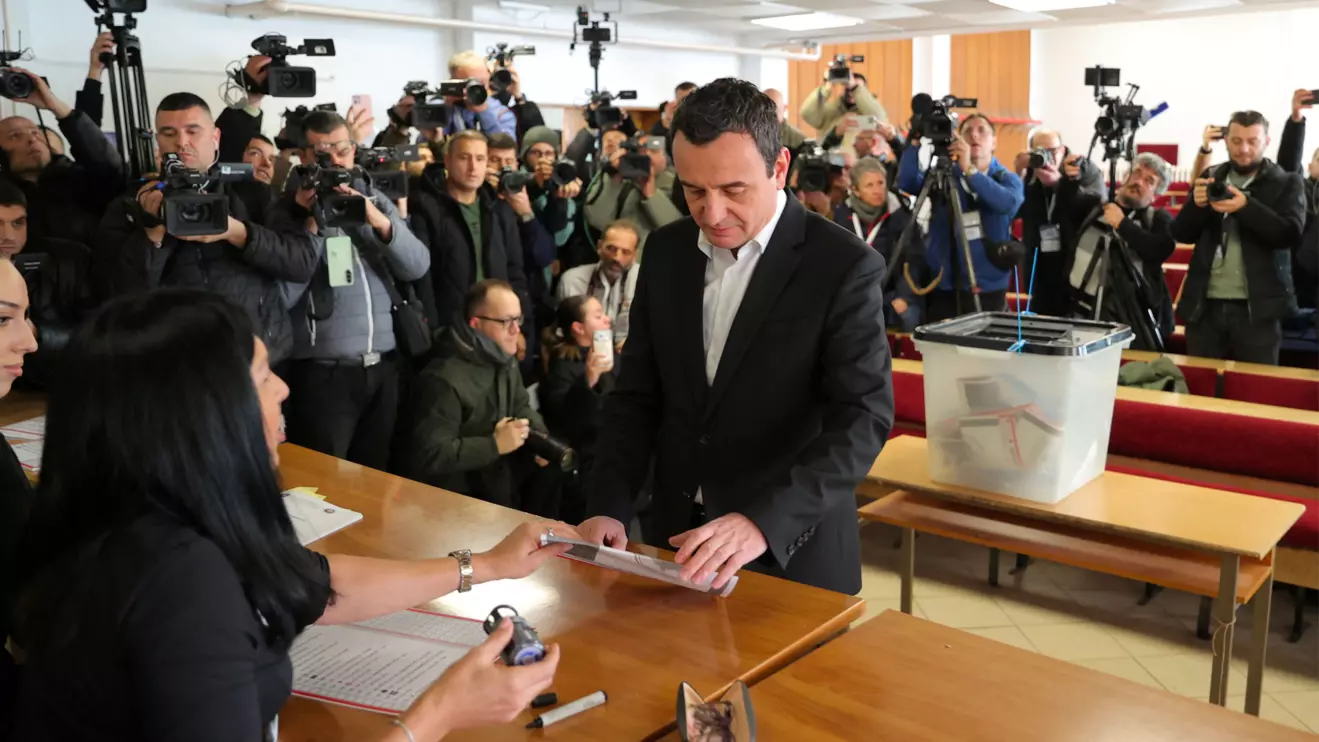
After casting his ballot in Pristina, Kurti urged people to vote, saying higher turnout would bolster parliament's legitimacy.
"Once the election result is known, we will do everything we know and can to constitute the parliament as soon as possible and to proceed with a new government," he said.
Turnout was 45%, according to the results.
Kosovo declared independence from Serbia in 2008 with U.S. backing, including a 1999 NATO bombing campaign against Serbian forces trying to crush an uprising by the 90% ethnic Albanian majority.
Despite international support, the country of 1.6 million has struggled with poverty, instability and organised crime. Kurti's tenure, which began in 2021, was the first time a Pristina government completed a full term.
Tensions with Serbia flared in 2023, prompting the EU to impose sanctions on Kosovo. The bloc said this month it would lift them after ethnic Serb mayors were elected in northern municipalities, but the measures likely cost Kosovo hundreds of millions of euros.
($1 = 0.8495 euros)
By Fatos Bytyci and Edward McAllister