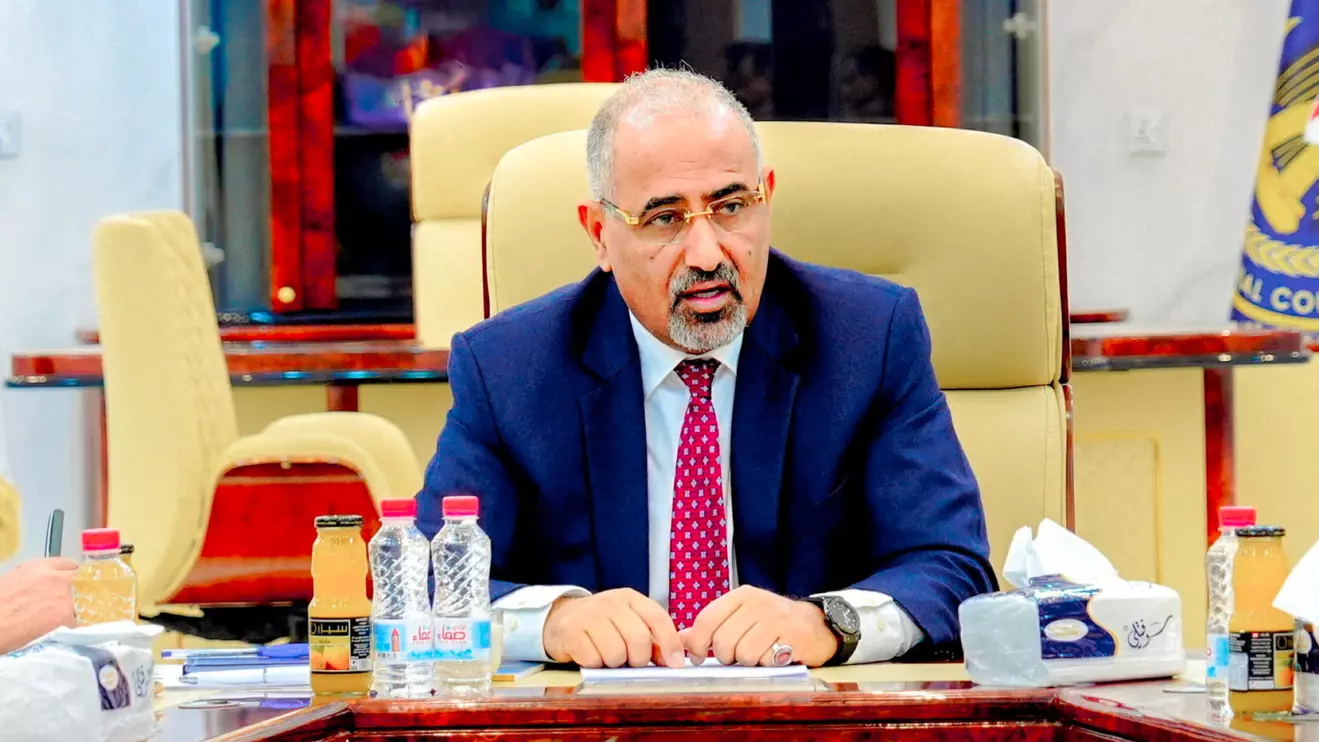
Yemeni separatist leader Aidarous al-Zubaidi, who took up arms early in life and never shied away from joining conflicts, shows no signs of abandoning his dream of creating an independent state in the south.
Zubaidi, the leader of Yemen's Southern Transitional Council, failed to board a flight to Saudi Arabia on Wednesday for talks on ending a military escalation that saw his forces sweep towards the Saudi border last month.
His no-show added to deep uncertainty in Yemen, ravaged by more than 10 years of civil war and now caught in a deepening feud between Saudi Arabia and the United Arab Emirates, the most powerful countries in the region and both close allies of the United States.
Yemen's Saudi-backed presidential council expelled Zubaidi and accused him of treason.
The crisis erupted last month, when STC forces suddenly seized swathes of territory, shifting the delicate balance of power and putting Saudi Arabia and the UAE on opposite sides of the conflict.
HARDLINER ON INDEPENDENCE FOR SOUTH
Born in 1967 in Al Dhalea province, in southern Yemen, a region known for agriculture and widely-used narcotic leaf qat, he became an officer in the military forces of South Yemen, which was unified with the North in 1990 after 23 years as separate states.
Known for his hardline stance on the independence of the south, Zubaidi often returned to his native region to regroup after setbacks. Now, he appears ready to take on Saudi Arabia to achieve his goals even as Saudi-backed Yemeni government forces advance towards Aden.
Zubaidi fought in the civil war in the summer of 1994 that ended with the defeat of southern forces, an outcome that led him to set up his own armed group in Dhalea calling for self-determination.
After civil war erupted again 20 years later, when the Houthis ousted the Saudi-backed, internationally recognised government of then-president Abd Rabbu Mansour Hadi and took the capital Sanaa, Zubaidi led efforts to oust the Iran-aligned group from Dhalea.
He was appointed governor of the restive southern port city of Aden in 2016, surviving an assassination attempt claimed by the Islamic State before being fired from the post in April 2017 after tensions emerged with Hadi's government.
A month later, the STC was founded with backing from the UAE, initially part of the Sunni Muslim Saudi-led alliance against the Houthis.
While joining the fight against the Houthis, whom he labelled "the biggest threat" in an interview with Reuters at Davos in 2025, he never lost focus on the separatist fight for the south.
Zubaidi last week called for a referendum on independence from the north in two years, the clearest indication yet of the STC's intention to secede and a further escalation in the unfolding crisis, which has added to Yemen's woes after more than 10 years of civil war that created one of the world's worst humanitarian crises.