Lebanon's most embarrassing billboard problem just got fixed

1 min Antoine Khoury

Lebanon's Interior Minister Ahmad Hajjar ordered Thursday the removal of pro-Iran banners that had been displayed along the road leading to Beirut's international airport, the country's most visible gateway to the world.

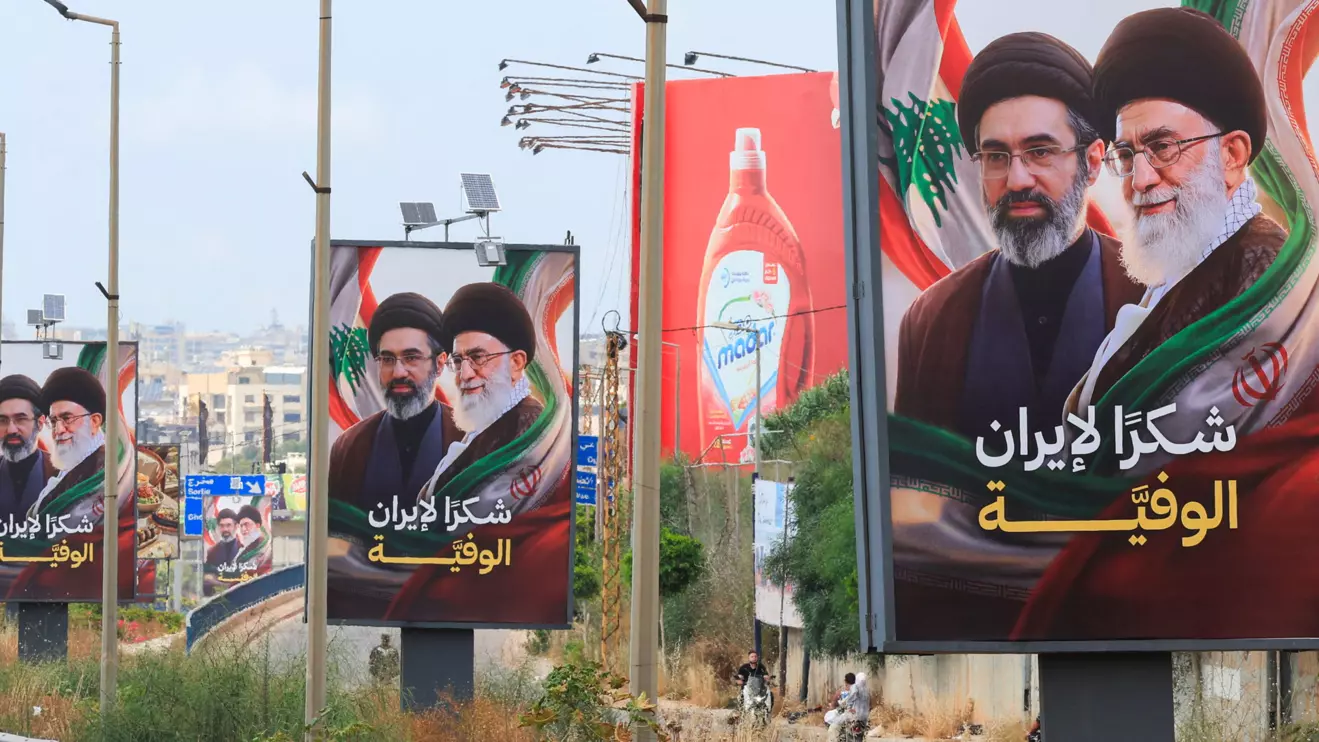
Billboards showing Iran’s new Supreme Leader Ayatollah Mojtaba Khamenei and his late father Ali Khamenei, with the slogan “Thank you to loyal Iran,” stand along the highway leading to Rafic Hariri International Airport in Beirut, Lebanon June 22, 2026.Reuters/Mohamed Azakir

Billboards showing Iran’s new Supreme Leader Ayatollah Mojtaba Khamenei and his late father Ali Khamenei, with the slogan “Thank you to loyal Iran,” stand along the highway leading to Rafic Hariri International Airport in Beirut, Lebanon June 22, 2026.Reuters/Mohamed Azakir

Lebanon's Interior Minister Ahmad Hajjar ordered Thursday the removal of pro-Iran banners that had been displayed along the road leading to Beirut's international airport, the country's most visible gateway to the world.

The posters, featuring Iran's Supreme Leader Mojtaba Khamenei and his late father Ali Khamenei alongside the slogan "Thank You Loyal Iran," appeared in the days following the announcement of a ceasefire between Israel and Hezbollah, a deal negotiated between Iran and the United States, without Lebanon at the table.

The airport road has long served as an ideological billboard for Hezbollah and its ally Amal. In 2022, Lebanon's Tourism Ministry was forced to ask both groups to replace their partisan signage with tourism advertisements, a request that illustrated, with painful clarity, who actually controls public space in that part of Beirut.

The appearance of banners thanking Iran on Lebanon's most internationally visible artery, celebrating a deal the Lebanese government did not negotiate, is not an accident. It is a statement, Tehran’s way of reminding the world, and the Lebanese themselves, who holds real power in the country.

Minister Hajjar framed his order in bureaucratic terms,  »organising public space and ensuring the application of laws and regulations." But the reality is starker: the Lebanese state is still fighting, street by street and billboard by billboard, to assert authority over its own territory.

Antoine Khoury

Antoine Khoury

Antoine Khoury is based in Beirut and has been reporting for Mena Today for the past year. He covers news from Lebanon, Syria, Jordan, and Turkey, and is widely regarded as one of the region’s leading experts

Related

Israel

Netanyahu left out in the cold

The biggest casualty of the U.S.-Iran deal may not be Israel's Iran strategy, but the political brand Benjamin Netanyahu spent decades building as the Israeli leader who could uniquely bend Washington to his will on Iran, analysts, former U.S. officials and diplomats say.

Lebanon

Israel and Lebanon push back on U.S. statement

Senior Israeli and Lebanese officials denied on Thursday that there had been any Israeli withdrawal from occupied southern Lebanon, after a U.S. official said Israel had pulled some troops back in a good faith gesture toward Lebanon's government.

Bahrain

U.S. seeks Bahraini support for Iran deal

U.S. Secretary of State Marco Rubio will meet with Bahrain officials on Thursday on the final leg of a trip to the Middle East where he has sought to sell the Trump administration's preliminary Iran accord to skeptical Gulf Arab allies. 

Subscribe to our newsletter

Mena banner 4

To make this website run properly and to improve your experience, we use cookies. For more detailed information, please check our Cookie Policy.

  • Necessary cookies enable core functionality. The website cannot function properly without these cookies, and can only be disabled by changing your browser preferences.