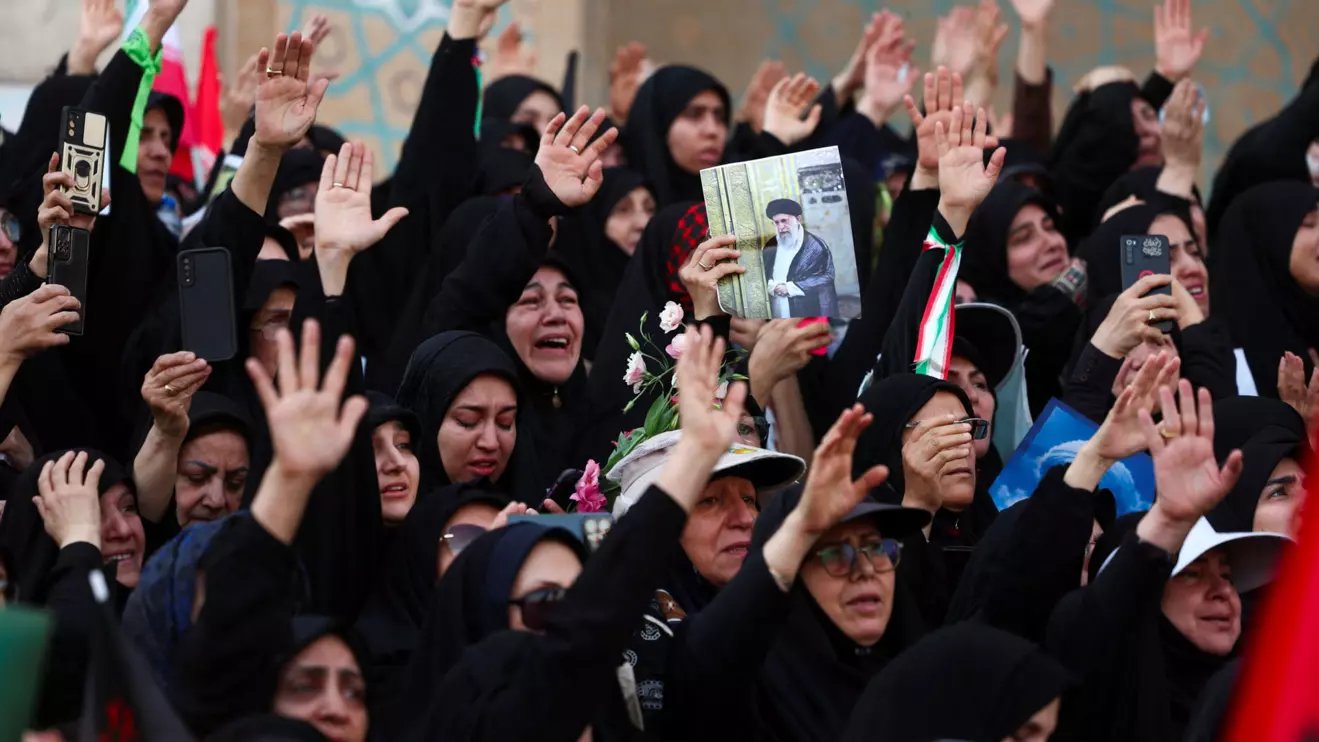
Tens of thousands filled Tehran's Imam Khomeini Grand Mosalla on Saturday to view the coffins of Supreme Leader Ali Khamenei and family members killed alongside him in the February airstrikes that opened the US-Israeli war on Iran.
Mourners in black beat their chests, waved Islamic Republic banners and chanted "Death to America" as a compere encouraged the crowds through loudspeakers to "let us wail."
The Islamic Republic wants the world to see this as a spontaneous outpouring of grief from a united nation. Let us not be fooled.
What the regime's cameras are carefully framing is a performance, not a reflection of Iranian public sentiment. The crowds filling the prayer complex represent, at most, the 15% of the Iranian population that genuinely supports the theocratic state, the true believers, the Revolutionary Guard families, the beneficiaries of the system.
The rest of those filling the venue? Bussed in from other regions, their transport paid for, their attendance essentially compelled by a regime that understands perfectly well that empty streets would tell a very different story.
This is the oldest trick in the authoritarian playbook: manufacture the appearance of popular legitimacy through logistics, not genuine sentiment.
What Most Iranians Actually Feel
The vast majority of the Iranian people are not mourning Ali Khamenei. They are not weeping for the man who presided over four decades of systematic repression, the execution of thousands of political prisoners, the violent crushing of the 2009 Green Movement, the 2019 crackdown that killed hundreds of protesters in the streets, the imprisonment and torture of women who simply refused to wear the hijab, the shooting down of Ukraine International Airlines Flight 752 and the subsequent lies to grieving families.
Khamenei's Iran was a country where Nobel Peace Prize laureates were jailed, where journalists disappeared, where young women died in police custody for the crime of living freely. The people who suffered under his rule are not in the streets of Tehran today wailing for his loss.
A Regime Performing Strength It No Longer Has
The funeral spectacle serves a clear political purpose: to project the image of an Islamic Republic that remains strong, united and defiant in the face of military defeat.
But the reality is that Iran has just lost its supreme leader, its military infrastructure has been devastated by Israeli and American strikes, its economy is in ruins, its nuclear programme has been set back years, and its new leader Mojtaba Khamenei has not been seen publicly since the attack, reportedly injured, his whereabouts and condition unknown.
A regime that needs to bus people in to fill its mourning squares is not a regime overflowing with popular support. It is a regime staging its own survival.
The chants of "Death to America" echo through the Mosalla.
But behind closed doors across Iran, in millions of homes the cameras never enter, the mood is very different, and the Islamic Republic knows it.