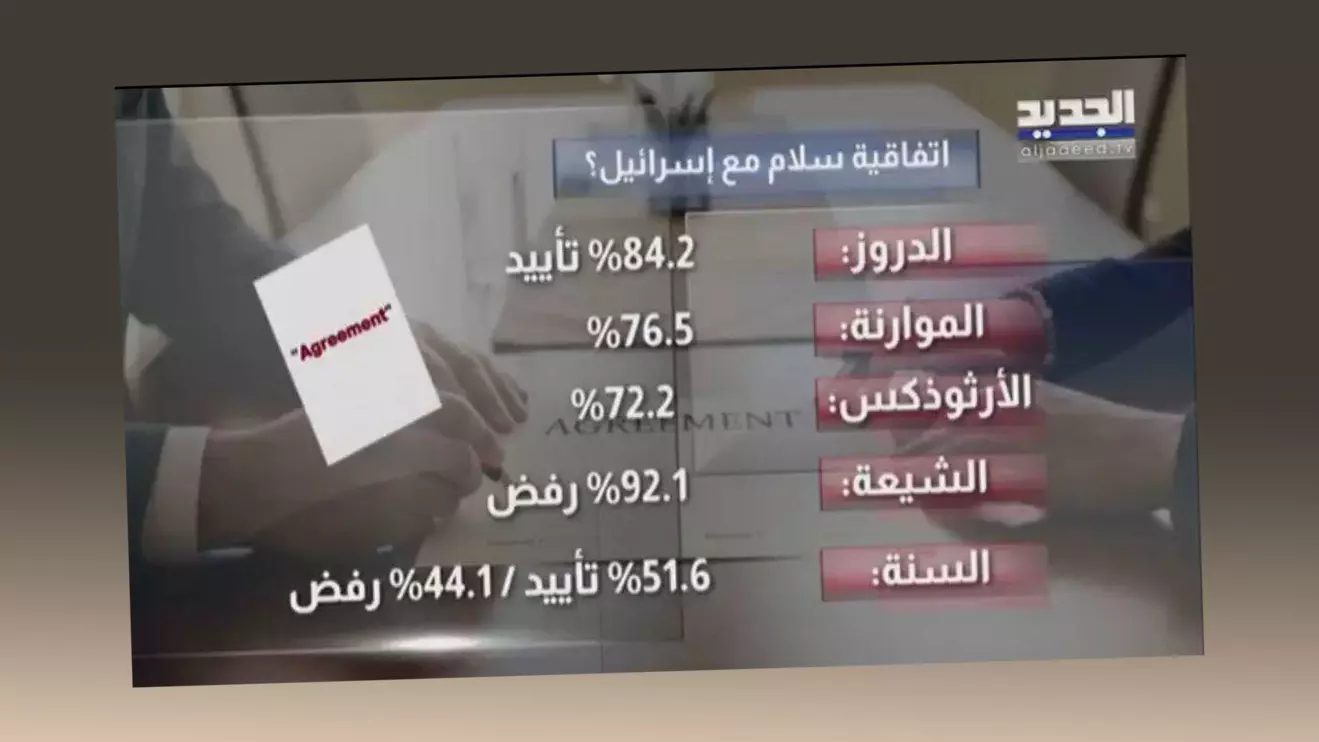
A new poll conducted between April 28 and May 5 reveals a striking picture of Lebanese public opinion on a potential peace agreement with Israel: across most of the country's major religious communities, support is either strong or majority, with one dramatic exception.
The Druze lead the way, with 84.2% in favour of a peace deal. Maronite Christians follow at 76.5%, with Orthodox Christians close behind at 72.2%. Even among Sunni Muslims, historically more cautious on the question, a narrow majority of 51.6% support an agreement, against 44.1% opposed.
Then there is the Shia community. A striking 92.1% oppose any peace deal with Israel, a figure that reflects Hezbollah's iron grip on Shia political identity and its foundational opposition to any normalisation with the Jewish state.
What the numbers mean
The poll tells two stories simultaneously. The first is quietly remarkable: across Lebanon's diverse sectarian landscape, a clear majority of the population appears ready to contemplate peace with Israel, a position that would have been politically unthinkable just a few years ago.
The war, the destruction, and the growing perception that Hezbollah's "resistance" has brought Lebanon nothing but ruin appear to have shifted the calculus for many Lebanese.
The second story is the obstacle: as long as Hezbollah remains armed and politically dominant within the Shia community, which represents a substantial share of Lebanon's population, any formal peace process faces a structural veto that no electoral majority can easily override.
Prime Minister Nawaf Salam has already signalled his government's willingness to pursue direct negotiations with Israel. The poll suggests he has broader popular backing than the political noise might suggest. But in Lebanon, majorities do not always translate into outcomes, and 92.1% Shia opposition, backed by weapons, carries a weight that polling numbers alone cannot capture.
Peace in Lebanon has a majority. It does not yet have a path.