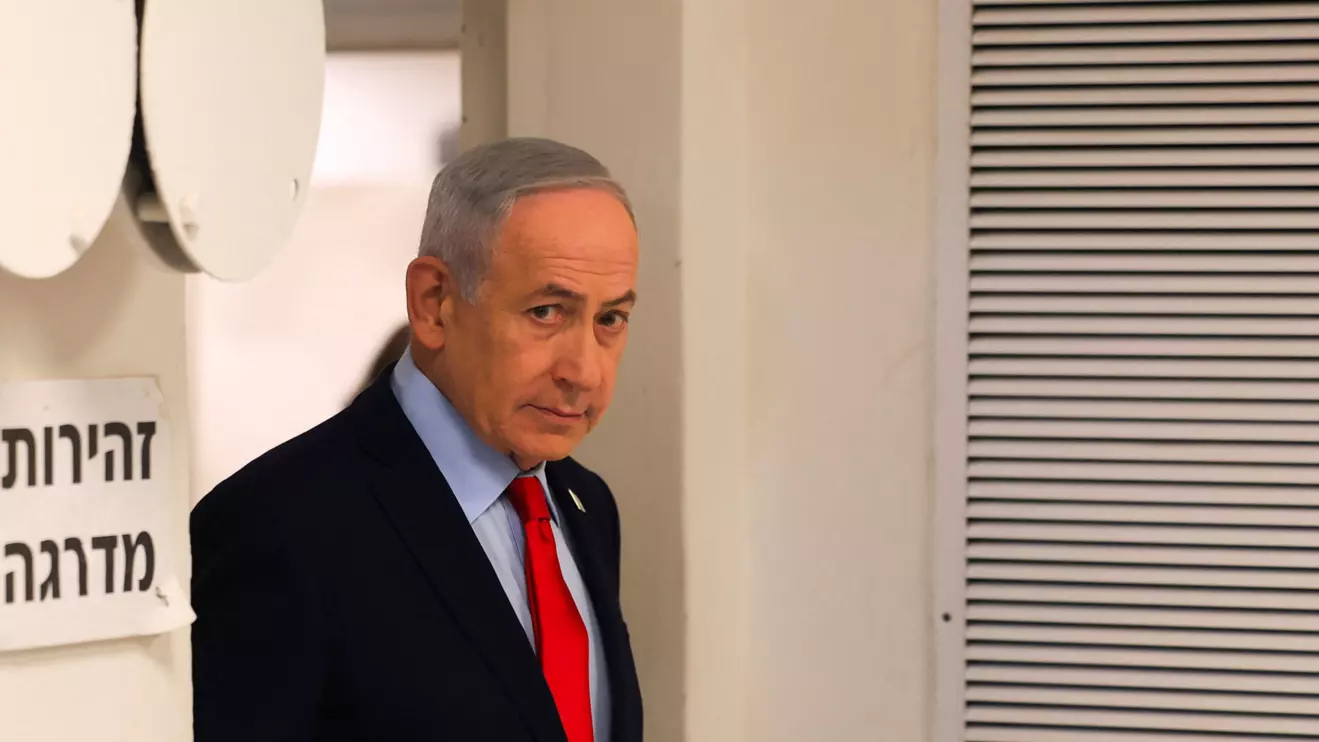
Prime Minister Benjamin Netanyahu said on Thursday he believes pipelines should be built to transport Middle East oil and gas across the Arabian Peninsula and up to Israeli ports to avoid threats by Iran in the Hormuz Strait and other Gulf waters.
A day after Israel attacked Iran's main gas field in a sharp escalation of the U.S.-Israeli war on Iran, Netanyahu told a press conference that Tehran no longer has the capacity to enrich uranium, a claim that has been contested by the U.N.'s nuclear watchdog.
Netanyahu sought during the 45-minute event to defend his country's military operations even as its attacks on Iran's South Pars field inspired tit-for-tat strikes on energy plants across the Gulf, sending energy prices spiralling.
NETANYAHU SAYS TRUMP ASKED HIM TO HALT FUTURE GAS ATTACKS
Asked by a reporter about the South Pars attack, Netanyahu said that Israel had acted alone. "President Trump asked us to hold off on future attacks," he said.
Trump, politically vulnerable to rising fuel prices among his core voters, has lashed out at allies who have responded cautiously to his demands that they help secure the Strait of Hormuz, the conduit for around a fifth of the world's oil.
Netanyahu said that he believed alternative routes to Hormuz would need to be found, appearing to point to a potential benefit for Israel from a prolonged closure of the choke point.
"Just have oil pipelines, gas pipelines, going west through the Arabian Peninsula, right up to Israel, right up to our Mediterranean ports and you've just done away with the choke points forever," Netanyahu said.
"I see that as a real change that will follow this war."
IRAN NO LONGER CAN ENRICH URANIUM, NETANYAHU SAYS
The U.S. and Israel launched their war on Iran on February 28, following months of talks primarily over Tehran's nuclear program that failed to yield an agreement.
Netanyahu told the press conference that after 20 days of war, "Iran today does not have the ability to enrich uranium and no possibility to produce missiles." He did not provide evidence for either claim.
The head of the International Atomic Energy Agency, Rafael Grossi, told CBS News on Thursday that "a lot has survived" of Iran's nuclear enrichment capacity.
"They have the capabilities, they have the knowledge, they have the industrial ability to do that," Grossi said.
Netanyahu did not comment on Tehran's stockpile of highly enriched uranium, believed to be buried under Iran's nuclear site in Isfahan following U.S. strikes in June.
Israel and Gulf countries have come under heavy Iranian missile and drone attacks since the start of the war.
"We are not only acting to destroy the remaining ballistic missiles and what is left of the nuclear programme - very little remains - but also to destroy the industries that enable the production of these programmes," Netanyahu said.
'GROUND COMPONENT' POSSIBLE IN IRAN FIGHTING
Despite the nearly three-week war, it was still too soon to tell whether Iranians would take to the streets to try to overthrow their government, Netanyahu said.
"It's up to the Iranian people to show that, to choose the moment and to rise to the moment," he said.
Netanyahu said that overthrowing the government would not be possible with air strikes alone, and suggested there might be potential action on the ground.
"There has to be a ground component as well. There are many possibilities for this ground component, and I take the liberty of not sharing with you all those possibilities," Netanyahu said.
By Maayan Lubell and Steven Scheer