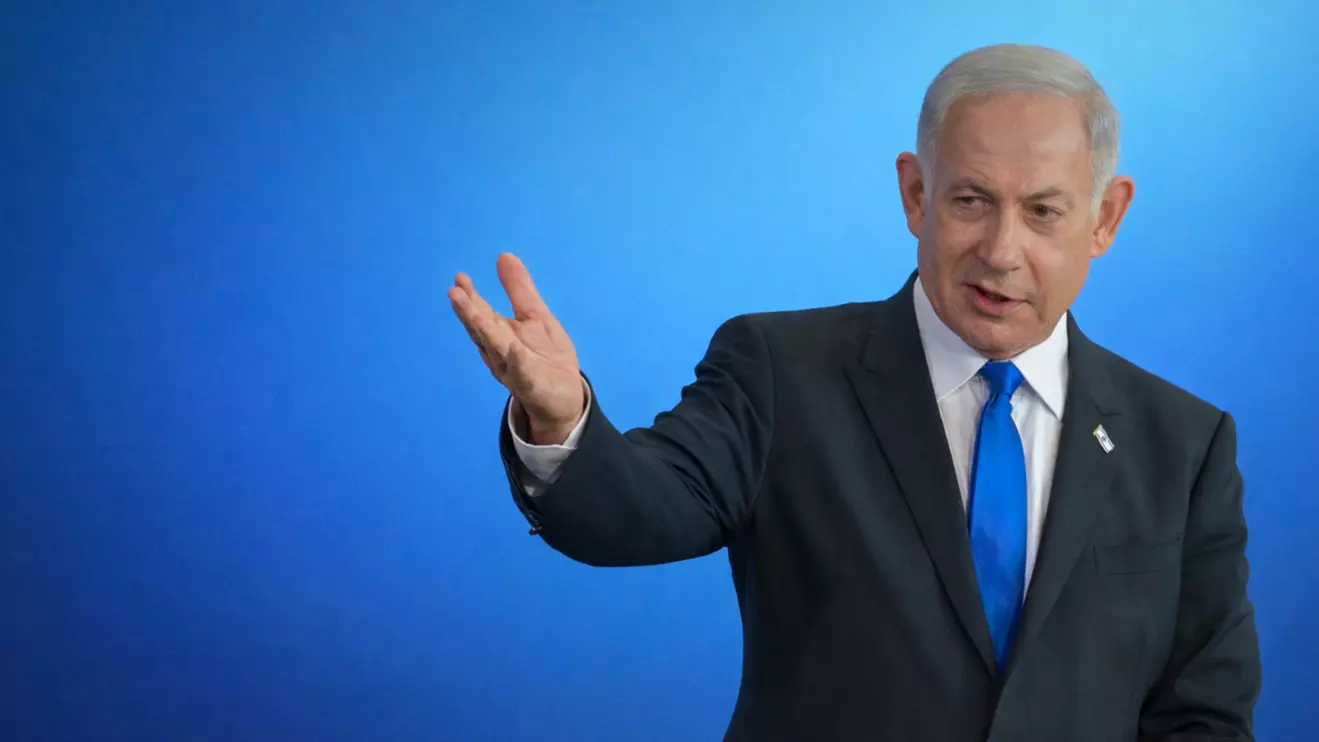
In his first press conference since the outbreak of war against Iran, Israeli Prime Minister Benjamin Netanyahu laid out Thursday, on day 13 of the joint US-Israel offensive, a bold and explicit three-part war agenda that goes far beyond military strikes.
The first two goals are military: destroying Iran's capacity to build a nuclear weapon and eliminating its ballistic missile capabilities. But it is the third objective that sent shockwaves across the region.
"I have added a third objective, to create the means for the Iranian people to bring down this regime," Netanyahu declared, becoming the first Israeli leader to openly state regime change in Tehran as an official war aim.
On Mojtaba Khamenei, whose first official statement was read Thursday by an Iranian television presenter, Netanyahu was withering: "We eliminated the old tyrant. The new tyrant, a puppet of the Revolutionary Guards, cannot show his face in public."
Asked whether Mojtaba Khamenei and Hezbollah chief Naim Kassem could expect to survive the conflict, Netanyahu's answer was ice-cold: "I would not take out life insurance on Khamenei and Kassem."
A Warning to Lebanon
Netanyahu delivered a pointed ultimatum to the Lebanese government: "You are playing with fire if you let Hezbollah operate."
He made the choice stark: "If they don't deal with Hezbollah, we will. How, on the ground or otherwise, I won't specify. But Hezbollah will pay a heavy price. It would be better if the Lebanese government handled it."
"We are living historic days for the State of Israel," Netanyahu declared, asserting that Israel was "crushing Iran and Hezbollah" and that both now posed significantly diminished threats compared to before the offensive.
He confirmed daily conversations with President Donald Trump, describing their exchanges as "free and open », signaling tight coordination between Washington and Jerusalem as the war enters its third week.