Iran
Trump downplays duration of renewed Iran strikes
President Donald Trump said on Wednesday that the renewed U.S. campaign against Iran would not continue for "too long" after the biggest exchange of fire between Tehran and Washington since July.

Iran and the United States remain at loggerheads over efforts to agree a permanent end to the war in the Gulf, according to a senior Iranian source who said there had been no progress in talks to revive the interim deal agreed in June and define a timeframe to implement it.
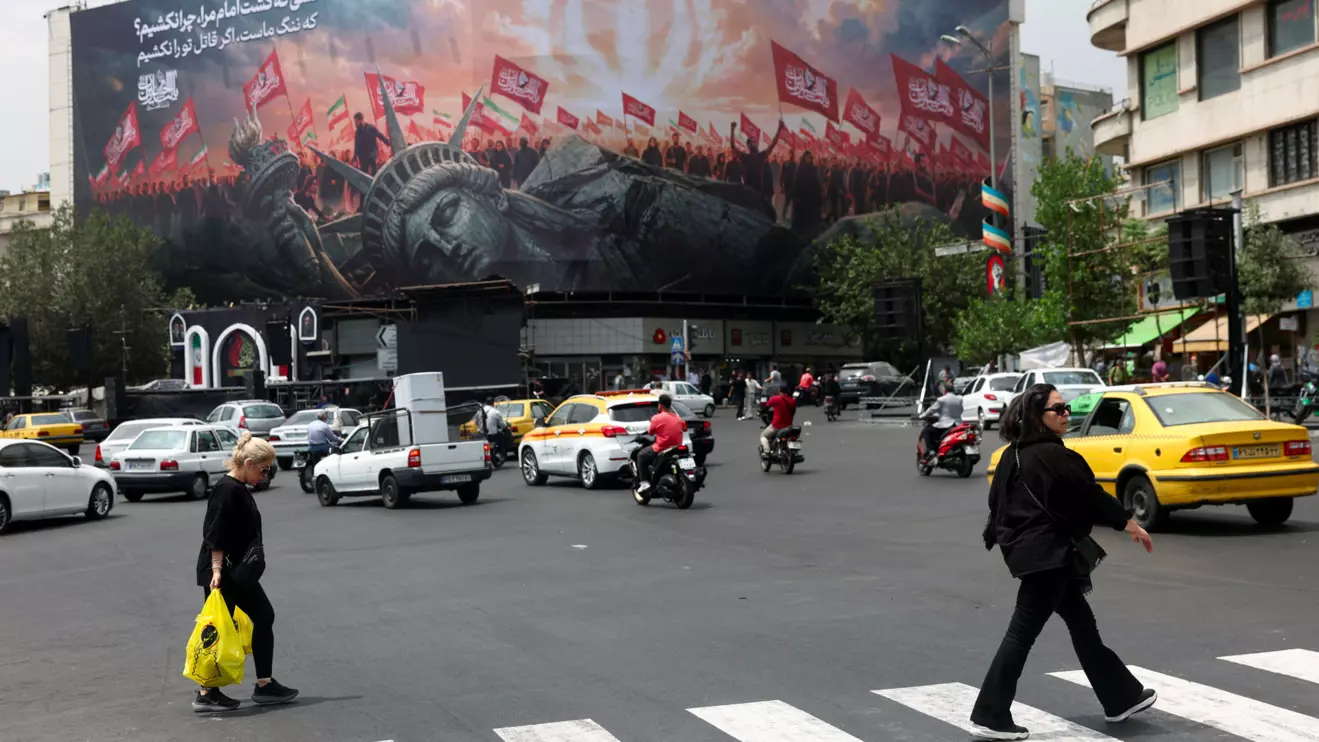
People walk past an anti-U.S. billboard on a street in Tehran, Iran, August 3, 2026. Majid Asgaripour/WANA (West Asia News Agency) via Reuters
Iran and the United States remain at loggerheads over efforts to agree a permanent end to the war in the Gulf, according to a senior Iranian source who said there had been no progress in talks to revive the interim deal agreed in June and define a timeframe to implement it.
The comments were a further blow to hopes of a swift resolution to the crisis, following attacks on shipping in the region on Tuesday that pushed oil prices higher.
The deal agreed in June declared an "immediate and permanent termination of military operations on all fronts", but quickly unravelled, with U.S. President Donald Trump saying it was "over" on July 7 and Iran's foreign ministry declaring it "suspended" a week later.
The U.S. accuses Iran of failing to honour an agreement under the deal to reopen the vital Strait of Hormuz shipping route. Tehran says Washington has reneged on its commitments, including lifting a blockade of Iranian ports and releasing frozen Iranian assets.
"One of the issues that is being discussed via mediators is the U.S. returning to the interim agreement and defining a timeframe for implementing the commitments. There has been absolutely no progress on this issue," the Iranian source said.
There was no immediate comment from Washington.
Thousands of people have been killed in the conflict, mainly in Iran and Lebanon, since the U.S. and Israel launched attacks on Iran on February 28.
Iran has struck U.S. assets and infrastructure in countries including Oman, Jordan, Kuwait, Israel, the United Arab Emirates and Saudi Arabia.
BOTH SIDES STEP UP RHETORIC
The June interim ceasefire agreement set a 60-day period, extendable by mutual consent, within which Iran and the U.S. were expected to reach a final deal limiting Tehran's nuclear programme and lifting U.S. sanctions.
The Iranian source dismissed a report on Wednesday from Turkey's Anadolu news agency that quoted Pakistani government sources as saying they had agreed to extend that 60-day period.
"There is no talk of an extension because, from Iran’s perspective, there is no period that began and therefore nothing to extend. The United States violated the interim agreement 48 hours after it was reached and withdrew from it a few days later," the source told Reuters.
Both Iran and the United States have stepped up rhetoric in the past two days.
Iran's top security official, Mohsen Rezaei, said on Tuesday that the Strait of Hormuz would remain closed unless the U.S. accepted Iran's conditions to end the war.
That followed a new demand from Trump on Monday that Iran should pay compensation for people killed in 50 years of wars, attacks and protests.
Throughout the conflict, Trump has alternated between threats of escalation and claims that a peace deal is imminent.
Speaking to reporters after a visit to Ohio on Tuesday, Trump said: "Iran is going fine, going just absolutely fine."
"We have a country that has been the bully of the Middle East for 50 years, really 51 if you think about it ... and they're no longer the bully of the Middle East."
ATTACKS ON SHIPPING
The Strait of Hormuz, a narrow waterway between Iran and Oman and the entrance to the Gulf, handled a fifth of global oil and liquefied natural gas flow before the war.
Benchmark Brent crude futures have surged since the start of the war in February, hitting a peak of $126 a barrel, roughly 75% above pre-war levels, with choppy trade reflecting concerns over disruptions to Gulf oil supplies and shifting signals on peace talks.
Those concerns were compounded by separate attacks on shipping on Tuesday.
At the southern end of the Red Sea, four crew members were killed in an attack by Iran-backed Houthis on a small cargo ship in the Bab el-Mandeb Strait on Tuesday, the first deadly strike on shipping by the group since the start of the war.
The U.S. military, meanwhile, said a U.S. Navy MH-60 helicopter fired two Hellfire missiles to disable the steering gear of a Panama-flagged cargo ship.
The ship ignored repeated warnings to stop violating a naval blockade on Iranian ports, the U.S. Central Command said. Maritime sources told Reuters the vessel was hit off Pakistan while sailing into the Gulf of Oman.
Brent futures rose 35 cents, or 0.4%, to $89.26 a barrel on Wednesday, heading for a sixth day of gains.
By Parisa Hafezi and Elwely Elwelly
President Donald Trump said on Wednesday that the renewed U.S. campaign against Iran would not continue for "too long" after the biggest exchange of fire between Tehran and Washington since July.
Top aides to President Donald Trump are pushing to keep the Iran war from escalating before November's midterm elections to staunch Republican electoral losses, four people familiar with the discussions said, a strategy already under strain as the U.S. and Iran exchanged back-and-forth attacks overnight.
Russia has secretly helped Iran develop advanced supersonic cruise missiles, in what the Financial Times describes as one of the most significant known transfers of strategic military technology from Moscow to Tehran, according to an investigation published Wednesday.
To make this website run properly and to improve your experience, we use cookies. For more detailed information, please check our Cookie Policy.
Necessary cookies enable core functionality. The website cannot function properly without these cookies, and can only be disabled by changing your browser preferences.