
Jordan
Jordanian army foils armed incursion from Syria
Jordanian border guards stopped a group of 14 armed individuals attempting to cross into the country from Syria, state news agency Petra quoted the armed forces as saying on Saturday.

King Abdullah II of Jordan delivered a sharp warning to Israel on Monday, telling parliament that there can be no security in the region without respect for Palestinian rights.
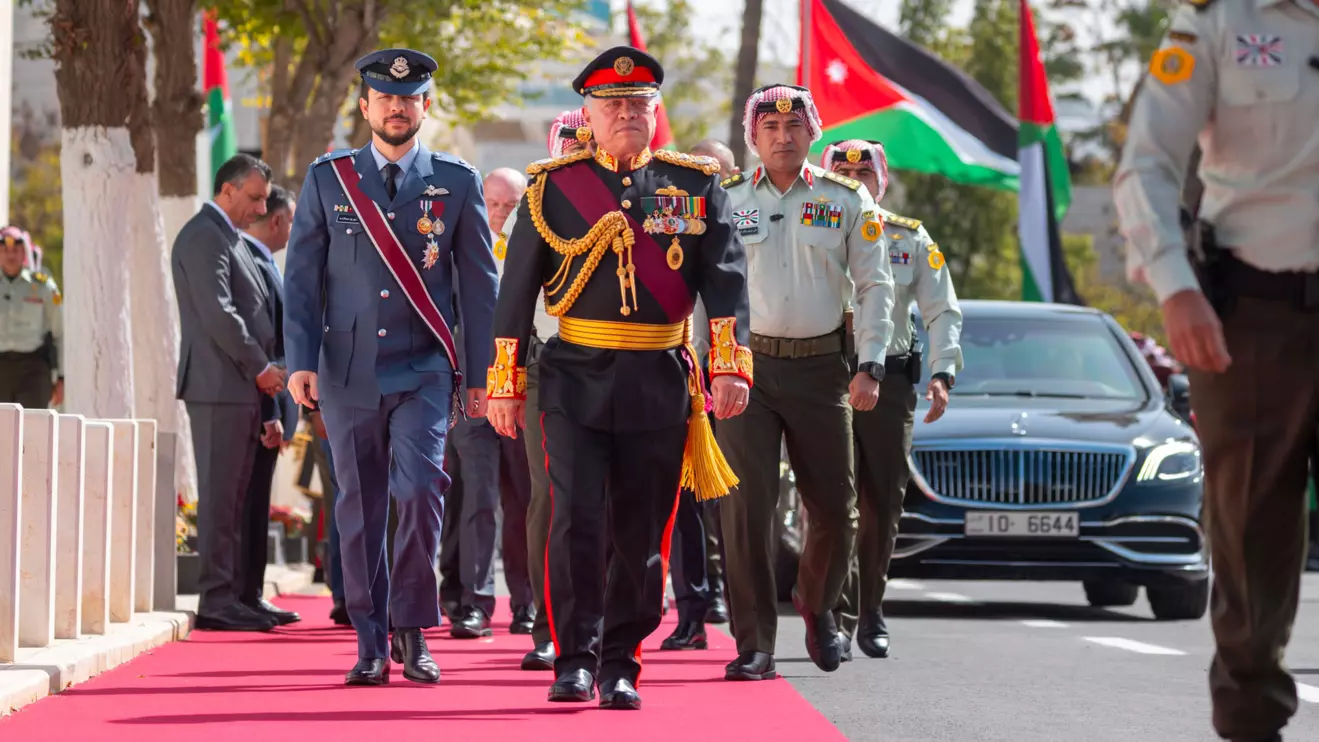
Jordan’s King Abdullah II on Monday at the opening of the third ordinary session of the Parliament © The Royal Hashemite Court
King Abdullah II of Jordan delivered a sharp warning to Israel on Monday, telling parliament that there can be no security in the region without respect for Palestinian rights.
Behind the message lies a domestic reality few Jordanian leaders can ignore: a majority of the kingdom’s population is of Palestinian origin.
“There can be neither security nor stability in our region without respect for the right of the Palestinian people to their land,” the king said. “Israel’s expansionist ambitions remain the greatest threat to the future and hopes of the region.”
Despite international calls, he added, the humanitarian catastrophe continues in Gaza, alongside relentless attacks in Jerusalem and the West Bank.
The speech came days after Israel’s general election, in which Benjamin Netanyahu’s Likud finished first but without a majority, and as Israel announced the end of a 10-day military operation in Hebron that displaced more than 3,000 Palestinians. The army entered the West Bank’s largest city after a deadly attack on a nearby checkpoint killed two soldiers.
Jordan, which borders both Israel and the West Bank, signed a peace treaty with Israel in 1994 and has long championed a two-state solution.
Abdullah’s words are aimed as much at his own people as at Israel. More than half of Jordan’s population, by some estimates over 60%, is of Palestinian origin, descendants of refugees who fled or were expelled during the wars of 1948 and 1967. Jordan also hosts some of the largest Palestinian refugee camps in the region.
That demographic weight makes the Palestinian question a domestic issue in Amman, not just a foreign policy file. Every escalation in Gaza or the West Bank reverberates on Jordanian streets, and anger can quickly turn against the monarchy if it appears too accommodating toward Israel.
The shadow of Black September
The royal palace has not forgotten the lessons of history. In September 1970, armed Palestinian factions challenged the authority of King Hussein, Abdullah’s father, triggering a bloody confrontation with the Jordanian army. The fighting, known as Black September, ended with the expulsion of the Palestine Liberation Organization to Lebanon.
More than half a century later, the monarchy must still strike a delicate balance: preserving its peace treaty and security cooperation with Israel and its close ties with Washington, while giving voice to the anger of a population deeply attached to the Palestinian cause.
Monday’s speech showed which side of that balance the king chose to emphasise.
Jordanian border guards stopped a group of 14 armed individuals attempting to cross into the country from Syria, state news agency Petra quoted the armed forces as saying on Saturday.
Jordan said on Tuesday its forces had killed more than 20 Islamic State militants in airstrikes on southern Syria the previous evening, following a deadly church attack in Jordan that authorities linked to militants operating across the border.
Jordan said on Monday its air force struck what it described as militant hideouts in southern Syria after determining that the suspects behind last week's deadly church attack in the kingdom were linked to "terrorist groups" operating there.

To make this website run properly and to improve your experience, we use cookies. For more detailed information, please check our Cookie Policy.
Necessary cookies enable core functionality. The website cannot function properly without these cookies, and can only be disabled by changing your browser preferences.