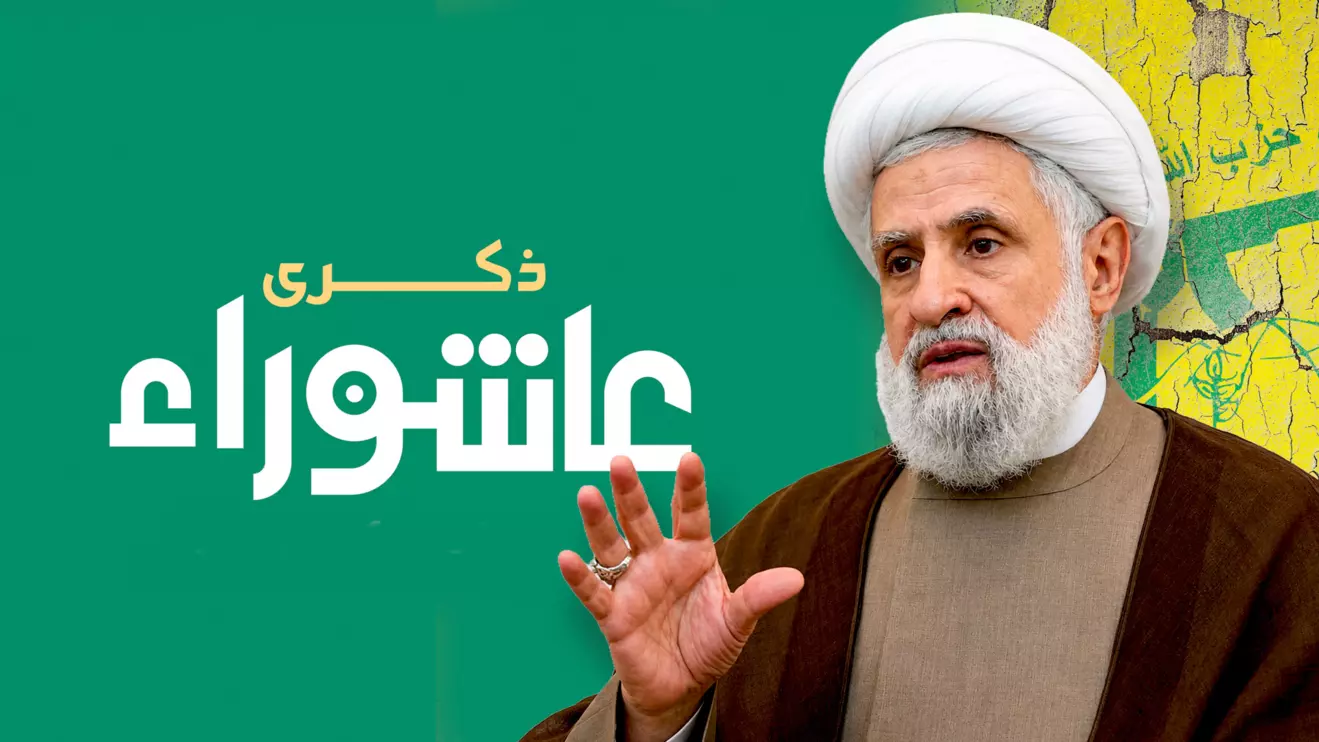
Naim Qassem took to the podium Friday for the Ashura commemorations and delivered precisely the speech the world expected, word for word, beat for beat, with all the spontaneity of a hostage reading from a script prepared in Tehran.
Ashura is one of the most solemn dates in the Shia Muslim calendar, commemorating the martyrdom of Imam Hussein, grandson of the Prophet Muhammad, killed alongside 72 members of his family and companions at the Battle of Karbala in 680 AD. For Hezbollah, this sacred day of mourning has long doubled as a convenient stage for political theatre, a tradition Qassem honoured faithfully on Friday.
"We thank Iran and we will remain by your side," Qassem declared, with the enthusiasm of a middle manager thanking his CEO for keeping him employed after a catastrophic year. "The strength of Iran, combined with that of fighters on the ground, can break Israel's power."
Right. The same fighters who just lost thousands of commanders, weapons depots and tunnel networks. The same "power" that couldn't prevent Israel from decimating Hezbollah's military infrastructure, killing Hassan Nasrallah and reducing the organisation to a fraction of its former capacity. That power.
Imagining Naim Qassem criticising Tehran is like imagining a ventriloquist criticising his own hand.
Hezbollah is Iran, created by Iran in 1982, funded by Iran, armed by Iran, directed by Iran. Qassem is not thanking an ally. He is thanking his employer, his financier, his reason for existing. The gratitude is not diplomatic courtesy. It is a job description.
The Balance Sheet of "Resistance"
While Qassem was performing his annual act of gratitude, the Lebanon that Hezbollah claims to defend was counting its dead, its displaced, its razed villages and its thoroughly wrecked economy.
More than 5,000 Lebanese killed since the beginning of the conflict, for a population of just 5 million. A devastating ratio that dwarfs Iran's losses of 3,500 among 93 million people who supposedly "gave everything," as Qassem graciously put it.
Iran gave. Lebanon bled. That is the actual arithmetic of this "alliance."
Qassem also rejected, with great rhetorical flourish, any prospect of normalisation with Israel: "neither normalisation, nor end of the state of hostility, nor Israeli gains, nor any Israeli presence on our territory."
A magnificent programme. Stirring, even. In practice, it translates to: no reconstruction, no foreign investment, no tourism revival, no return of hundreds of thousands of displaced Lebanese, and no economic future for the country's citizens, Christian, Sunni, Druze and Shia alike.
All sacrificed on the altar of a "resistance" that serves Tehran's regional agenda, not Beirut's national interest.
The Central Paradox
Here it is, laid bare: a movement that presents itself as "the foundation of Lebanese independence" has kept the country under Iranian tutelage for four decades.
A militia that claims to protect Lebanese sovereignty has made Lebanon the perpetual battlefield for someone else's war. A secretary general who thanks Iran for « everything », while his own organisation is strategically defeated, militarily hollowed out and politically isolated, and expects the Lebanese people to applaud.
Thanking Iran for the ruins of southern Beirut. Thanking Iran for 5,000 dead. Thanking Iran for an economy in freefall.
That takes a very particular kind of audacity. Or a very particular kind of blindness.
Either way, the Lebanese people have noticed, and increasingly, they are done paying the price.