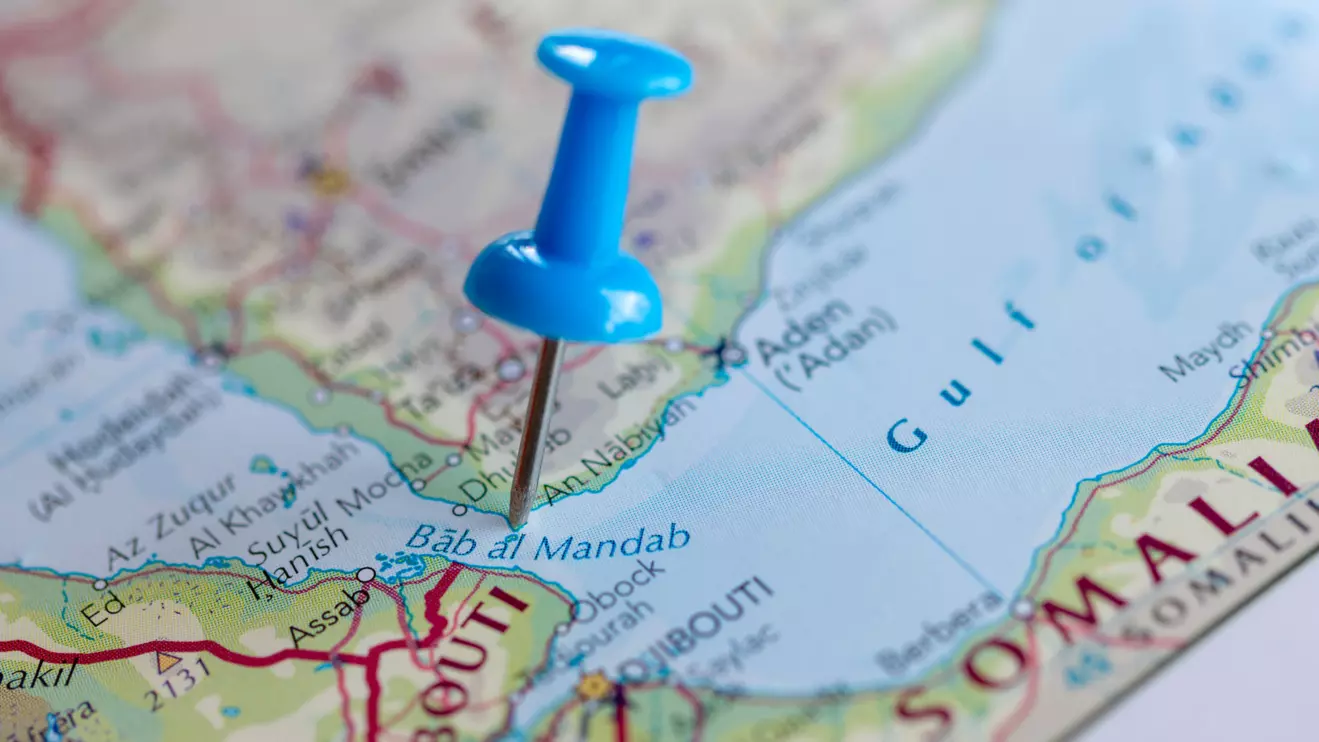
Qatar warned Tuesday that a closure of the Bab al-Mandeb Strait, following its seizure by Yemen's Houthi rebels, would be "catastrophic" for the global economy.
"The world is suffering enough with the closure of the Strait of Hormuz, so we cannot also afford to add the Bab al-Mandeb into that equation," said Ibrahim Al Hashmi, an official at Qatar's Ministry of Foreign Affairs, during a press briefing.
He added that a closure of the southern entrance to the Red Sea would be "catastrophic for the entire world," noting: "We are already seeing the consequences... so Qatar is pushing for diplomacy, dialogue."
The warning comes as the Iran-backed Houthi rebels have advanced toward the strait, reaching the Yemeni town of Dhubab and seizing the island of Perim, located in the middle of the passage, according to several sources cited by Reuters.
This significantly strengthens their ability to threaten vessels transiting between the Red Sea and the Indian Ocean, and tensions have already begun deterring shipping traffic through the corridor.
Bab al-Mandeb's growing importance amid the Hormuz blockade
At first glance, Bab al-Mandeb appears less strategically significant than the Strait of Hormuz, the world's foremost oil chokepoint, through which roughly 20.9 million barrels of oil and petroleum products transited daily in the first half of 2025, according to the US Energy Information Administration, about four times the volume passing through Bab al-Mandeb at the time.
However, flows through Bab al-Mandeb have surged sharply amid the difficulties in the Persian Gulf, rising from 3.7 million barrels per day in early 2025 to around 5.4 million by spring 2026, as Saudi Arabia in particular relied on its East-West pipeline to move crude to its Red Sea port of Yanbu, bypassing Hormuz altogether, a route now directly threatened by the Houthi advance.