
Morocco
UN ends Western Sahara peacekeeping mission after 35 years
The 35-year-old UN peacekeeping mission in the Western Sahara region will come to an end after the Security Council failed to renew its mandate, the UN chief said on Sunday.

The end of the UN peacekeeping mission in Western Sahara after 35 years marks a turning point in one of Africa’s oldest conflicts. For Rabat, it is a major diplomatic victory.
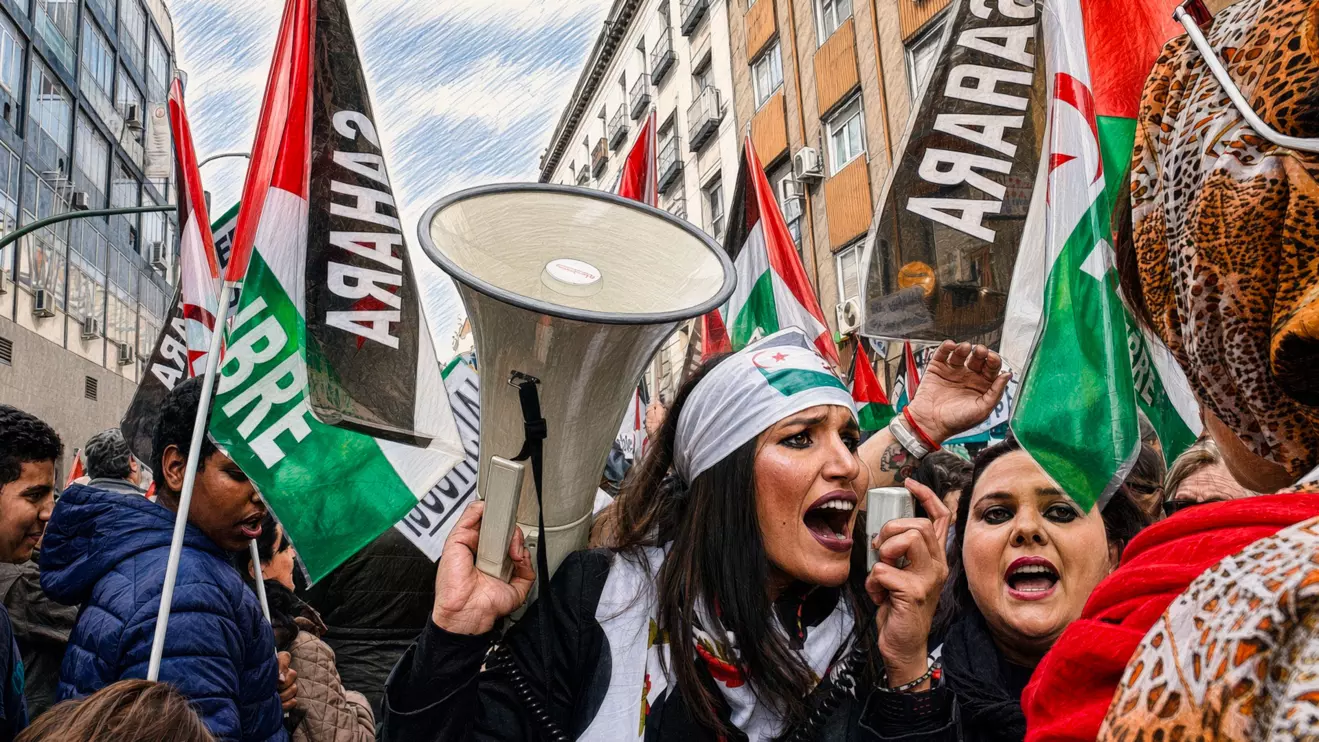
Women shouting using a megaphone during the demonstration for a free Sahara held in Madrid © Mena Today
The end of the UN peacekeeping mission in Western Sahara after 35 years marks a turning point in one of Africa’s oldest conflicts. For Rabat, it is a major diplomatic victory.
For Algiers and the Polisario Front, it is a stinging blow.
UN Secretary-General António Guterres confirmed on Sunday that MINURSO would enter its “liquidation phase” from November 1, after the Security Council failed to renew its mandate. Its assets will be returned to troop-contributing countries.
Deployed after the UN-brokered ceasefire of 1991, MINURSO had two tasks: monitoring the truce and organising a referendum on self-determination. The vote never took place, blocked for decades by disputes over who would be eligible to cast a ballot.
Moroccan Foreign Minister Nasser Bourita summed up Rabat’s view bluntly, calling the “R” for referendum in the mission’s name an “anachronism.” Morocco, he said, had been told in advance that Russia would veto the US-drafted resolution, but saw the outcome as “an opportunity to review certain rules of the game.” The royal palace hailed a “significant development” toward removing the issue from the Security Council’s agenda altogether.
A diplomatic tide in Rabat’s favour
The outcome caps years of patient Moroccan diplomacy. Washington recognised Moroccan sovereignty over the territory in 2020. Spain, the former colonial power, endorsed the autonomy plan in 2022, followed by France and the United Kingdom.
Last year, the Security Council itself described Rabat’s proposal, granting the territory broad self-rule under Moroccan sovereignty, as the “most feasible” solution. This year, France, the UK and eight non-permanent members again backed a text along those lines, blocked only by a Russian veto.
Dozens of African and Arab countries have opened consulates in Laayoune and Dakhla, the territory’s main cities, a powerful symbol of recognition on the ground.
For many observers, the autonomy plan now stands as the only realistic option on the table: a pragmatic compromise that offers local self-government without redrawing borders.
A slap for Algiers
The contrast with Algeria could hardly be sharper. Its foreign ministry expressed “deep regret” and blamed the “excessive bias” of the United States toward Morocco. The Polisario, which Algeria has backed and hosted for half a century in the Tindouf camps, said it was “concerned” by the deadlock.
Their last line of defence at the UN was a Russian veto, followed by a Russian draft that won just three votes. Diplomatically, Algiers looks increasingly isolated on the issue.
Development as a strategy
On the ground, Morocco has paired diplomacy with heavy investment. Under a development programme for its southern provinces launched in 2015, Rabat has poured billions into the region: a new expressway linking Tiznit to Dakhla, renewable energy projects, desalination plants and, above all, the Dakhla Atlantic port, designed to become a gateway to West Africa and the Sahel.
The message is clear: Rabat intends to win the argument not only in New York, but also on the ground.
Challenges remain. Low-intensity hostilities have persisted since the Polisario announced a return to armed struggle in 2020, and humanitarian groups warn that the departure of UN monitors could raise tensions and leave Sahrawi refugees more vulnerable.
But the balance of power has shifted decisively. After 35 years, the era of the referendum is over. The question now is no longer whether autonomy will prevail, but how it will be implemented.
The 35-year-old UN peacekeeping mission in the Western Sahara region will come to an end after the Security Council failed to renew its mandate, the UN chief said on Sunday.
Russia vetoed a US-drafted resolution on Western Sahara at the Security Council on Friday, leaving the UN peacekeeping mission there without a renewed mandate just a day before it expires.
Egyptian President Abdel Fattah el-Sisi and Moroccan Prime Minister Fatima Ezzahra El Mansouri are attending the Russia-Africa summit in Moscow on Wednesday and Thursday.
To make this website run properly and to improve your experience, we use cookies. For more detailed information, please check our Cookie Policy.
Necessary cookies enable core functionality. The website cannot function properly without these cookies, and can only be disabled by changing your browser preferences.