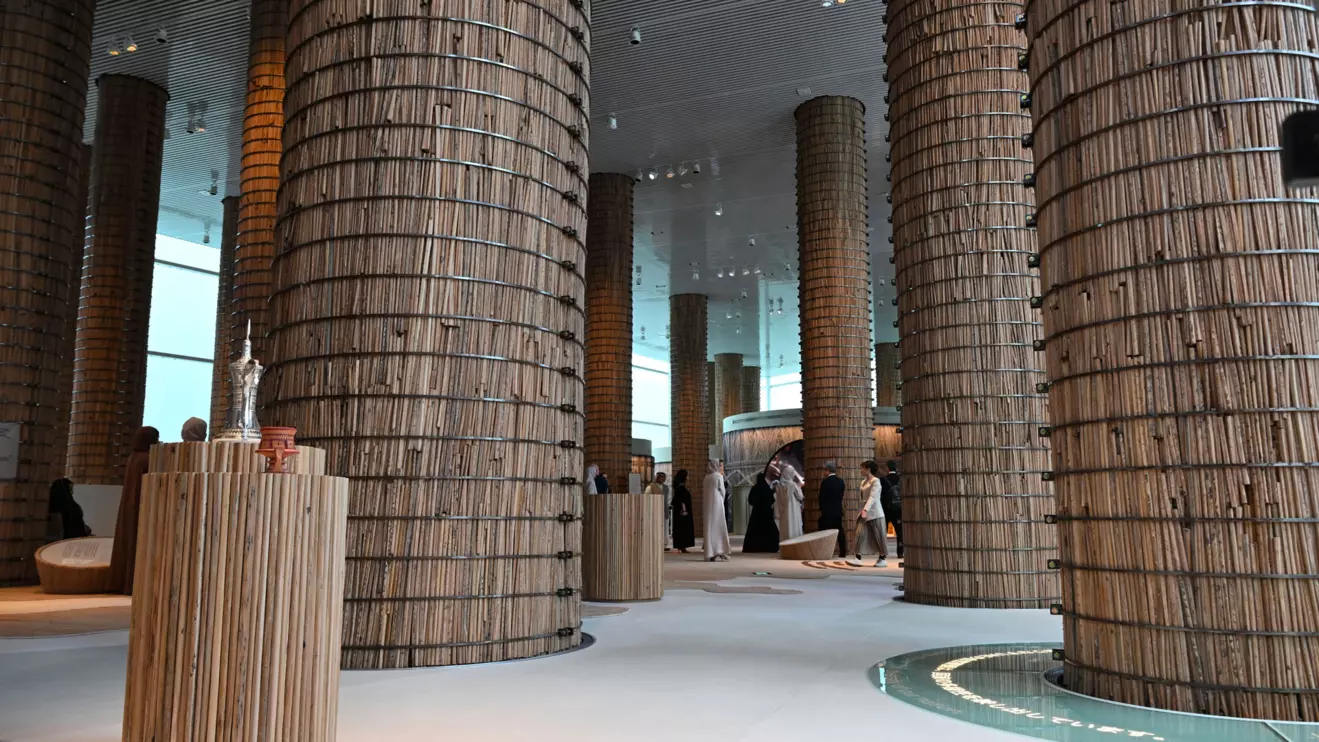
In a breathtaking architectural statement at Expo 2025 Osaka-Kansai, the United Arab Emirates unveils a pavilion that powerfully blends deep-rooted tradition with cutting-edge design.
Titled “Earth to Ether”, the UAE Pavilion takes the form of a towering forest composed of 90 wooden columns—each 16 meters high—crafted from over two million palm fronds collected across the Middle East and North Africa. This structure tells a story of resilience, generosity, and sustainable vision rooted in Emirati culture.
More than a design feat, the pavilion is a poetic embodiment of the UAE’s national identity. The palm tree—a timeless symbol of sustenance and hospitality in the Gulf—is reimagined as a sustainable building material.
The columns are a tribute to nature, while the facades are innovatively adorned with recycled date pits, roughly two tonnes of which have been used in the structure and entrances. This design element reflects a commitment to sustainability while showcasing the versatility of local resources.
Shaikha Al Ketbi, Creative Director and Deputy Commissioner General of the UAE Pavilion, emphasized that the entire concept revolves around recycling natural materials from the local environment.
Among the notable innovations is “Datecrete”, a sustainable flooring material made from ground date pits—a 100% Emirati alternative to cement. Another material, “Date Form”, also derived from palm and date waste, has been used in key elements of the interior design.
The pavilion’s construction is the result of a global and interdisciplinary collaboration, bringing together Emirati vision, Japanese carpentry precision, and European design expertise.
Under the leadership of the Expo UAE Team, creative studios such as Atelier Brückner, Raymond, Ro’ya, and SLA contributed their architectural, engineering, and design talents to shape this unique landmark.
Beyond its architecture, the pavilion creates a cultural dialogue between the UAE and Japan. Inspired by the Japanese concept of “Satoyama”—a harmonious coexistence between people and nature—the pavilion’s outer gardens feature oak and red pine trees that echo this philosophy.
Visitors are welcomed into a shaded space beneath a pergola made from Japanese cedar, intricately patterned with Emirati Khoos—the traditional art of weaving palm fronds.
At once a tribute to the past and a vision of the future, the UAE Pavilion at Expo 2025 stands as a beacon of sustainable design, cultural storytelling, and collaborative innovation—redefining how nations can showcase identity in a global, environmentally conscious context.