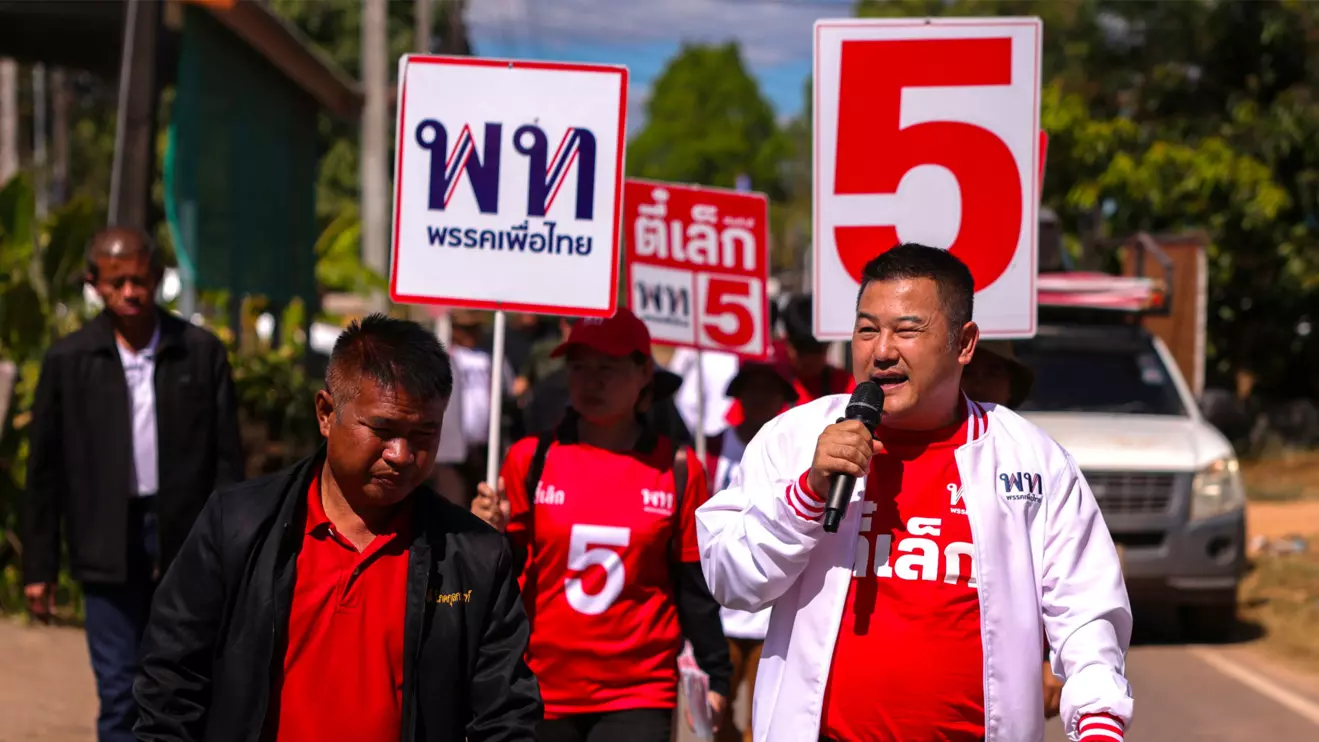
Rubber farmer Pinittaya Boonlieng sat with friends in a key political battleground in Thailand to discuss how to vote in the February 8 general election - a choice that once would have been simple in a region long loyal to former premier Thaksin Shinawatra.
Thaksin's populist Pheu Thai party has dominated agrarian Ubon Ratchathani and neighbouring provinces in northeastern Thailand for decades, but that grip is weakening and voters are switching allegiance to powerful individual candidates.
In this region, Pheu Thai is polling at 30.1%, slightly behind the national frontrunner, the reformist People's Party, according to a survey conducted by the University of Khon Kaen in January. The conservative Bhumjaithai Party of Prime Minister Anutin Charnvirakul is third at 27.2%.
In the last election in 2023, Pheu Thai won 73 of 133 direct constituency seats available across 20 provinces in Thailand's northeast, which houses 4 million of the country's 8.56 million registered farmers.
Many of its candidates from the 2023 election remain popular, reflecting the patronage politics they have followed, although some have switched parties, particularly after the removal of Thaksin's daughter - Paetongtarn Shinawatra - as premier last year for her botched handling of border tensions with Cambodia.
The row exploded into the worst fighting between the neighbours in decades, killing at least 149 people, and stoking public anger in Thailand over Thaksin's once-close ties with former Cambodian leader Hun Sen.
Thaksin is currently in prison because of an unrelated case, and a wave of nationalism washing over Thai politics has weakened Pheu Thai, which is also drawing flak for its inability to deliver on handouts promised when taking office in 2023.
Pinittaya, the rubber farmer, said she is considering backing the ruling Bhumjaithai Party, not because of its ideology or policies, but because she likes her local candidate, a former Pheu Thai lawmaker who defected.
"I am choosing the candidate," Pinittaya, 48, said. "The party is less important."
Six other farmers interviewed by Reuters in Ubon Ratchathani and a neighbouring province shared the same sentiment, showing how farm communities battered by falling crop prices, rising costs and mounting debt are shifting from party-based loyalty to backing candidates they believe can help them.
LOST FAITH
Manee Ruamtham, 62, a rice farmer in Sisaket province, said she was once a Pheu Thai voter but walked away from the party when it failed to deliver on its promise of a 10,000 baht ($317) cash handout after it took power following the 2023 polls.
"I was like their number one supporter but what they did isn't right," she said. "People lost faith in the party."
Paetongtarn blamed steep tariffs proposed by the United States for stalling her government's flagship handout programme, and her administration was eventually ousted due to the Cambodia crisis, leaving the handouts unfinished.
The local candidate Manee said she will vote for is Nuchanat Jaruwongsethian, a former Pheu Thai lawmaker who defected to the smaller Kla Tham party, an ally of the ruling Bhumjaithai.
"People voted for me to fight for farmers, to fight for decent wages," said Nuchanat, a former long-time Pheu Thai supporter. "But one day it wasn't about this anymore, so how can I answer the people?"
But not all rural voters are abandoning Pheu Thai. In Ubon Ratchathani, 53-year-old tapioca farmer Ubon Thanomsup said she may still back the party she has supported for many years - largely because of the local candidate.
"The candidate lives in our area, so he is nearer to help," she said.
Cherdsak Phokkunlanon, a Pheu Thai candidate in the province, said that his party could retain, and even expand, its rural support base with the help of populist policies, a playbook that Pheu Thai has successfully deployed before.
"Pheu Thai policy will guarantee the price of agricultural goods, so that people will gain 30% profit when they sell their products," Cherdsak said.
DEFECTION STRATEGY
Political parties are responding to the swing in sentiment by aggressively recruiting well-known local figures, including defectors from rival camps, in a strategy aimed at capturing personal loyalty networks, rather than relying solely on national campaigns.
Among those is Sudarat Pitakpornpunlop, a former Pheu Thai lawmaker now running for Bhumjaithai in Ubon Ratchathani's District 7.
"Even if I change to another four or five parties, I will be the same old person who worked for all of you like before," she told voters at a rally last month.
Nationwide, at least 91 lawmakers elected in 2023 have changed their political affiliation ahead of February polls, according to multiple local media.
Of these, Bhumjaithai attracted 64 defectors, while Kla Tham took second place with 21 lawmakers joining its ranks. Only one has switched to Pheu Thai.
The trend reflects the enduring power of patronage politics in the Thai hinterland, rooted in gaps in state welfare schemes and public service delivery, said Titipol Phakdeewanich, a political scientist at Ubon Ratchathani University.
"When people help you, you feel you owe them something. These networks are long-term investments, and they can still help politicians win elections," he said.
($1 = 31.5500 baht)