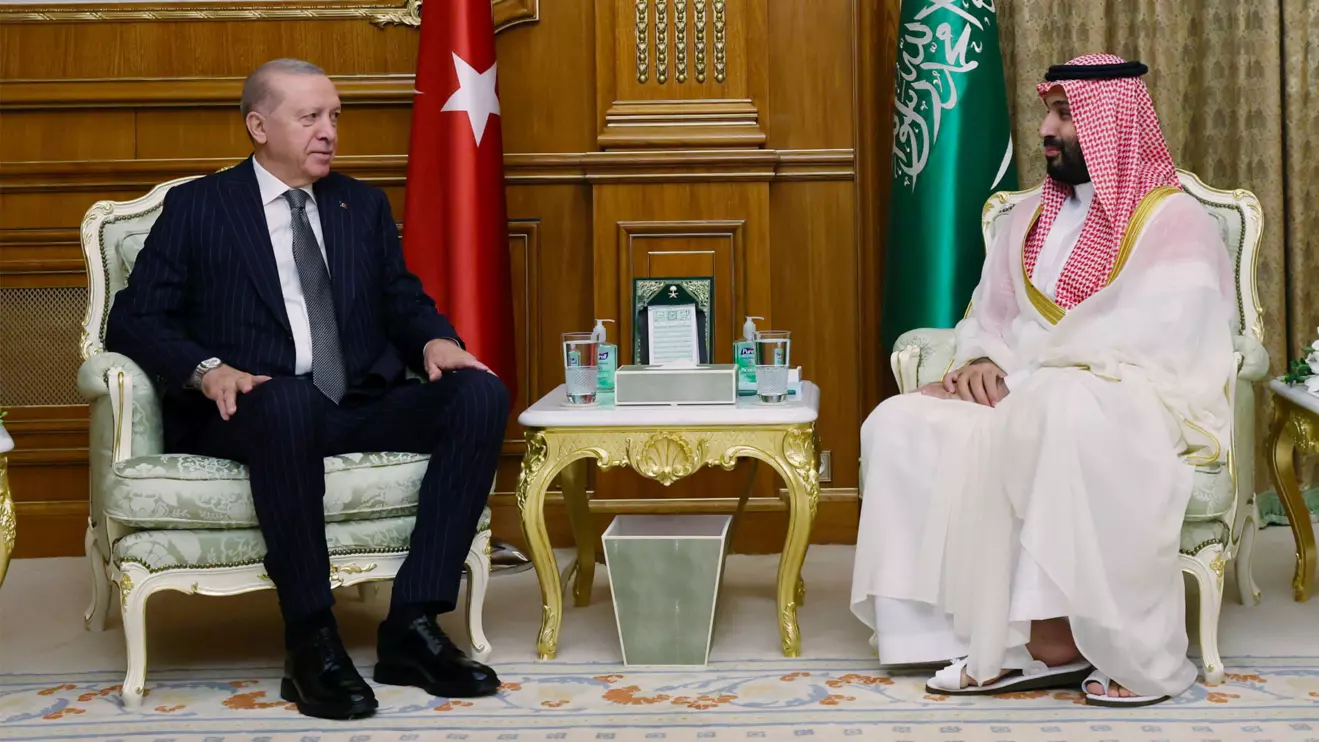
Saudi Arabia, Pakistan and Turkey signed a joint defence agreement in Mecca on Friday, wedding Sunni Muslim U.S. allies alarmed at a regional conflagration that has brought Iranian missile fire onto Gulf oil exporters.
Iran and its allies have been firing on Saudi Arabia and other Gulf states, and blockading their energy shipments, since the U.S. and Israel attacked it on February 28 in a major escalation after years of regional tumult.
The "Mecca Joint Defence Agreement" is intended to strengthen collective deterrence against any act of aggression and stipulates that an armed attack against any of the three would be regarded as an attack on all, they said in a joint statement.
However, the statement did not give specifics on the commitments each had accepted and it was not clear how far their agreement would bind them to any particular military action in each other's defence.
Turkish Vice President Cevdet Yilmaz said the agreement was not aimed at any specific country. A Turkish official added that it was purely defensive and did not abrogate any existing agreements the countries had with other states.
The three nations share concerns about the increasingly aggressive military stances of both Israel and revolutionary Shi'ite Iran, as their longtime U.S. ally struggles to contain regional upheaval that has caused a global energy crisis.
POWERFUL POLITICAL SYMBOLISM
"Three of the Muslim world's most influential states are convening at a moment of heightened uncertainty, demonstrating a growing willingness among regional and middle powers to coordinate more closely on security matters," said Abdulaziz Sager, chairman of the Gulf Research Center, a Saudi-based think tank.
"The trilateral framework could strengthen the three countries' collective diplomatic and defense weight while contributing to the emergence of a more regionally driven security architecture," Sager added.
Turkey has NATO's second-largest military. Saudi Arabia is home to Islam's holiest sites and one of the world's top oil exporters, while Pakistan is the only nuclear-armed Muslim country.
However, Rayed Krimly, Saudi deputy minister for public diplomacy, said in a social media post that the accord does not represent an effort to establish a military axis or a sectarian bloc.
"Nor is it linked to any nuclear ambitions or arms race," he said.
Although Pakistan agreed a mutual defence pact with Saudi Arabia last year, it has not responded to Iran's attacks on the kingdom militarily. It has also played down suggestions its nuclear deterrent might be extended to allies, saying last year of its pact with Saudi Arabia that atomic weapons were "not on the radar".
Both Pakistan and Turkey have also voiced support for a maritime defence coalition Saudi Arabia has announced to protect regional shipping and energy routes.
Friday's pact was signed in Mecca by Saudi Crown Prince Mohammed bin Salman, Turkish President Tayyip Erdogan and Pakistani Prime Minister Shehbaz Sharif and follows nearly a year of negotiations, reported by Reuters in January.
PACT BUILDS ON LONGSTANDING MILITARY TIES
The Middle East has been in flames for nearly three years since the October 7, 2023 Hamas attack on Israel.
Israel has waged war in Gaza, invaded southern Lebanon and seized territory in Syria as well as launching two air campaigns against Iran. Tehran has fired on Saudi Arabia, Kuwait, Bahrain, Qatar, the United Arab Emirates, Oman, Jordan and Israel.
While Turkey and Pakistan, on the fringes of the Middle East, have avoided significant direct attacks, both are anxious to calm conflicts that threaten their own security and economies.
For Saudi Arabia, three years of Middle East conflicts have imperiled its oil exports and ambitious development plans and drawn big questions over the reliability of its longstanding U.S. security umbrella.
Burcu Ozcelik, senior research fellow for Middle East Security at the RUSI think tank, said the agreement was focused on counterbalancing Iranian hegemony in the region and building deterrence against Israel rather than moving towards a confrontation with Tehran.
"I think the objective is very much the opposite," Ozcelik said.
Pakistan has provided training and technical assistance to Saudi forces for decades, while Turkey and Pakistan have exchanged warships and training aircraft. Saudi Arabia is a major purchaser of drones from Turkey.
Pakistan has deployed about 8,000 troops, fighter jets, drones and an air-defence system to the kingdom and opened negotiations with Kuwait to provide security in exchange for energy cooperation and investment.
Israeli Prime Minister Benjamin Netanyahu's office declined to comment. A spokesperson for India's Foreign Ministry said the pact was a development that the country was closely following. Iran did not immediately comment.