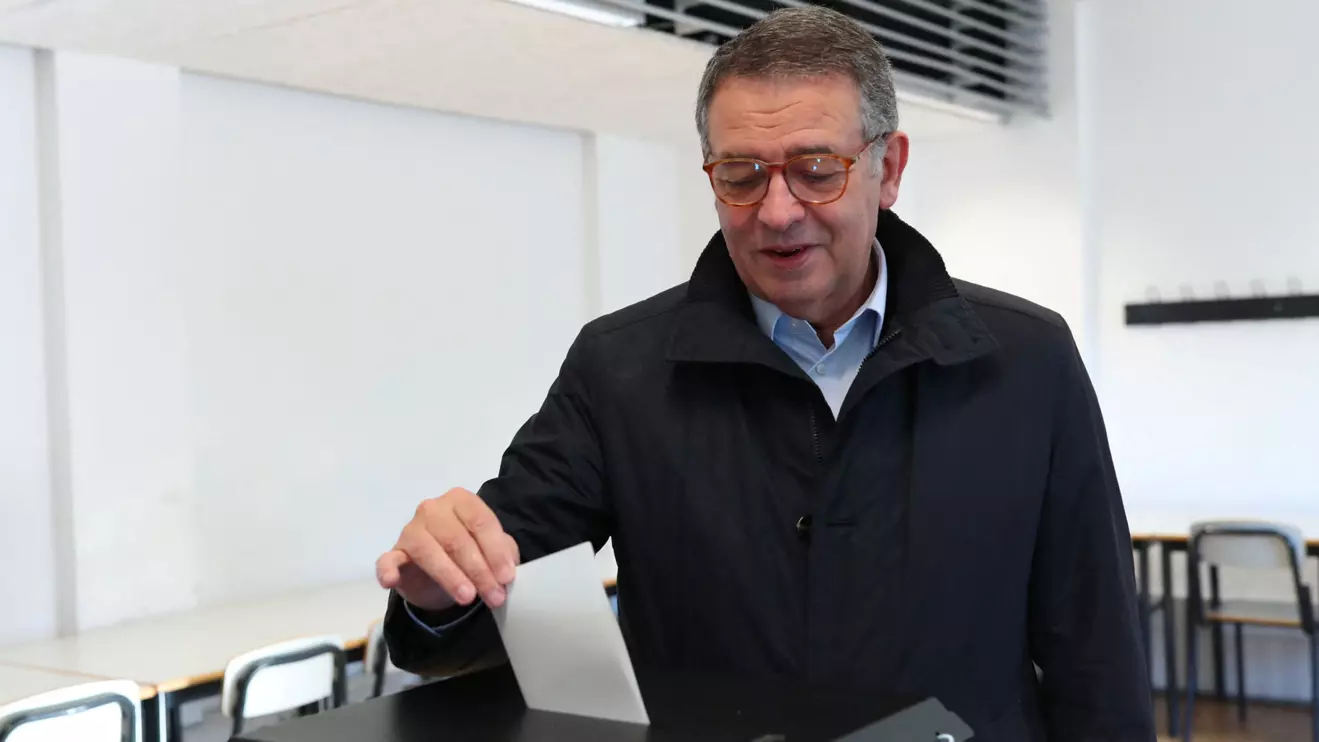
Moderate Socialist Antonio Jose Seguro led the first round of Portugal's presidential election on Sunday, followed by the far-right leader Andre Ventura, with exit polls and first partial results showing the two are heading into a runoff next month.
In the five decades since Portugal threw off its fascist dictatorship, a presidential election has only once before - in 1986 - required a runoff, highlighting how fragmented the political landscape has become with the rise of the far right and voter disenchantment with mainstream parties.
The presidency is a largely ceremonial role in Portugal but wields some key powers, including in some circumstances to dissolve parliament, to call a snap parliamentary election, and to veto legislation.
Partial results with around 50% of the vote counted put Seguro at just over 30% of the vote, while exit polls put him in the range of 30-35%. Ventura was at 26.9%, above the upper band of his exit poll range of 19.9%-24.1%.
Joao Cotrim de Figueiredo of the right-wing, pro-business Liberal Initiative party likely came third among a total of 11 contenders, according to the exit polls conducted for television channels RTP, SIC and TVI/CNN that placed him at 16.3%-21%.
The second-round vote is tentatively scheduled for February 8.
Last May, the anti-establishment, anti-immigration Chega, founded just about seven years ago, became the main opposition party in a parliamentary election, winning 22.8% of the vote. As in much of Europe, the rise of the far right has swayed government policies, particularly on immigration, towards a more restrictive stance.
However, all recent opinion polls have shown Ventura losing the runoff due to his high rejection rate of more than 60% of voters.
The Economist Intelligence Unit said in a recent note that a Seguro-Ventura runoff "would be more straightforward given his (Ventura's) limited appeal beyond his core base."
"While the presidency is largely symbolic, Ventura is the only candidate signalling a more interventionist approach, though EIU sees this as unlikely to translate into victory," it said.
There were eight other contenders, including Luis Marques Mendes, backed by the ruling centre-right Social Democrats on 14% in partial results, retired Admiral Henrique Gouveia e Melo, who led the country's COVID-19 vaccination campaign, with 11.9%, and even comedian Manuel Joao Vieira, who had just under 1% of the vote, according to partial results, on a promise of a Ferrari sports car for every Portuguese and tap wine in every home.
Some voters vented frustration at such a broad pool of candidates.
“With so many, it's harder to choose, because everyone has their own opinion and their own way of being," said Jose Pereira as he went to cast his ballot in Lisbon.
By Andrei Khalip and Sergio Goncalves