Syria
Facing Alawite backlash, Syria’s new leaders take controversial steps to win loyalty
He carried no weapons and helped keep government security forces alive, but Khairallah Dib still needed a promise of amnesty to come out of hiding.
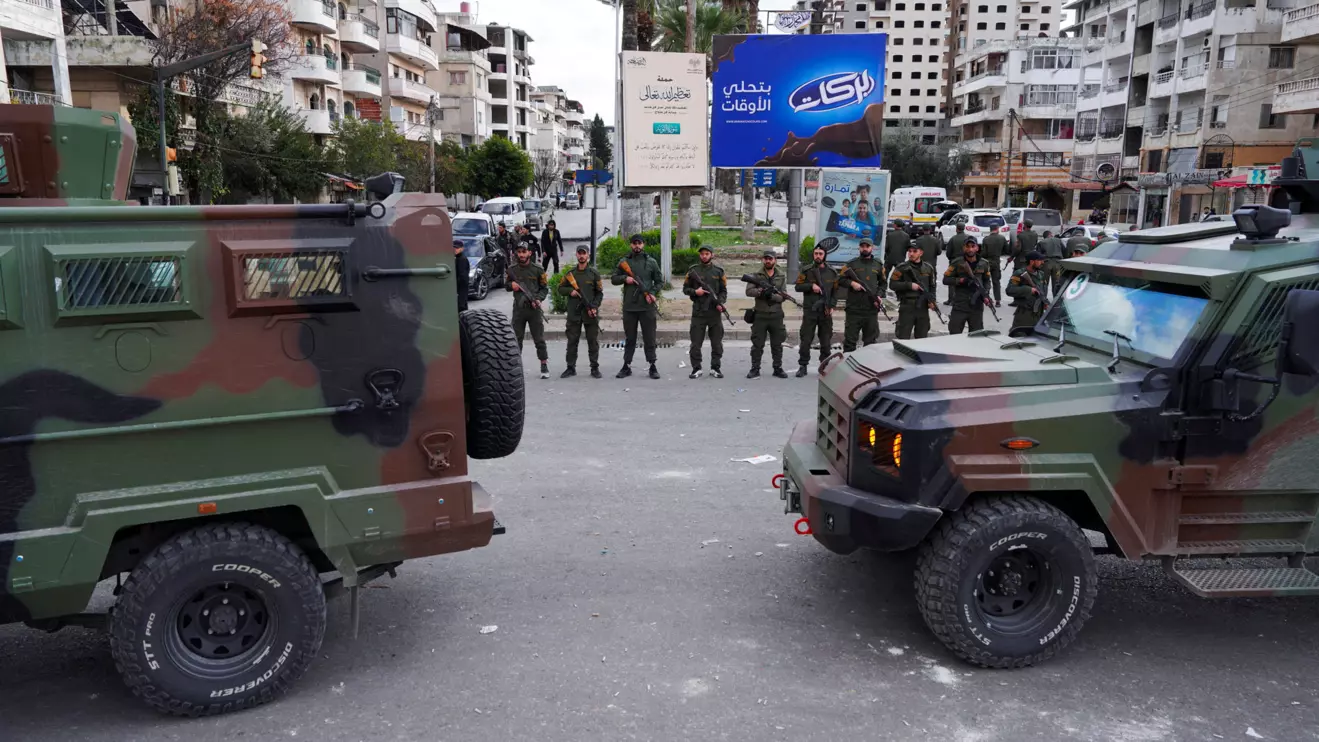
Syrian security forces imposed a curfew on Latakia city, a bastion of the country's Alawite minority, state media reported on Tuesday, days after four people were killed in protests that spiralled into violence.
Members of the Syrian Security forces stand guard near military vehicles on the day people from the Alawite sect protest as they demand federalism and an end to what they say is the killing and violations against Alawites, in Latakia, Syria, December 28, 2025. Reuters/Karam al-Masri
Syrian security forces imposed a curfew on Latakia city, a bastion of the country's Alawite minority, state media reported on Tuesday, days after four people were killed in protests that spiralled into violence.
Syria has been rocked by several episodes of sectarian bloodshed since longtime leader Bashar al-Assad, who hails from the Muslim Alawite community, was ousted by a rebel offensive last year and replaced by a Sunni-led government.
State media said the curfew was set to last from 5 p.m. (1400 GMT) on Tuesday until 6 a.m. (0300 GMT) on Wednesday.
Security forces reinforced their deployment in a number of neighborhoods in Latakia city on the Mediterranean coast, which witnessed riots on Monday that injured about a dozen people.
Thousands of Alawite protesters gathered on Sunday in Azhari Square in Latakia city to demand a decentralized political system in Syria and the release of thousands of Alawite prisoners.
A similar protest in November lasted barely an hour before being confronted by a rival protest in support of Syria's new government. Syrian security forces used gunfire to break up both.
Reporting by Ahmed Elimam, Leila Bassam and Kinda Makieh
He carried no weapons and helped keep government security forces alive, but Khairallah Dib still needed a promise of amnesty to come out of hiding.
Syria’s government has ordered soldiers to guard a mass grave created to conceal atrocities under Bashar al-Assad and has opened a criminal investigation, following a Reuters report that revealed a yearslong conspiracy by the fallen dictatorship to hide thousands of bodies on the remote desert site.
Three people were killed on Sunday when protests in Syria's Alawite heartland of Latakia spiralled into gunfire and other violence, according to the province's media office.
To make this website run properly and to improve your experience, we use cookies. For more detailed information, please check our Cookie Policy.
Necessary cookies enable core functionality. The website cannot function properly without these cookies, and can only be disabled by changing your browser preferences.