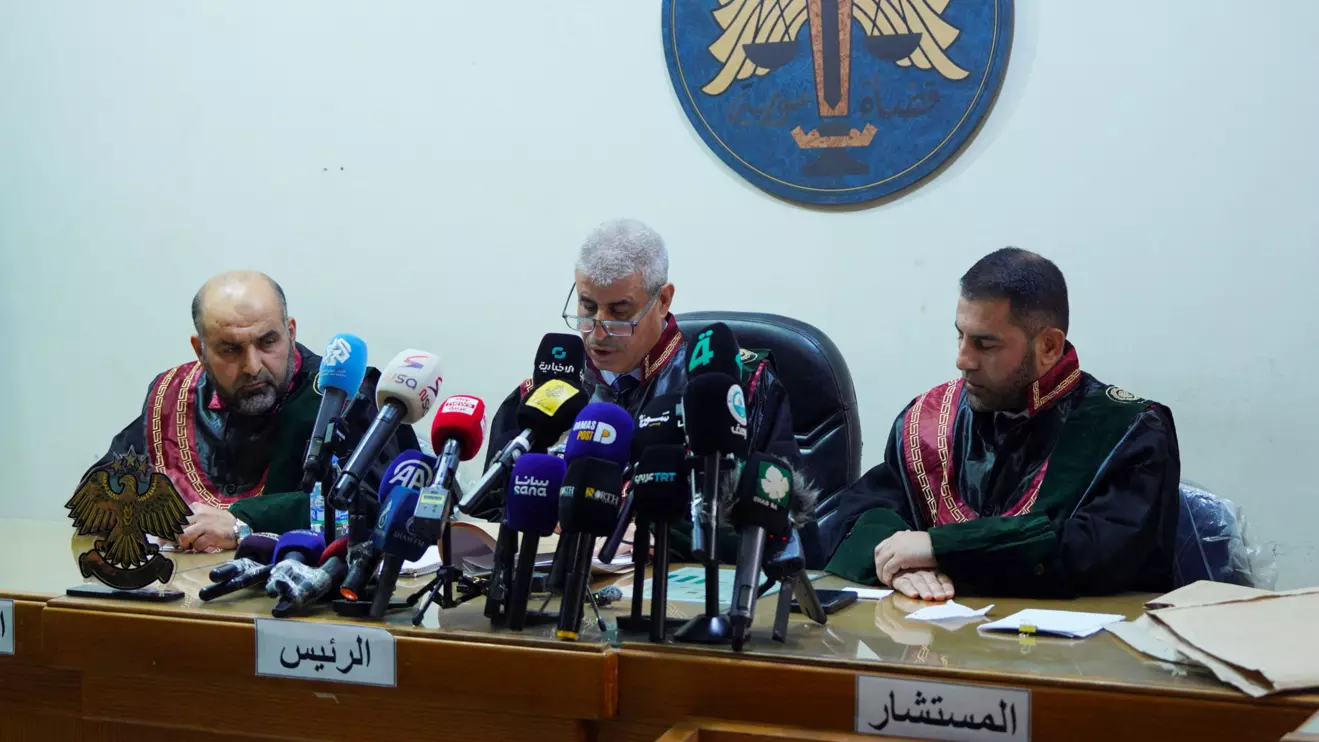
Syria on Tuesday began the first trial of suspects in a wave of bloodshed in March during which pro-government fighters killed hundreds of members of the Alawite minority - a case seen as a test of President Ahmed al-Sharaa's promise of accountability.
Judicial sources said the group of a dozen defendants was evenly split between people alleged to have taken part in attacks on Alawite communities, and others accused of taking part in attacks on government forces by militias loyal to ousted former president Bashar al-Assad, which sparked the violence.
The bloodshed marked one of the worst eruptions of violence since Sunni Islamist rebels led by Sharaa toppled Assad, a member of the Alawite minority, in December, ending 54 years of autocratic rule by the Assad family.
CHARGES INCLUDE FOMENTING CIVIL WAR
The defendants went on trial in a public session at the Aleppo Court of Justice in northern Syria. The judicial sources said they faced charges that included fomenting civil war, secession, premeditated murder and looting.
Defendants from both sides were questioned on charges of killing civilians and forming militias that carried out attacks on army checkpoints and government installations, according to a source in court and a televised broadcast of the proceedings.
The prosecutor general has pressed charges against around 300 people linked to armed factions affiliated with the army, and around 265 who belonged to Assad-era paramilitary groups, Jumaa Al-Anzi, head of a fact-finding committee appointed by Sharaa, said in comments carried by Syrian media reports of the trial. It is unclear how many are currently in detention.
A Reuters investigation published in June found that Syrian forces killed nearly 1,500 Syrian Alawites from March 7 to 9. The attacks came in response to a day-old rebellion organised by former officers loyal to Assad that left 200 members of the security forces, according to the government.
A Syrian government fact-finding committee reported in July that 1,426 people had died in March in attacks on security forces and subsequent mass killings of Alawites.
COMMITMENT TO ACCOUNTABILITY
Officials say the authorities are committed to accountability in a new era that ends a dark phase of secretive authoritarian rule, noting it was previously unheard of in Syria to put members of the security forces on trial for crimes.
Anti-government activists and Alawite lobbyists say the process is not independent and amounts to a sham by the authorities.
U.N. investigators said in August that war crimes were probably committed by interim government forces as well as by fighters loyal to Syria's former rulers during the violence.
Sharaa denounced the violence as a threat to his mission to unite Syria and pledged to hold those responsible to account.
A senior Justice Ministry official said the trials mark the start of a long process that would also hold to account those responsible for atrocities during the Assad family’s long rule.
“The trials won’t stop at the coastal violations. They will continue to include the leading criminals who perpetrated crimes and mass killings in past years,” Deputy Minister of Justice Mustafa al-Qassem told state media.