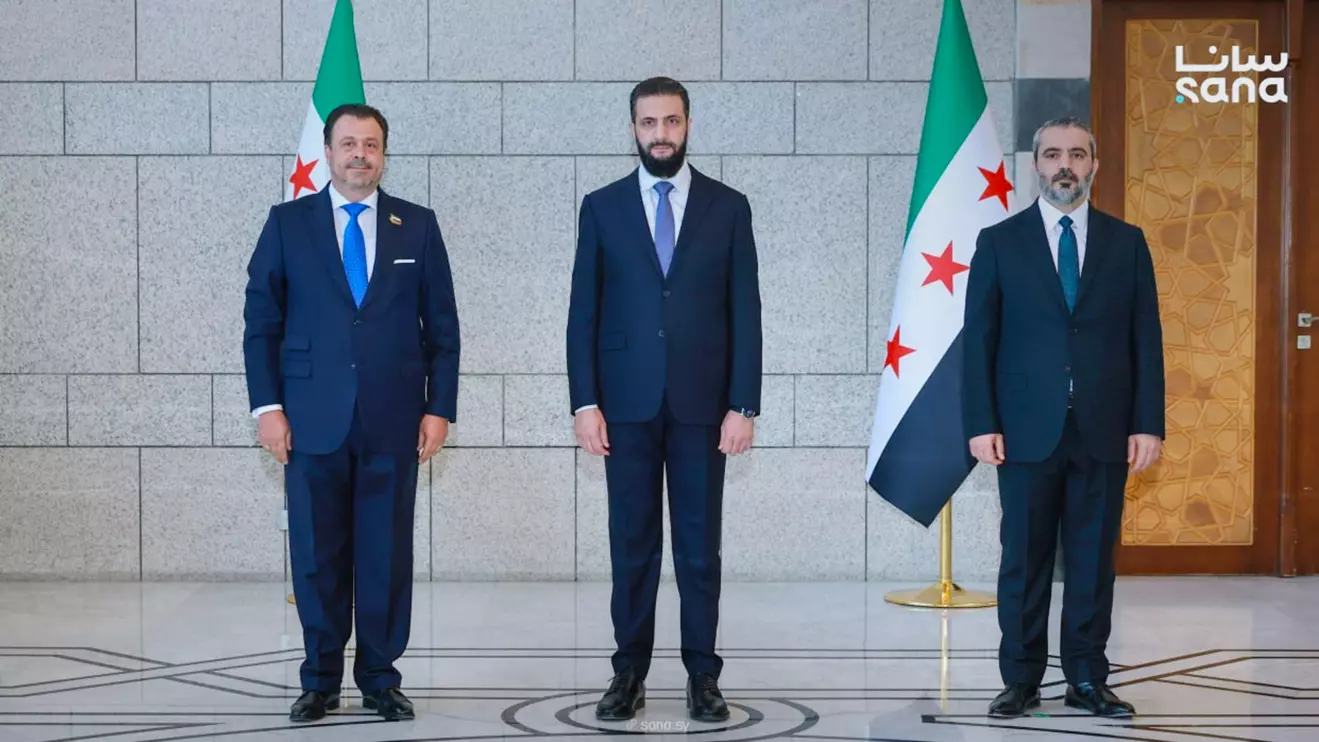
The presentation of credentials by a fresh wave of ambassadors to Syria's transitional president, Ahmad al-Sharaa, has drawn a notably warm response from the Syrian Liberal Party, whose statement this week reads less like routine diplomatic courtesy and more like a manifesto for what post-war Syria could become.
The party singled out seven new envoys - from Saudi Arabia, the Holy See, the European Union, Brazil, Greece, Sweden and Denmark - framing their arrival in Damascus as proof that Syria is re-entering the community of nations after years of isolation.
It is a symbolically loaded moment, and the party leans into that symbolism unapologetically: Saudi Arabia is cast as an anchor for Syria's Arab and Gulf reintegration; the EU's upgrade of its mission from chargé d'affaires to full ambassador is read as validation of Syria's reconstruction and rule-of-law ambitions; and the Vatican's presence is tied to Syria's role in early Christian history, a reminder that the country's identity has never been monolithic.
That last point deserves to be taken seriously rather than treated as ceremonial flourish. A Syria emerging from over a decade of war and authoritarian collapse has every incentive to perform pluralism for a diplomatic audience.
But the harder test is whether "equal citizenship" and "religious freedom », the phrases invoked in the statement, translate into enforceable guarantees for Syria's Christian, Alawite, Druze and Kurdish communities, rather than remaining aspirational language aimed at foreign chancelleries.
The same tension runs through the statement's economic framing.
Casting Europe and the Gulf as partners rather than donors is the right instinct: dependency dressed up as friendship rarely survives contact with domestic politics on either side.
But partnership requires Syria to hold up its end, functioning institutions, credible courts, a security sector accountable to something other than itself. Ambassadors can walk back through Damascus's gates; investment and trust will only follow if what they find inside matches the rhetoric that greeted them.