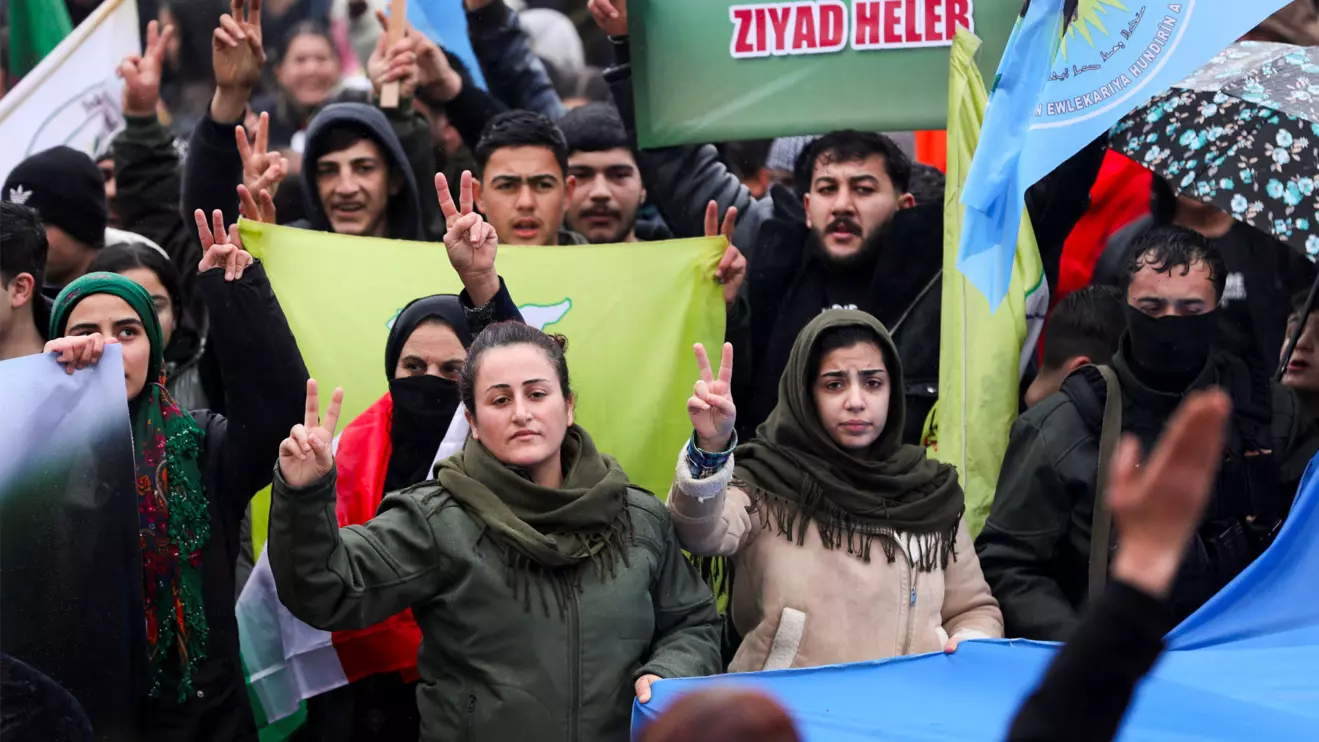
Several thousand people marched under the rain in northeast Syria on Tuesday to protest the expulsion of Kurdish fighters from the city of Aleppo the previous week after days of deadly clashes.
The violence in Aleppo has deepened one of the main faultlines in Syria, where President Ahmed al-Sharaa's promise to unify the country under one leadership after 14 years of war has faced resistance from Kurdish forces wary of his Islamist-led government.
Five days of fighting left at least 23 people dead, according to Syria's health ministry, and saw more than 150,000 flee the two Kurdish-run pockets of the city. The last Kurdish fighters left Aleppo in the early hours of January 11.
On Tuesday, several thousand Syrian Kurds protested in the northeastern city of Qamishli. They carried banners bearing the logos of Kurdish forces and faces of Kurdish fighters who died in the battles - some of whom had detonated explosive-laden belts as government forces closed in.
FEARS OF WIDER CONFLICT
Other posters featured the faces of Sharaa and Turkish Foreign Minister Hakan Fidan, crossed out with red "X"s and carrying the caption "Killers of the Kurdish people."
Turkey accuses the Syrian Democratic Forces - the main Kurdish fighting force which runs a semi-autonomous zone in northeast Syria - of links to the Kurdistan Workers' Party, which Ankara considers a terrorist organization.
Many Kurds say last week's bloodshed has deepened their scepticism about Sharaa's promises to govern for all Syrians.
"If they truly love the Kurds, and if they sincerely say that the Kurds are an official and fundamental component of Syria, then the rights of the Kurdish people must be recognized in the constitution," said Hassan Muhammad, head of the Council of Religions and Beliefs in Northeast Syria, who attended Tuesday's protest.
Others worry that the bloodshed will worsen. Syria's defense ministry on Tuesday declared eastern parts of Aleppo still under SDF control to be a "closed military zone," and ordered all armed forces in the area to withdraw further east.
Idris al-Khalil, a Qamishli resident who protested on Tuesday, said the Aleppo violence reminded him of the sectarian killings last year of the Alawite minority on Syria's coast and the Druze minority in the country's south.
"Regarding the fears of a full-scale war - if they want a full-scale war, the people will suffer even more, and it will lead to division among the peoples of the region, preventing them from living together in peace," Khalil said.
Reporting by Orhan Qereman