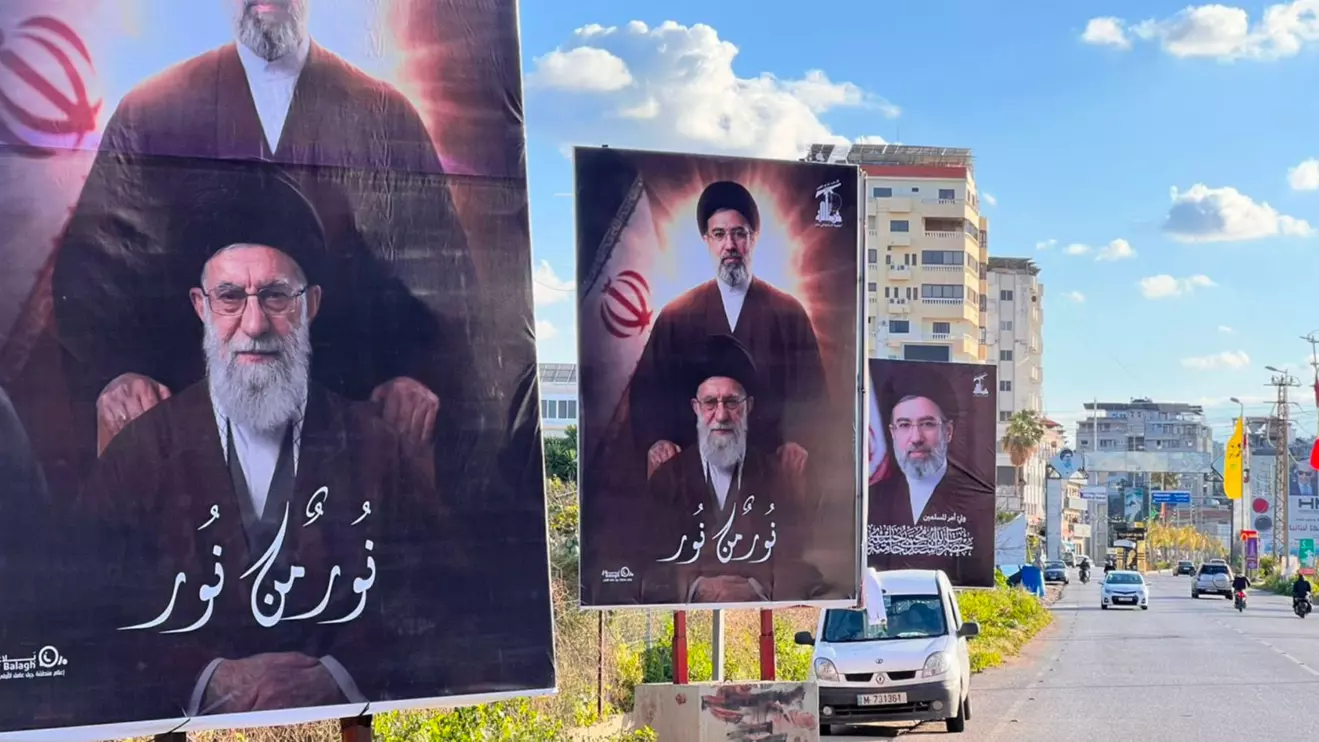
Drive through the main arteries of South Lebanon today and the landscape tells a story that Beirut's government would rather not acknowledge: this is not Lebanon. This is Hezbollah's territory — and it looks like an Iranian province.
Giant billboards line the major roads of South Lebanon, bearing the portraits of Ali Khamenei - the former Iranian Supreme Leader killed in the US-Israeli strikes of February 28 - and his son and designated successor, Mojtaba Khamenei.
The Iranian flag. Revolutionary slogans. The imagery of the Islamic Republic plastered across a country that is supposed to be a sovereign Arab nation.
Hezbollah's propaganda machine is running at full capacity, and its message is unambiguous: South Lebanon belongs not to Beirut, but to Tehran.
A Population That Didn't Ask for This
Not everyone is convinced. Local residents observe this display of Iranian allegiance with a mixture of unease and quiet resentment. These are Lebanese citizens, not Iranian revolutionaries. Many have watched their villages, their livelihoods and their futures consumed by a conflict they never voted for, serving the interests of a foreign regime that has never once asked for their consent.
The billboards celebrate a Supreme Leader. The people beneath them are counting their dead.
While the propaganda war plays out on the roadside, Hezbollah's military machine is back in force. Fighters have returned en masse to South Lebanon, launching daily attacks against Israel in defiance of the Lebanese government's own declarations of disarmament.
The consequences are devastating. Israeli retaliatory strikes have left a trail of destruction across the south. Towns and villages that survived previous wars are being reduced to rubble.
And the human cost is mounting - an unprecedented wave of displaced civilians, uprooted from their homes by a conflict triggered not by Lebanon's government, not by Lebanon's army, but by Hezbollah's unilateral decision to go to war.
South Lebanon's roads carry the faces of Iranian leaders. Its fields carry the scars of Israeli airstrikes. Its roads carry hundreds of thousands of refugees.
And somewhere in Tehran, the mullahs call it resistance.
The Lebanese people call it something else entirely.