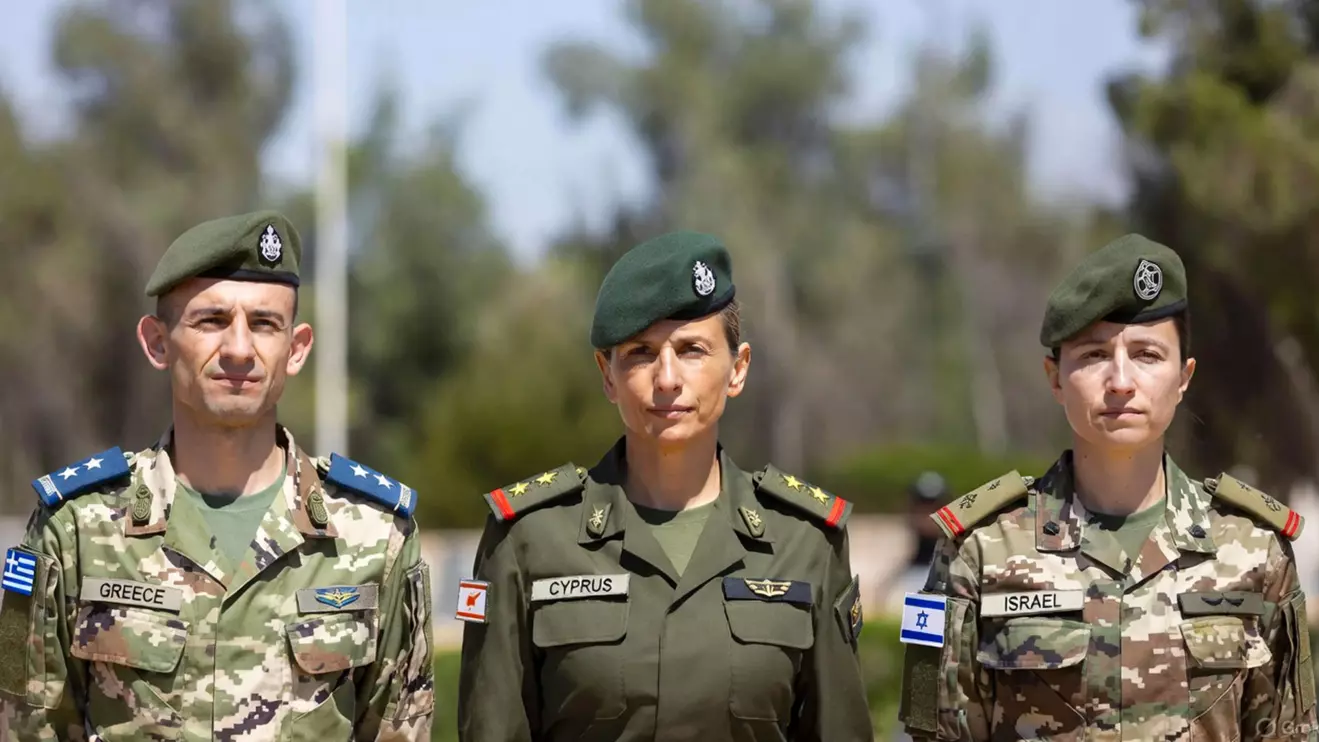
Senior air force commanders from Greece, Israel and Cyprus held a confidential meeting in Nicosia on Wednesday, as the three countries reportedly explore expanded security cooperation and tighter operational coordination.
An Israeli public broadcaster reported that Israel’s air force chief, Major General Tomer Bar, met senior Greek and Cypriot officers to discuss practical coordination and shared readiness, against a backdrop of heightened concern about Turkey’s growing military reach and regional influence.
According to the reporting, the participants exchanged assessments of the evolving security environment and reviewed options for closer cooperation, including joint exercises and enhanced operational preparedness.
The meeting fits within wider discussions in Athens, Nicosia and Tel Aviv about moving from ad-hoc cooperation toward a more durable framework that can act quickly in a crisis.
The discussions also highlight Jerusalem’s elevated strategic position after two years of regional upheaval. Claims of Israel’s diplomatic isolation increasingly look overstated: when core security interests are at stake, Israel is not being sidelined—it is being actively integrated into regional planning.
From coordination to capability: the rapid reaction concept
Parallel reporting in the Greek press indicates that senior Greek military officers and defence analysts are now examining scenarios that, until recently, were viewed as operationally ambitious.
Central among the ideas being explored is the establishment of a joint rapid reaction force of roughly 2,500 personnel: approximately 1,000 troops each from Greece and Israel, and about 500 from Cyprus. Air support would reportedly include one squadron from the Greek air force and one from the Israeli air force.
The concept also relies on access to key naval and air infrastructure across the Eastern Mediterranean, including facilities on the Greek island of Rhodes, Cyprus and Israel.
In the maritime domain, Greece would reportedly contribute a frigate and a submarine, while Israel would deploy a new-generation corvette alongside a submarine—an outline that signals an intent to cover both visibility (surface presence) and endurance (sub-surface deterrence).
Why this matters: stabilisation through a credible, shared posture
The subtext is straightforward: the Eastern Mediterranean is no longer just a set of legal arguments over lines on a map—it’s a contest over who gets to operate freely, who can protect critical routes and infrastructure, and who effectively holds a “soft veto” through intimidation.
Turkey has shown that it can shape outcomes without firing a shot: persistent naval and air presence, pressure on exploration and infrastructure activity, and constant signalling can delay projects and isolate smaller neighbours. Greece, Israel and Cyprus are responding in the most stabilising way available, by linking planning, training and access so that attempts to pressure one of them become a coordinated regional problem rather than a bilateral squeeze.
That kind of clarity is a net positive for stability because it narrows the space for miscalculation and grey-zone coercion.
A joint rapid reaction force, if it moves from concept to reality, would be a smart deterrent for this specific theatre: not a war machine, but a tripwire and a toolbox. Its value would be speed and predictability: a shared playbook for the incidents that actually occur here, from maritime intimidation and airspace friction to pressure on critical sea routes and coastal facilities.
When a rival’s advantage depends on ambiguity and incremental pressure, the antidote is an alliance that can act early, present a unified front, and make clear that coercion will trigger coordinated consequences rather than fragmented responses.
What to watch next
If the political will holds, the most likely near-term steps are practical rather than headline-grabbing: more frequent trilateral drills, shared operational planning, and improved interoperability.
The strategic direction, though, is already visible: Greece, Israel and Cyprus are laying the foundations for a standing ability to deter and respond togethe, an approach that strengthens regional security by making the rules of the game clearer, faster, and harder to disrupt.